Is clean girl aesthetic over?
Last updated: August 10, 2026
Introduction
Is clean girl aesthetic over? In 2026, the best answer is: its reign is ending, but its influence is not. The rigid uniform of glazed skin, brushed-up brows, a slicked bun, gold hoops and neutral athleisure no longer controls the beauty conversation by itself. However, skin-first makeup, glossy lips, simple routines and polished basics have become so normal that they can survive without the “clean girl” label.
Meanwhile, color, smudged liner, dark lips, asymmetry and visible personality are returning. Pinterest recorded triple-digit growth for several experimental beauty searches, while beauty editors declared the arrival of the “messy girl,” “drama queen” and “glitchy glam.” Still, retail data tells a more complicated story. Skincare remains strong, hybrid makeup continues to sell and lip treatments sit comfortably between minimalism and maximalism.
Therefore, the clean girl aesthetic is not disappearing in one dramatic collapse. Instead, it is losing its status as the default aspiration. Beauty culture is moving from one tightly controlled template toward a mixed landscape where a sheer base can coexist with blue eyeshadow, a dark lip or imperfect liner.
The short verdict: The clean girl era as a cultural monopoly is over. The clean girl look as an everyday beauty option is not.
Is clean girl aesthetic over? The evidence at a glance
Several datasets point in different directions because they measure different things. Search interest tracks curiosity, social listening measures conversation and sales reveal what people actually buy. Consequently, no single percentage can declare an aesthetic dead.
| Question | Best available signal | What it suggests | Important limitation |
|---|---|---|---|
| Is the label losing momentum? | Google Trends showed a February 2026 spike followed by a gradual decline, according to The Observer | Curiosity may have peaked as the “is it over?” debate intensified | Google Trends measures relative interest, not absolute search volume or purchases |
| Do people still like the aesthetic? | Infegy counted 664,000 posts from September 15 to December 6, 2025, with +95% net sentiment | The look still had a large, positive audience near the end of 2025 | One social-listening dataset cannot represent every platform or country |
| Was conversation already slowing? | Weekly discussion fell from a peak near 68,000 posts to roughly 61,000 by early December 2025 | Saturation appeared before broad rejection | A short measurement window cannot prove a long-term collapse |
| Are expressive looks rising? | Pinterest searches rose 100% for “eccentric makeup,” 115% for “weird makeup looks” and 270% for “avant garde makeup editorial” | Users increasingly seek color, play and intentional imperfection | Growth rates can start from small baselines |
| Has minimalist beauty stopped selling? | U.S. prestige makeup grew 4% in 2025, while mass skincare grew 6% in dollars and units | Shoppers still want makeup, skincare and hybrid products | Product categories do not map neatly onto internet aesthetics |
| Is bold color replacing skincare? | McKinsey says color cosmetics are regaining momentum, yet skincare will continue to restrain their growth | The market supports coexistence rather than total replacement | Forecasts describe categories, not a single named trend |
The strongest conclusion, then, is a split verdict. Still, the phrase “clean girl” shows signs of fatigue, while many products and techniques associated with it remain commercially durable.
What is the clean girl aesthetic?
At its core, the clean girl aesthetic is an internet-born beauty and lifestyle template built around controlled simplicity. It creates the impression that someone looks naturally fresh, healthy, organized and expensive without trying too hard. In practice, however, the look often requires careful grooming, multiple products and enough time to hide the effort.
The clean girl makeup formula
Clean girl makeup usually starts with luminous skin rather than full-coverage foundation. A typical routine includes a skin tint or strategic concealer, cream blush, subtle bronzer, brushed-up brows, curled lashes and clear or tinted lip gloss. Moreover, highlighter or skincare gives the face a hydrated finish.
The goal is not a completely bare face. Instead, the wearer uses makeup to produce an edited version of bare skin. Consequently, acne, discoloration, texture and fatigue can become harder to accommodate because the complexion carries most of the visual burden.
Clean girl hair and fashion
Hair often appears in a tight bun, sleek ponytail or claw-clip twist. Small gold hoops, short neutral nails, fitted basics and matching workout sets complete the visual code. Likewise, white, beige, gray, black and muted brown dominate the palette.
Lifestyle content extends the look beyond clothing. Matcha, water bottles, Pilates, tidy bathrooms, carefully arranged skincare and quiet morning routines communicate discipline. As a result, the aesthetic sells not only a face or outfit but also the fantasy of a well-managed life.
Clean girl aesthetic is not the same as clean beauty
Although the names overlap, “clean girl aesthetic” and “clean beauty” describe different ideas. The first refers to a social-media look. By contrast, the second appears on cosmetic labels and retailer shelves as a marketing category for products that omit selected ingredients or claim broader safety, ethical or environmental values.
No legal or official definition governs “clean beauty,” according to Harvard Health. Therefore, shoppers should not assume that a “clean” label automatically makes one formula safer or more effective than another. This article analyzes the aesthetic, not the safety of particular ingredients.
How the clean girl aesthetic became the look of the early 2020s
Internet trends rarely have one inventor. Nevertheless, researchers and fashion journalists generally trace the term’s rise to late 2021 and its major acceleration to 2022. A 2026 study in the journal First Monday also found a clear increase in global search interest during the second half of 2022.
A post-pandemic reset
The timing mattered. During the first pandemic years, many people spent less time at offices, parties and formal events. Masks also changed how consumers used color cosmetics, while skincare routines offered a repeatable form of self-care at home. Consequently, heavy 2016-style contour, cut creases and matte liquid lipstick began to feel connected to another era.
Clean girl content offered a visual reset. Bright bathrooms, natural light, gentle music and short routines made order look achievable during a period of uncertainty. Moreover, the result worked well on phone screens because gloss, hydration and simple product steps created immediate visual satisfaction.
The algorithm loved a repeatable template
TikTok did more than distribute the look. Its recommendation system rewarded recognizable formats that creators could reproduce quickly: get-ready-with-me videos, bathroom-shelf tours, slick-bun tutorials and short product routines. Therefore, viewers learned both the aesthetic and the content grammar used to perform it.
The First Monday study describes this environment as hyper-fragmented, with many overlapping micro-aesthetics rather than one true monoculture. Even so, algorithms can elevate a narrow visual norm within each niche. As creators copy successful colors, camera angles, products and hashtags, the feed begins to look more uniform.
Celebrities and brands turned the look into commerce
Hailey Bieber, Bella Hadid, Kendall Jenner and other model-off-duty references helped move the style beyond niche feeds. Rhode, which Bieber launched in 2022, became the clearest commercial expression of skin-first minimalism. Then, in 2025, e.l.f. Beauty agreed to acquire Rhode in a deal valued at up to $1 billion.
That price does not prove that every clean girl product will endure. However, it shows that the aesthetic built valuable habits around barrier care, lip treatments, sheer color and highly recognizable packaging. In 2026, e.l.f. reported that Rhode’s revenue had outperformed the thresholds tied to the acquisition’s earnout. This result further weakens any claim that skin-focused minimalism suddenly became commercially irrelevant.
The rise and fall of the clean girl aesthetic: a timeline
The clean girl story looks less like a straight line and more like a pendulum. Minimalism grew, countertrends appeared and both sides eventually blended.
| Year | What happened | Why it mattered |
| 2021 | The “clean girl” phrase began circulating alongside “that girl,” no-makeup makeup and model-off-duty style | The name bundled familiar beauty practices into one searchable identity |
| 2022 | Google interest accelerated, while TikTok tutorials standardized glazed skin, slick hair, gloss and gold jewelry | A repeatable look became a lifestyle category and shopping list |
| 2023 | Clean girl content reached mass visibility; Vogue reported 2.1 billion TikTok views for the broader look in July | Minimalism extended from makeup into nails, clothing, interiors and routines |
| 2024 | Mob wife, indie sleaze and Charli XCX’s Brat offered louder alternatives | The first major “clean girl correction” made mess, glamour and nightlife culturally desirable again |
| 2025 | Editorials promoted dark lips, smoky eyes and expressive color, yet Spate data reported continued clean girl search growth going into the year | The aesthetic fractured rather than vanished |
| 2026 | Pinterest elevated Glitchy Glam and Vamp Romantic; Google interest spiked in February and then eased; sales still favored skincare, lips and hybrids | Beauty entered a plural phase where minimalist and maximalist signals coexist |
Notably, internet culture declared the clean girl dead more than once. The mob wife aesthetic challenged it in early 2024, while British Vogue argued in 2025 that it refused to die. By late 2025, Byrdie announced that 2025 had killed it. Those contradictory headlines reveal how trend media works: announcing a death often generates more attention for the supposedly dying trend.
What search and social data say about the clean girl era
The phrase “Is clean girl aesthetic over” became a search query partly because the debate itself created a second wave of interest. Accordingly, a spike can reflect renewed desire, criticism or simple curiosity about whether something remains fashionable.
Google Trends shows a long rise and a recent cooling period
A five-year Google Trends comparison shows that interest emerged from a low base before climbing in the early 2020s. The 2026 First Monday paper identifies 2021 and 2022 as the formative years. More recently, The Observer reported a February 2026 spike followed by gradual decline.
However, Google normalizes its chart from 0 to 100 within the selected place and period. A score of 100 marks the point of highest relative interest, not a fixed number of searches. Therefore, readers should avoid converting the chart into invented audience totals.
Late-2025 social listening found popularity and saturation at once
An Infegy social-listening brief offers one of the most useful snapshots because it includes volume, audience and sentiment. From September 15 through December 6, 2025, the company identified 664,000 clean girl posts. Women ages 18 to 34 generated more than 80% of the discussion, while net sentiment reached +95%.
At the same time, weekly volume stopped accelerating. Conversation generally ranged from 45,000 to 60,000 posts, peaked near 68,000 during the week of November 17 and fell to roughly 61,000 by the week of December 1. Thus, people could still like the aesthetic even as they produced fewer new conversations about it.
| Infegy metric | September 15–December 6, 2025 result | Interpretation |
| Total posts | 664,000 | The aesthetic still commanded substantial visibility |
| Share from women ages 18–34 | More than 80% | The conversation remained concentrated in its core audience |
| Net sentiment | +95% | Most detected discussion remained positive |
| Typical weekly volume | 45,000–60,000 posts | Interest stayed high but relatively stable |
| Peak week | About 68,000 posts | A short-term high arrived in mid-November |
| Early-December level | About 61,000 posts | Momentum eased without collapsing |
| Negative posts | More than 1,000 | Criticism formed a small but culturally visible counterstory |
This distinction matters. Saturation means a format no longer feels new; rejection means audiences actively dislike it. Infegy found far more evidence of the first condition than the second.
Two dramatic percentages need context
In late 2024, Allure cited Spate data showing a 61.1% year-over-year rise in searches for “clean girl makeup.” Conversely, Cosmetics Business reported in January 2026 that Fresha measured a 60.8% decline in the popularity of “clean girl.”
Those numbers appear to cancel each other out, but they do not cover the same period, query set or measurement system. Moreover, the public Cosmetics Business article does not explain enough of Fresha’s methodology to treat 60.8% as a universal decline. The responsible reading treats both figures as directional signals: interest remained strong going into 2025, then weakened as 2026 approached.
Pinterest data shows an appetite for imperfection
Pinterest’s 2026 forecast offers the clearest quantitative evidence for a countertrend. The company compared search behavior and identified “Glitchy Glam,” a look based on mismatched details, bright color and deliberate asymmetry. According to the official Pinterest Predicts 2026 newsroom report, every related query below grew sharply.
| Pinterest search term | Reported growth | What the look communicates |
| Avant garde makeup editorial | +270% | Makeup as art rather than invisible correction |
| Nails with different colors on each hand | +125% | Intentional mismatch and anti-uniformity |
| Weird makeup looks | +115% | Curiosity about unconventional placement and color |
| Eccentric makeup | +100% | A desire for recognizable personality |
| Asymmetrical lob | +85% | Deliberate imbalance in hair |
Pinterest also forecast “Vamp Romantic,” which favors black nails, smoky kohl and gothic styling. Meanwhile, its Extra Celestial trend included strong interest in opalescence and alien-inspired makeup. Therefore, the larger shift does not point to one replacement uniform. It points to many expressive options.
The surrounding data makes that coexistence even clearer. Searches rose 160% for “dark romantic makeup,” 180% for “gothic coffin nails” and 140% for “alien inspired makeup.” Yet “soft dewy makeup,” a finish closely related to clean girl beauty, also climbed 115%. Thus, consumers appear to be adding expressive details rather than rejecting every minimal technique.
Curiosity: Pinterest says trends now grow 4.4 times faster than they did seven years ago. Even so, 42% of respondents in its global study said they join only trends that suit them, while nearly one-quarter of Gen Z and millennial trend participants said they combat fatigue by adding their own spin.
Growth percentages require caution, though. A small query can rise quickly from a low base, and prediction reports select the searches that best support a theme. Nevertheless, five related increases across makeup, nails and hair provide stronger evidence than one viral video.
Pinterest bases the report on year-over-year growth across searches and visual signals from a platform that reaches 600 million people each month. The company also claims that its annual forecasts achieved 88% accuracy across the previous six years. However, that accuracy figure comes from Pinterest itself rather than an independent audit.
Beauty sales reveal coexistence, not a clean break
If the clean girl look had truly erased makeup, color cosmetics would shrink while skincare absorbed the entire market. Instead, 2025 and early 2026 sales show growth in both categories, with consumers favoring products that cross the boundary.
What sold in the United States in 2025
Circana’s full-year 2025 retail report found that U.S. prestige beauty sales rose 4% to $36 billion. Mass beauty grew 5% to $72.7 billion. In addition, unit sales increased 4% in prestige and 2% in mass.
| 2025 U.S. retail measure | Result | Relevance to the aesthetic debate |
| Prestige beauty dollar sales | $36 billion, up 4% | Beauty demand remained resilient |
| Mass beauty dollar sales | $72.7 billion, up 5% | Affordable products gained alongside prestige |
| Prestige makeup | Up 4% | Consumers did not abandon color cosmetics |
| Prestige skincare | Up 3% | Skin-first routines remained durable |
| Mass skincare | Up 6% in dollars and units | Cleansers and moisturizers still attracted broad demand |
| Mass fragrance | Up 15% in dollars | Self-expression expanded beyond visible makeup |
| Fastest-growing makeup area | Lip in both prestige and mass | Liners, oils, balms and treatments bridge subtle and bold looks |
Makeup sets, lip liner, oils and balms ranked among the strongest prestige segments. Furthermore, Circana identified “skinification,” or makeup that incorporates skincare benefits, as a growth driver. That hybrid category explains why the market does not need to choose between clean girl and full glam.
Q1 2026 made the split even clearer
During the first quarter of 2026, Circana reported prestige beauty growth of 6% to $8.1 billion and mass growth of 7% to $18.1 billion. Makeup became the softest major category, especially by unit demand. Still, lip treatments, lip liner, blush and bronzer produced pockets of strength.
Skincare, by comparison, remained a central growth engine. Face creams, serums and eye treatments drove most prestige skincare gains, while clinical brands captured more than one-third of prestige skincare dollars. Consequently, the clean girl’s emphasis on skin has not disappeared even as consumers experiment with stronger color.
Online behavior also accelerated the trend cycle. Beauty and personal care captured 20% of TikTok Shop spending in Q1, according to Circana, and TikTok Shop already represented 10% of U.S. beauty e-commerce sales. Thus, the same platform can sell a barrier serum in one video and a blue metallic pigment in the next.
The global market expects bold color and skincare to grow together
McKinsey projects that the global beauty market will grow about 5% annually and reach $590 billion by 2030. Its 2026 report says color cosmetics are regaining momentum after years of minimalist trends because consumers want bolder looks. However, continued skincare demand should keep color cosmetics growth below several other beauty categories.
The report also highlights fragmentation in discovery. E-commerce already represents 28% of global beauty sales, while social commerce grows faster than any other channel. In the United States, TikTok beauty sales have increased about 260% annually since 2023 and could reach $4 billion in 2026, according to McKinsey’s cited market data.
Therefore, no single aesthetic needs to dominate for a product to grow. Algorithms can deliver a minimalist routine to one niche, gothic lips to another and both to the same shopper on different days.
Why people think the clean girl aesthetic is over
The clean girl aesthetic did not lose momentum for one simple reason. Instead, cultural fatigue, nostalgia, economics and platform dynamics converged.
1. Effortless perfection stopped feeling effortless
At first, the look seemed easier than a full beat. A skin tint, brow gel and balm certainly require less technique than a cut crease. However, the promise changed once creators tied “natural” beauty to clear skin, laminated brows, professional treatments, disciplined food, daily workouts and an immaculate home.
The result created a paradox: the less makeup appeared on screen, the more the face itself had to look perfected. Consequently, a supposed shortcut could demand extensive skincare, hair removal, cosmetic procedures or filters. The visual simplicity hid labor rather than eliminating it.
2. Uniformity created trend fatigue
A repeatable formula helps a trend spread, yet repetition eventually makes it boring. Neutral rooms, matching sets, identical buns and the same product shelf gave viewers an instantly recognizable fantasy. Nevertheless, that recognition reduced individuality.
In 2026, The Observer described the look as hyper-controlled and increasingly homogenizing. Likewise, Robert Welsh argued that beauty audiences wanted to wear visible makeup again. Both pieces capture a broader mood: consumers did not necessarily reject simplicity, but many wanted permission to be seen trying something creative.
3. Brat, indie sleaze and 2016 nostalgia made mess desirable
Charli XCX’s Brat era gave cultural momentum to sweat, nightlife, flash photography, smudged makeup and emotional contradiction. Meanwhile, revivals of indie sleaze and 2016 beauty brought back smoky eyes, strong lip combinations and conspicuous effort. Thus, visible makeup started to signal fun rather than dated excess.
Stellar’s 2025 “messy girl” analysis connected the change to nostalgia and fatigue with polished online faces. Similarly, Byrdie traced the shift through colorful eyes, unusual brows and a more playful approach to beauty. These articles offer cultural interpretation rather than market proof, but their shared language shows how quickly editors recognized the mood.
4. Trend cycles became too fast for one permanent uniform
TikTok no longer sends every user through the same cultural front door. Instead, recommendation systems build personalized niches around goth beauty, K-beauty, minimal makeup, drag technique, acne positivity or vintage glamour. As a result, one user may believe the clean girl disappeared while another sees it every day.
The 2026 First Monday study explicitly describes TikTok as a hyper-fragmented environment. Therefore, asking “Is clean girl aesthetic over?” may reveal more about a person’s feed than the entire market. A declining aesthetic can remain enormous inside the right algorithmic neighborhood.
5. Consumers became more value-conscious
Looking effortlessly expensive becomes harder to sell when shoppers watch their budgets. McKinsey reports that beauty consumers increasingly mix mass and prestige products, question luxury performance claims and seek visible results. In addition, Circana found that mass beauty outgrew prestige in dollar terms during 2025.
This shift does not automatically favor maximalist makeup. Still, it weakens a lifestyle fantasy built around premium routines, boutique fitness, salon maintenance and perfectly curated products. Affordable experimentation with one liner or lipstick may feel more achievable than rebuilding an entire identity.
6. The name carried moral and social baggage
“Clean” sounds positive, but the opposite is “dirty.” Consequently, the label can imply that acne, textured hair, visible age, disability, fatigue or an untidy home reflects personal failure. Critics also questioned why styles long associated with Black and Latina women gained prestige only after white influencers repackaged them.
The backlash did not target every person who enjoys lip gloss or a bun. Rather, it challenged the hierarchy hidden inside the label: who gets recognized as polished, who receives credit and who has enough money and time to perform constant maintenance.
What academic research found inside #CleanGirl videos
A 2026 First Monday study analyzed 100 TikTok videos under #CleanGirl. The researcher selected English-language videos with more than 5,000 likes, covering posts from September 2022 through February 2025. She then coded visual, demographic and thematic features.
The sample cannot represent all clean girl content because TikTok search results depend on algorithmic curation. Moreover, one coder handled the analysis, although a repeat-coding check produced 89% agreement. Still, the findings quantify the uniformity that critics often describe.
| Finding from 100 videos | Count or result | What it shows |
| Beauty and self-care as the main theme | 53 videos | Appearance and routine formed the aesthetic’s core |
| Tutorial format | 39 videos | Content often taught viewers how to reproduce the look |
| Products visible | 48 videos | Minimalism still relied heavily on consumer goods |
| Recorded indoors | 90 videos | Private spaces helped create controlled intimacy |
| Recorded at home | 83 videos | Bedrooms and bathrooms turned routine into content |
| Videos without spoken language | 77 videos | Music and visuals made the template easy to copy across languages |
| Median duration | 16.5 seconds | A complex lifestyle ideal fit into a very short format |
| Identified women | 73 | The trend overwhelmingly coded itself as feminine |
| White women among identified women | 56 | Representation remained racially narrow in the sample |
| Young adults | 66 | Youth dominated; the study found no older women |
| Above-average body types | 0 | The visible body standard remained highly restricted |
The researcher also found strong repetition in colors, settings, behaviors and camera styles. Beauty products appeared not only during application but also in the background as identity markers. In other words, the aesthetic communicated belonging through what creators displayed as much as through what they used.
Most importantly, comments exposed the gap between aspiration and access. Some viewers said acne or curly hair prevented them from fitting the template. Therefore, the trend’s apparent universality did not translate into universal inclusion.
The race, class, age and body politics behind the look
The question “Is clean girl aesthetic over?” involves more than deciding which lipstick to wear. In addition, the trend became a case study in how platforms rename existing practices, reward particular faces and convert discipline into products.
Black and Latina beauty practices did not begin on CleanTok
Slicked hair, gold hoops, acrylic nails and brown liner with gloss existed long before TikTok named a clean girl. Black and Latina communities developed, adapted and popularized those elements across generations. Yet mainstream coverage often credited model-off-duty celebrities when the combination became fashionable among white creators.
Nylon documented this criticism in 2022, including the different meanings a slicked bun can carry for women whose textured hair has faced labels such as “unprofessional.” Likewise, TIME examined the “brownie glazed lips” controversy and the long history of brown liner and gloss in Black and Latina beauty.
Giving credit does not require banning anyone from a hairstyle or lip combination. Instead, it asks creators and publications to stop presenting recycled practices as discoveries that began with one celebrity.
The aesthetic made money and time look natural
A white T-shirt and lip balm can be affordable. However, the fully realized fantasy often includes clear skin, dental care, hair treatments, brows, nails, fitness classes, nutritious food, a bright home and enough leisure to maintain everything. Thus, class appears through the absence of visible struggle.
Clean girl content also turns maintenance into a moral performance. Waking early, drinking water, exercising and organizing a bathroom can all support well-being. Nevertheless, the feed can frame those choices as proof that someone deserves beauty, success and social approval.
Youth and flawless skin became hidden entry requirements
No older women appeared in the academic sample, while young adults dominated the identified creators. In addition, acne, melasma, wrinkles and other normal skin features disrupt a look that places the complexion at center stage. Therefore, “natural” did not necessarily mean more inclusive.
Age and texture can fit luminous, minimal makeup perfectly. The exclusion came from the template and its representation, not the techniques themselves. A more inclusive version would show mature skin, disability, different body sizes, varied hair textures and visible conditions without treating them as before pictures.
Appearance comparison carries measurable risks
Beauty content does not harm every viewer, and correlation does not prove that one trend causes distress. Even so, broader research shows why perfection-focused feeds deserve scrutiny. A 2025 systematic review and meta-analysis combined 83 studies with 55,440 participants. Higher online social comparison correlated with greater body-image concerns at r = 0.454 and eating-disorder symptoms at r = 0.36.
Those results address social-media comparison generally, not clean girl videos specifically. Nevertheless, they support a practical lesson: viewers should notice when inspiration becomes constant self-measurement. Curating the feed, following creators with varied appearances and taking breaks can matter more than choosing the “right” aesthetic.
For a related example of beauty standards, commercial language and colorism shaping one another, read our analysis of the global skin lightening market.
What is replacing the clean girl aesthetic?
No successor has won complete control. Instead, several counter-aesthetics share a preference for personality, color, nostalgia or imperfection.
| Emerging direction | Core features | What it rejects | What it keeps from clean girl |
| Messy girl | Smudged liner, lived-in hair, imperfect nails, visible clutter | Hyper-control and polished sameness | Effortless appearance, but with disorder instead of restraint |
| Glitchy Glam | Mismatched nails, two-tone lips, binary eye colors, asymmetry | Symmetry and invisible makeup | Short, recognizable visual formulas built for social platforms |
| Vamp Romantic | Dark lips, black nails, smoky kohl, romantic goth hair | Beige neutrality and daytime wellness codes | Glossy textures and carefully edited styling |
| 2016 revival | Defined brows, full base, contour, smoky eyes, strong lip combinations | The idea that obvious makeup looks outdated | Tutorials, hero products and transformation content |
| Whimsical beauty | Freckles, bright blush, gems, playful color and soft fantasy | Serious perfection and strict rules | Dewy skin and cream textures |
| Skin-first maximalism | Sheer or natural base with one dramatic eye, cheek or lip | The false choice between bare skin and full glam | Skincare preparation, lightweight complexion and hybrid formulas |
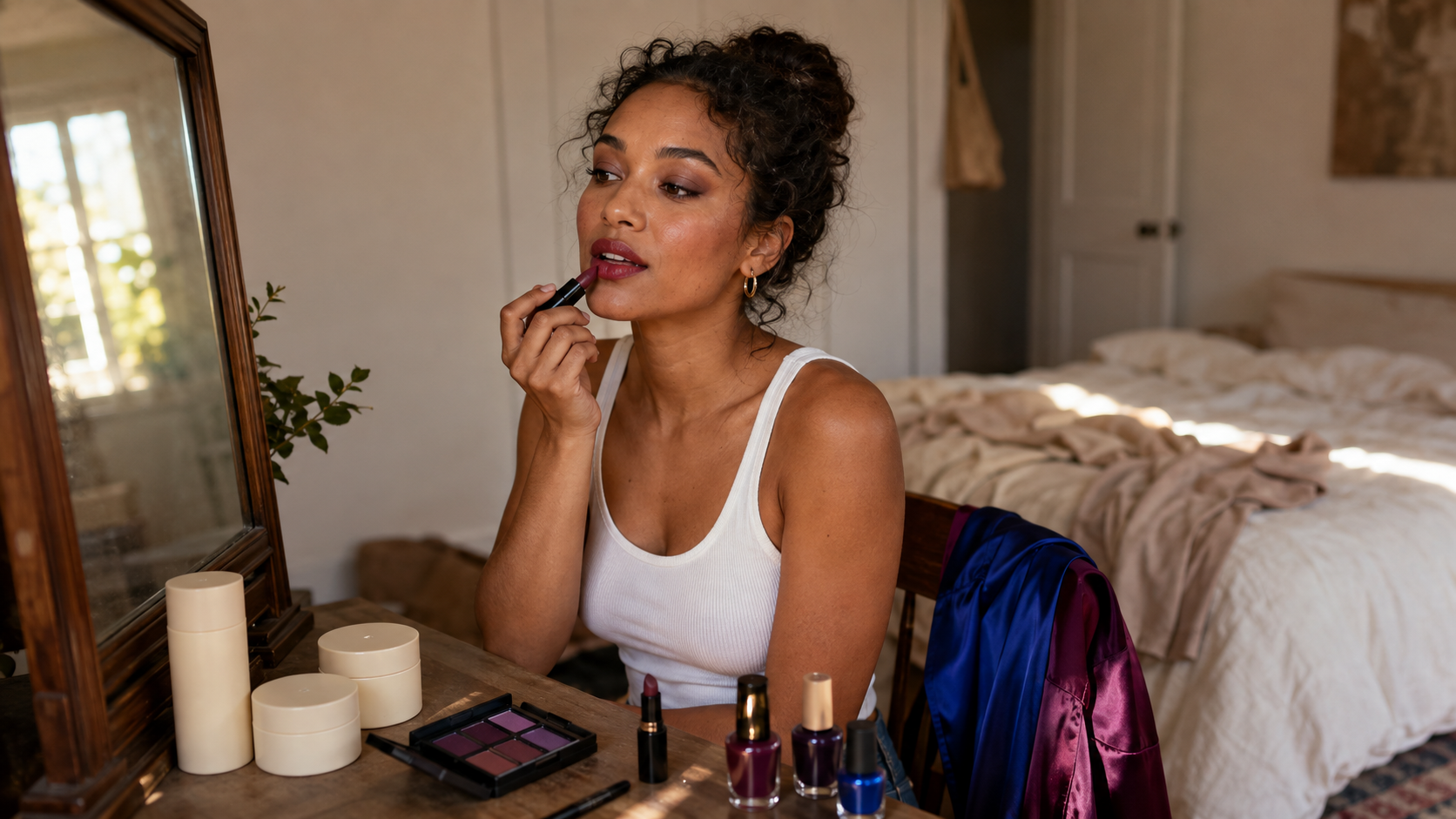
The last category may have the greatest staying power. A consumer can wear the same skin tint and balm on Monday, then add cobalt liner or a berry lip on Saturday. Consequently, brands can sell novelty without asking shoppers to abandon familiar routines.
Is messy girl more authentic, or just another performance?
Messy girl imagery can feel liberating because it welcomes flyaways, smudges, bedroom clutter and visible fatigue. Stellar argues that the look reflects real life more honestly than immaculate routines. Moreover, the aesthetic can reduce pressure to appear permanently organized.
However, online mess can become just as curated as online cleanliness. A creator may place the right half-empty glass, vintage camera and smudged pencil inside a carefully styled frame. Thus, “authenticity” becomes another visual product.
The messy girl label also carries risks when it romanticizes sleep deprivation, smoking, heavy drinking, skipped hygiene or untreated mental-health struggles. Smudged eyeliner is a style choice; harmful behavior is not an accessory. Therefore, the healthiest countertrend celebrates creative imperfection without turning self-neglect into proof of coolness.
Why the clean girl aesthetic will not fully disappear
Despite the backlash, several parts of the look solve real everyday needs.
Minimal makeup is practical
Many people want a five-minute routine for work, school, errands or hot weather. Tinted sunscreen, concealer, blush and balm meet that need regardless of what TikTok calls them. Therefore, no-makeup makeup will outlive the clean girl name just as it existed before the trend.
Skincare has become a durable category
Circana’s 2025 and Q1 2026 data show continued demand for cleansers, moisturizers, serums, eye products and clinical brands. Meanwhile, McKinsey expects consumer interest in skincare and visible efficacy to remain strong. A cultural swing toward color does not make people stop washing, moisturizing or protecting their skin.
Hybrid products erase the boundary
Lip oils, tinted balms, serum foundations and cream color can support either aesthetic. A deep berry balm can look clean girl in one layer and vamp romantic in three. Likewise, a luminous base can sit under almost any editorial eye.
The look evolved into a baseline
Once a trend becomes ordinary, users stop naming it. Brushed brows, cream blush, glossy lips and simple gold jewelry now appear across many aesthetics. As a result, a decline in the hashtag may reflect normalization rather than disappearance.
Beauty corrections often change the preferred result without eliminating the underlying category. Our history of the lip filler trend, “duck lips” and lip lifts documents a similar shift from conspicuous transformation toward subtler outcomes.
Commercial success keeps the visual language visible
Rhode’s billion-dollar acquisition gives retailers a reason to keep promoting glazed textures, lip treatments and restrained packaging. Furthermore, 2025 sales placed oils, balms and lip liner among the strongest makeup segments. The clean girl label may cool while the shelf remains full of clean girl-adjacent products.
How to update your beauty routine without replacing everything
Trend cycles encourage waste because every new “era” arrives with a shopping list. Yet most people already own enough products to move between minimal and expressive looks. The simplest strategy changes one variable at a time.
| If you already own… | Keep it | Add or change | Result |
| Skin tint or light foundation | Use your usual thin base | Add graphic liner, metallic shadow or a dark lip | Skin-first maximalism |
| Neutral cream blush | Apply it as usual | Place a brighter powder blush on top or extend it toward the temples | Whimsical color without a new routine |
| Clear or nude gloss | Keep the glossy texture | Layer it over a brown, plum or black cherry pencil | A wearable vamp lip |
| Black or brown eyeliner | Use the same pencil | Smudge the edge instead of perfecting a wing | Messy girl or soft grunge |
| Neutral eyeshadow palette | Keep the base shades | Use one deep shade around the lash line or as a monochrome smoky eye | 2016 influence with less structure |
| Several nail colors | Skip a new set | Paint each hand or finger differently | Glitchy Glam at no extra cost |
| Slick-bun products | Keep them for occasional use | Alternate with looser styles and visible texture | Polished hair with less tension |
First, shop your own makeup bag. Next, save reference images based on technique rather than branded products. Then, test one change in daylight and wear it for several hours. Finally, buy something only if it fills a real gap after repeated experiments.
This approach protects both money and personal style. Moreover, it prevents the algorithm from turning a desire for self-expression into another compulsory haul.
A practical beauty reality check
An aesthetic should not override skin or hair health. Fortunately, a safe routine can remain simple.
Skin does not need to look filtered to be healthy
The American Academy of Dermatology recommends gentle cleansing, products suited to individual skin needs, moisturizer when needed and sun protection. Its basic face-washing guidance also warns against aggressive scrubbing because irritation can worsen skin problems.
Therefore, a long shelf does not guarantee better skin. Acne, rosacea, eczema, melasma and irritation may require individualized care from a dermatologist. More importantly, those conditions do not make anyone dirty or disqualified from minimal makeup.
Repeated tight buns can damage hair
The slicked-back bun became the aesthetic’s signature hairstyle, but constant tension can cause traction alopecia. Accordingly, the American Academy of Dermatology advises people to avoid frequently wearing styles that pull, loosen buns and ponytails, and change hairstyles regularly. Pain, stinging, broken hairs or a receding hairline signal a need to stop the tension.
An occasional sleek style may cause no problem for many people. However, daily force, heavy extensions or repeated pulling raises risk, especially around the hairline. A polished look is never worth permanent hair loss.
What beauty brands and creators should learn
The clean girl debate offers several lessons beyond trend forecasting.
Stop treating aesthetics as total consumer identities
People move between looks according to weather, work, mood and occasion. Therefore, brands should show one product across minimal, bold and texture-inclusive applications. A balm can support a natural office look, a dark layered lip or a glossy editorial finish.
Represent real variation
Creators can show pores, acne, mature skin, deeper complexions, different bodies and varied hair textures without turning inclusion into a special campaign. Moreover, tutorials should explain how placement and texture change across faces instead of presenting one model as universal.
Credit the communities behind recycled techniques
Brown lip liner, hoops, styled baby hairs and slicked-back looks did not begin with CleanTok. Clear credit improves cultural accuracy and respects the people who carried those styles before algorithms rewarded them.
Measure momentum and affection separately
Infegy found strong positive sentiment alongside slower conversation. Consequently, brands should not interpret a plateau as hatred or a viral criticism as majority opinion. Search velocity, sales, repeat purchase, social volume and sentiment answer different questions.
Sell creativity without manufacturing insecurity
The best post-clean-girl message invites play. By contrast, the worst message tells consumers that yesterday’s face, products and personality have expired. Brands can demonstrate new techniques while encouraging shoppers to reuse what they own.
So, is clean girl aesthetic over in 2026?
Yes, if “over” means it no longer stands alone as the defining beauty ideal. The most controlled version of the clean girl has lost novelty, and strong search growth for eccentric, asymmetrical and dark beauty confirms a wider appetite for expression. In addition, critics have successfully exposed the labor, exclusivity and cultural erasure hidden inside the supposedly effortless look.
No, if “over” means nobody wants luminous skin, light makeup, a simple outfit or a quick routine. Sales of skincare, lip treatments and hybrid formulas remain strong. Furthermore, late-2025 social sentiment toward clean girl content stayed overwhelmingly positive even as volume began to cool.
The more accurate answer replaces death with evolution. Clean girl has shifted from a dominant identity into one option within a larger beauty wardrobe. Its most durable techniques will remain, while its rules continue to loosen.
Frequently asked questions
Is clean girl aesthetic over?
The clean girl aesthetic is over as the only dominant online beauty ideal, but it remains popular as an everyday look. Search and social momentum have cooled, while skincare, lip products and light complexion formulas continue to sell.
When did the clean girl aesthetic start?
The term began gaining visibility in late 2021 and accelerated during 2022. However, many of its elements, including slicked hair, gold hoops, brown liner, gloss and no-makeup makeup, existed for decades before TikTok grouped them under one name.
What replaced the clean girl aesthetic?
No single trend replaced it. Messy girl, Glitchy Glam, Vamp Romantic, whimsical beauty, indie sleaze and 2016-inspired makeup all compete for attention. Meanwhile, many people combine a clean base with one bold feature.
What is the messy girl aesthetic?
Messy girl beauty favors smudged eyeliner, lived-in hair, imperfect details and visible personality. It reacts against hyper-polished routines, although online “mess” can still involve careful styling.
Is no-makeup makeup out of style in 2026?
No. Minimal makeup remains practical and commercially relevant. The main change involves freedom: people can wear invisible makeup one day and obvious color the next without committing to one identity.
Is clean girl the same as clean beauty?
No. Clean girl describes a beauty and lifestyle aesthetic, while clean beauty describes a loosely defined product-marketing category. No official legal definition standardizes clean beauty in the United States.
Why did people criticize the clean girl trend?
Critics argued that it disguised expensive labor as natural beauty, centered young and thin white women, excluded common skin and hair realities, and repackaged Black and Latina beauty practices without adequate credit. Others simply found the uniform repetitive.
Can people combine clean girl and maximalist makeup?
Absolutely. A sheer base with graphic liner, bright blush, face gems or a dark lip creates an easy hybrid. In fact, sales growth for skincare-infused makeup and lip products suggests that consumers already mix both directions.
Will the clean girl aesthetic return?
Parts of it never left. Internet trends also move in cycles, so future creators may rename polished minimalism and present it as new. Still, the next version will probably include more visible texture, personalization and awareness of the original critique.
Conclusion: the uniform is over, not the option
Is clean girl aesthetic over? The data supports a qualified yes. Its hyper-controlled uniform no longer defines the entire beauty mood, and 2026 clearly rewards color, asymmetry, nostalgia and experimentation. Nevertheless, the clean girl’s practical core has entered the mainstream.
Glowing skin, quick makeup and simple clothes will not vanish. However, the pressure to look permanently flawless, disciplined and interchangeable deserves to fade. The most promising beauty shift does not replace one girl with another. Instead, it lets people stop performing a category and choose what works for their own face, life and mood.
Data notes and methodology
This article distinguishes among editorial trend forecasts, platform search behavior, social-listening data, academic research and retail sales. None of those sources measures the same population or behavior. Accordingly, the article uses cultural publications to identify narratives, primary industry reports for sales and search figures, and peer-reviewed research for claims about representation and social comparison.
Pinterest growth rates compare selected query periods and may begin from different baselines. Google Trends reports normalized relative interest rather than raw volume. Infegy’s findings cover a defined late-2025 window, while the academic TikTok study used a qualitative, algorithmically influenced sample of 100 popular videos. Finally, Circana’s retail categories cannot identify which purchases consumers made specifically to follow an aesthetic.
Sources and further reading
- The Observer: Is the era of the Clean Girl over?
- Pinterest Predicts 2026: Nonconformity, self-preservation and escapism
- Pinterest Business: Glitchy Glam
- Circana: U.S. prestige and mass beauty performance in 2025
- Circana: U.S. beauty market growth in Q1 2026
- McKinsey: State of Beauty 2026
- First Monday: Clean Girl aesthetic and neoliberal femininity performance on TikTok
- Infegy: Clean Girl Aesthetic conversations and early warnings
- e.l.f. Beauty: Agreement to acquire Rhode
- Allure: The best makeup trends of 2025
- British Vogue: Why the clean girl aesthetic refuses to die
- Byrdie: 2025 killed the Clean Girl
- Robert Welsh: The Clean Girl era is over
- ELLE Baltic: Three signs the Clean Girl era is ending in 2026
- Stellar: Goodbye Clean Girl, hello chaos
- Medium: The rise and fall of the Clean Girl aesthetic
- Nylon: The problem with Clean Girl beauty
- TIME: Brownie glazed lips and cultural appropriation
- Harvard Health: The lack of an official clean beauty definition
- American Academy of Dermatology: Hairstyles that pull can lead to hair loss
- Systematic review: Social comparison, body image and eating-disorder symptoms