Why Beauty Products on QVC and HSN Still Work
Long-Form Beauty Shopping Refuses to Disappear
Beauty products on QVC and HSN occupy a fascinating corner of personal care retail. While social media asks brands to explain a serum before we finish blinking, television shopping gives products room to breathe. A host can demonstrate the texture, discuss the ingredients, answer questions, compare options, and remind us seventeen times that the special offer ends tonight. Somehow, the bottle of moisturizer develops a backstory, a personality, and possibly a summer home.
At first, this format may seem completely out of step with modern media. However, its continued presence suggests that consumers do not always want the shortest explanation. They often want the clearest one.
Beauty Shopping Channels Turn Products Into Programs
QVC and HSN have long featured beauty, skincare, hair care, fragrance, and other personal care categories. Their programs often combine hosts, brand representatives, product demonstrations, customer questions, special pricing, and direct ordering.
That structure matters because personal care products can be difficult to evaluate from packaging alone. A shopper may want to see how a cream spreads, how a hair tool works, or how several shades compare. Consequently, demonstration becomes part of the product itself.
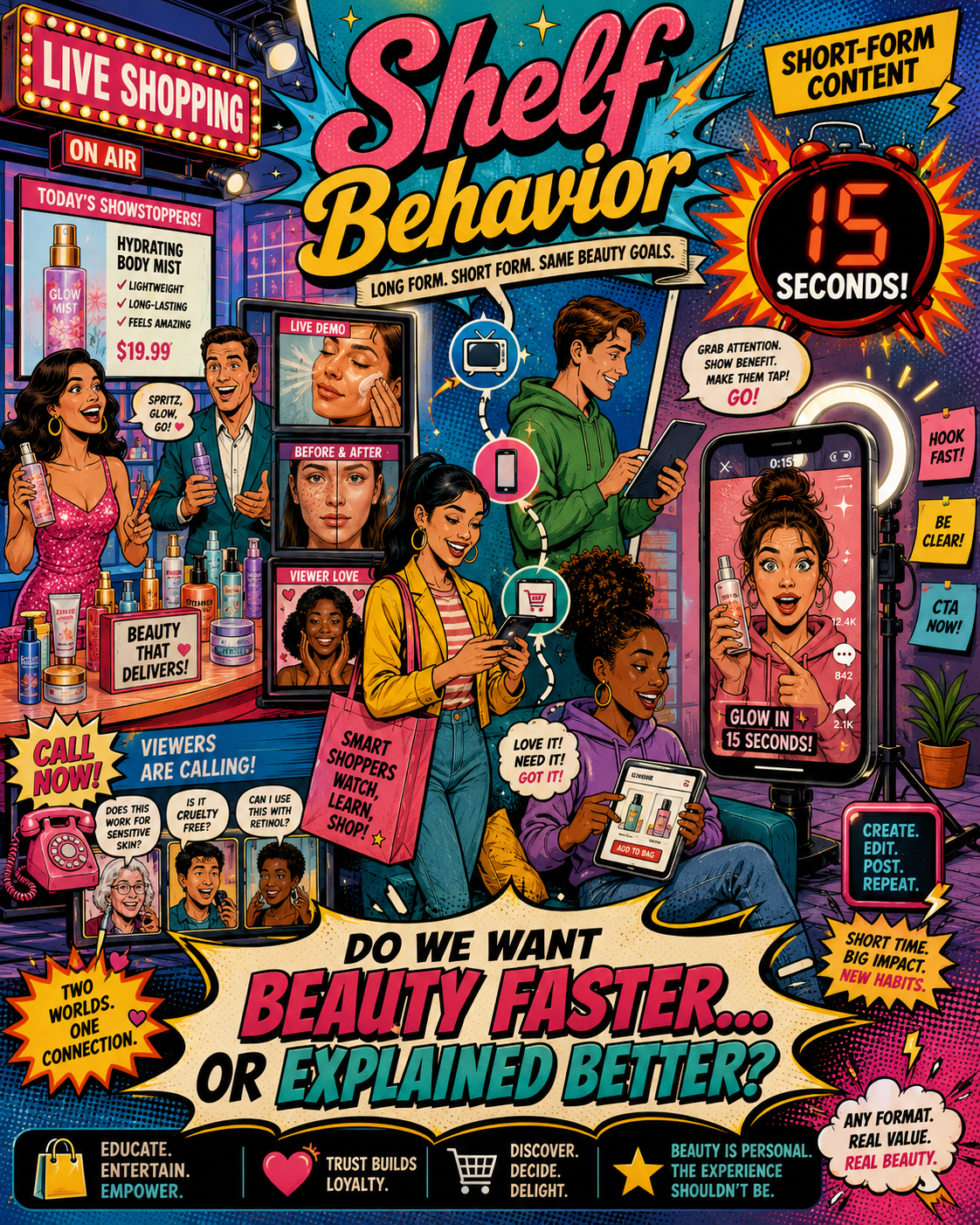
Social media handles discovery differently. A short TikTok video can introduce a product quickly, create curiosity, and send viewers searching for more information. Meanwhile, a shopping channel can remain with the same product long enough to explain why it exists.
Neither format automatically works better. Instead, they serve different moments in the customer journey.
Consumer Psychology Does Not Always Prefer Shorter
People often say that attention spans keep getting shorter. However, that claim oversimplifies how attention works. Consumers still watch long movies, listen to extended podcasts, follow livestreams, and spend hours researching purchases.
The real issue is not always attention span. It is attention choice.
People give more time to content when it feels useful, entertaining, or personally relevant. Therefore, long-form beauty shopping can succeed when it reduces uncertainty. Viewers hear repeated explanations, watch demonstrations, and see the product from several angles.
Familiar hosts may also create a sense of continuity. Over time, viewers learn how a host describes textures, fragrances, coverage, or value. That familiarity does not guarantee trust, of course. Still, it can make the experience feel more conversational than a traditional commercial.
In addition, live or time-sensitive offers can create urgency. Retailers should use that tool responsibly, since clear information supports better decisions than relentless pressure. Nobody should feel that civilization depends on ordering a six-piece lavender body-care collection before midnight.
The Future Could Combine Long and Short Beauty Content
Beauty shopping channels do not need to choose between traditional television and fast social media. Instead, they could treat long-form programs as content libraries.
A one-hour beauty show could include clearly labeled chapters. Viewers might jump directly to fragrance, hair care, skincare, or demonstrations. Afterward, retailers could turn the strongest moments into short videos for TikTok, Instagram Reels, YouTube Shorts, and product pages.
Moreover, brands could invite micro-influencers, cosmetic chemists, hairstylists, fragrance experts, package designers, and everyday consumers into selected segments. Each person could answer a different type of question.
The format could also become more interactive. Viewers might vote on which product receives the next demonstration. They could submit questions through an app or scan a code to compare ingredients, reviews, shades, or scent descriptions.
Imagine a host saying:
“Up next, we have a body mist described as warm, comforting, and sophisticated.”
A viewer immediately asks:
“But does it smell sophisticated—or like a cupcake wearing expensive sunglasses?”
That is the kind of question modern retail technology should help answer.
Long-Form Beauty Content Still Has Something to Teach Us
The appeal of beauty products on QVC and HSN does not come from length alone. It comes from explanation, demonstration, personality, and reassurance.
Short videos excel at creating interest. However, longer formats can turn interest into understanding. Therefore, the future may not belong exclusively to either one.
Instead, successful beauty retailers could build a flexible system. A shopper might discover a product in 15 seconds, explore it for five minutes, and watch a detailed demonstration before buying.
Perhaps consumers do not need every beauty story to become shorter.
They simply need every minute to earn its place.
If you enjoyed this, you might also like Could Beauty Trucks Become The Next Food Trucks?
Follow us here for videos on the psychology & culture of personal care: Shelf Behavior on TikTok and Shelf Behavior on Instagram