Coffee in Personal Care Deserves a Bigger Place
Coffee Is Too Interesting to Stay in the Mug
Coffee in personal care already exists, but I still think the beauty industry has barely explored what coffee can become. We can find coffee-inspired fragrances, scrubs, skincare, and products that use caffeine or coffee-derived ingredients. However, coffee often appears as one scent note, one ingredient, or one gourmand idea.
Meanwhile, actual coffee culture has built an entire world around itself.
There are cafés, roasting styles, brewing rituals, regional traditions, tasting language, morning routines, and afternoon coffee breaks. Moreover, some coffee enthusiasts can spend fourteen minutes explaining why one particular bean changed their life.
Personal care could have much more fun with all of that.
Instead of treating coffee simply as another sweet scent, brands could explore the culture, emotions, rituals, and sensory experiences surrounding it. Consequently, coffee could become an entire beauty universe rather than another bottle labeled “Vanilla Latte.”
Coffee Already Comes With a Remarkably Rich Story
Few everyday products carry as much ritual as coffee.
For many people, coffee marks the beginning of the day. For others, it represents a break, a conversation with friends, a favorite café, or a familiar routine. Across different cultures, coffee also appears in distinctive preparations and social traditions.
Therefore, the beauty industry already has an unusually rich creative vocabulary to explore.
Fragrance developers, for example, could play with roasted, bitter, creamy, spicy, smoky, nutty, chocolate-like, or caramel-like impressions associated with different coffee experiences. Body-care brands could also explore the emotions surrounding coffee instead of trying only to recreate the beverage itself.
Imagine First Cup, a warm and comforting fragrance.
Perhaps Coffee Break could feel soft, relaxed, and slightly sweet.
Meanwhile, Dark Roast might offer something deeper, smokier, and less gourmand.
Then there is Iced Coffee at 3 PM, which should probably smell bright, playful, and mildly irresponsible.
Suddenly, coffee becomes storytelling rather than simply flavor inspiration.
Consumer Psychology Loves Ritual
From a consumer psychology perspective, coffee has one major advantage: people already connect it with routines.
Personal care works similarly. We shower, wash our hair, moisturize, and apply fragrance as part of repeated daily habits. Therefore, coffee and personal care already occupy familiar places in everyday life.
Scent also has a particularly strong relationship with memory and emotion. As a result, a coffee-inspired fragrance does not need to smell exactly like someone poured espresso over your shoulder.
Instead, it could evoke an experience associated with coffee.
For example, a fragrance might suggest a quiet café before opening. Another could capture coffee with cardamom, while a playful body mist might evoke an iced-coffee run with friends.
Consequently, brands gain much more creative freedom when they explore the world around coffee rather than simply reproducing the smell inside the cup.
Coffee Beauty Could Move Beyond Gourmand
Gourmand fragrance has helped make edible notes enormously popular. Vanilla, caramel, chocolate, marshmallow, and pastry-inspired scents all fit comfortably within that world.
Naturally, coffee belongs there too.
However, coffee in personal care does not have to remain exclusively gourmand.
Coffee Could Become Sophisticated
A darker coffee fragrance could combine roasted impressions with woods, spice, amber, or leather-like notes. As a result, the finished scent might evoke a stylish café at night rather than a dessert counter.
Coffee Could Become Fresh
Alternatively, brands could pair coffee with citrus, herbs, or airy notes. That approach could create a brighter and more unexpected interpretation.
More importantly, it could challenge the assumption that every coffee fragrance needs to smell like it comes with whipped cream.
Coffee Could Become Comforting
Soft woods, vanilla, warm spices, and milk-like accords could emphasize coffee’s comforting associations. Therefore, these combinations might work especially well in body lotions, body washes, shampoos, or hair mists.
Coffee Could Become Cultural
Additionally, brands could thoughtfully explore coffee traditions from different places around the world.
Cultural storytelling, however, requires context and care. Brands should not simply attach the name of a country or tradition to a bottle because someone in marketing found an attractive photograph.
Instead, collaborations with coffee professionals, cafés, artists, roasters, and cultural experts could make these concepts richer and more respectful.
The Packaging Possibilities Are Almost Too Easy
Coffee also offers an enormous visual vocabulary.
For instance, beauty packaging could draw inspiration from café menus, ceramic cups, coffee bags, tasting cards, roasting labels, or vintage coffee advertising.
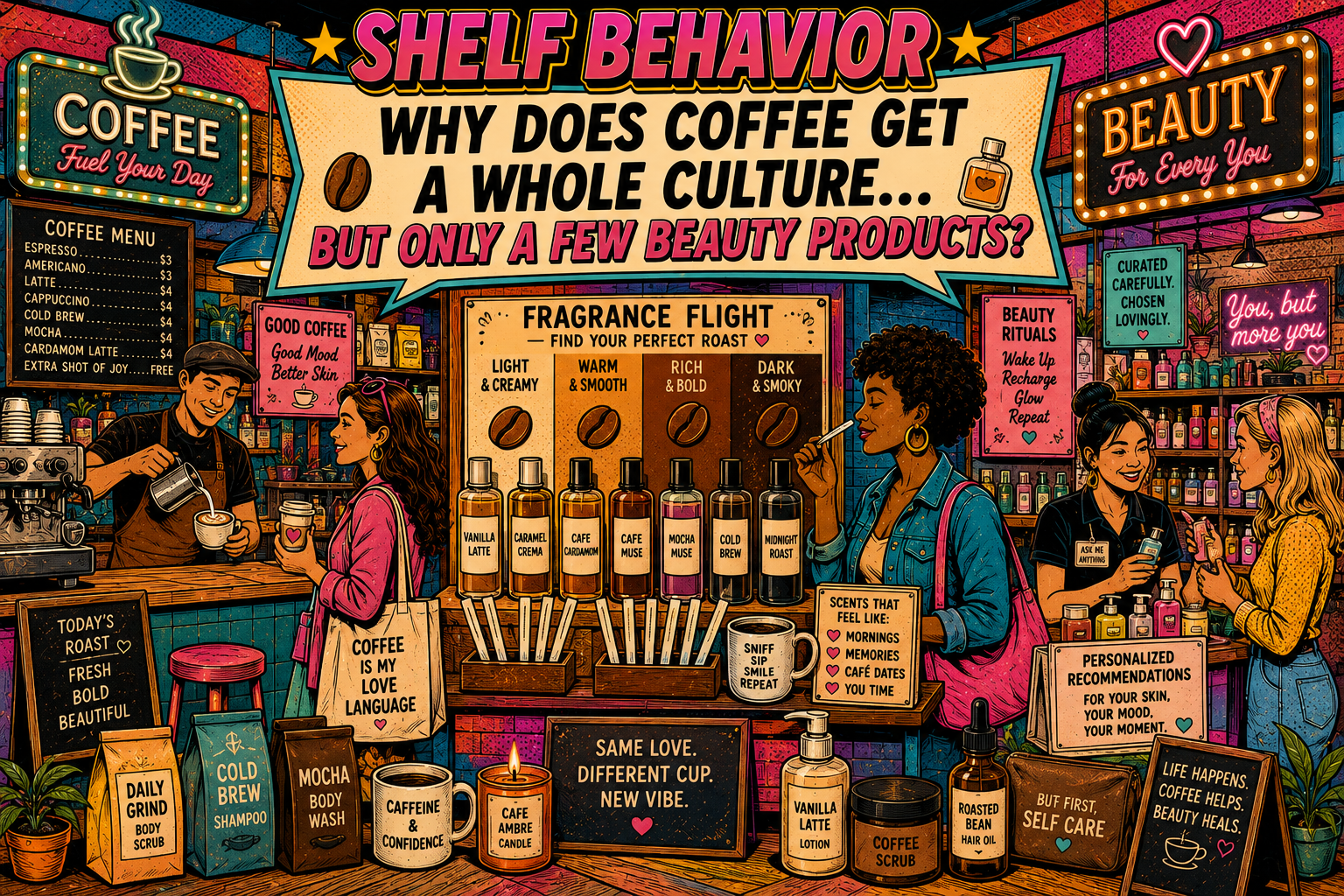
A body-mist collection might even organize fragrances like roast levels.
Light Roast: bright and airy
Medium Roast: warm and balanced
Dark Roast: smoky and intense
Similarly, a discovery set could resemble a coffee flight. Retailers might also create fragrance “tasting cards” that help shoppers compare several coffee-inspired scents.
Of course, nobody should actually drink the body mist.
Apparently, Shelf Behavior now needs a legal department.
Personal Care Stores Could Borrow From Café Culture
Beyond products and packaging, the retail possibilities may be even more interesting.
Imagine a temporary Coffee & Fragrance Bar inside a beauty store.
Rather than spraying six random fragrances and forgetting which wrist contains which scent, shoppers could explore coffee-inspired products in an organized sequence.
First, a beauty associate might ask whether you prefer your coffee creamy, sweet, dark, spicy, or barely recognizable beneath whipped cream. Then, your answer could guide fragrance recommendations.
Additionally, beauty brands could collaborate with independent coffee shops. A café might host a fragrance-discovery weekend, while a personal care store could offer coffee tastings alongside a product launch.
Such partnerships make intuitive sense because coffee and fragrance both rely heavily on aroma, ritual, atmosphere, and personal preference.
One sells something you consume.
The other sells something that makes strangers wonder why you smell unusually comforting at 8:15 in the morning.
Welcome to the Coffee Personal Care Department
Now imagine entering a beauty store and discovering an entire section called The Coffee Bar.
On one shelf sits Morning Espresso body mist.
Nearby, Vanilla Flat White lotion promises something softer.
Across the aisle, Cardamom Coffee hair perfume offers a spicier interpretation.
Finally, you discover a fragrance called Do Not Speak to Me Yet.
Naturally, you test it immediately.
First, you try the dark roast fragrance. Unfortunately, it feels slightly too intense. Next, you sample the vanilla latte and discover that it smells wonderful but also makes you want a pastry.
Eventually, an employee offers you a fragrance flight containing three different coffee interpretations.
Twenty minutes later, you own four personal care products and still have not purchased an actual cup of coffee.
At that point, the beauty industry has successfully caffeinated your bathroom.
Coffee Deserves a Beauty Culture of Its Own
Ultimately, coffee in personal care does not need to become another passing scent trend.
The category already offers almost everything the beauty industry loves: ritual, sensory richness, nostalgia, global culture, visual identity, storytelling, and enormous creative flexibility.
Therefore, the opportunity goes far beyond creating more coffee-scented products.
Brands could explore different moods, preparations, cultural traditions, times of day, packaging styles, collaborations, and retail experiences. Furthermore, fragrance developers could move beyond the predictable coffee-vanilla-caramel combination and explore coffee as dark, spicy, fresh, sophisticated, comforting, social, or surprising.
Coffee already has one of the richest cultures surrounding any everyday product.
Perhaps personal care simply needs to borrow the cup—and start exploring everything around it.
If you enjoyed this, you might also like this article about chocolate as a scent.
Follow us here for videos on the psychology & culture of personal care: Shelf Behavior on TikTok and Shelf Behavior on Instagram