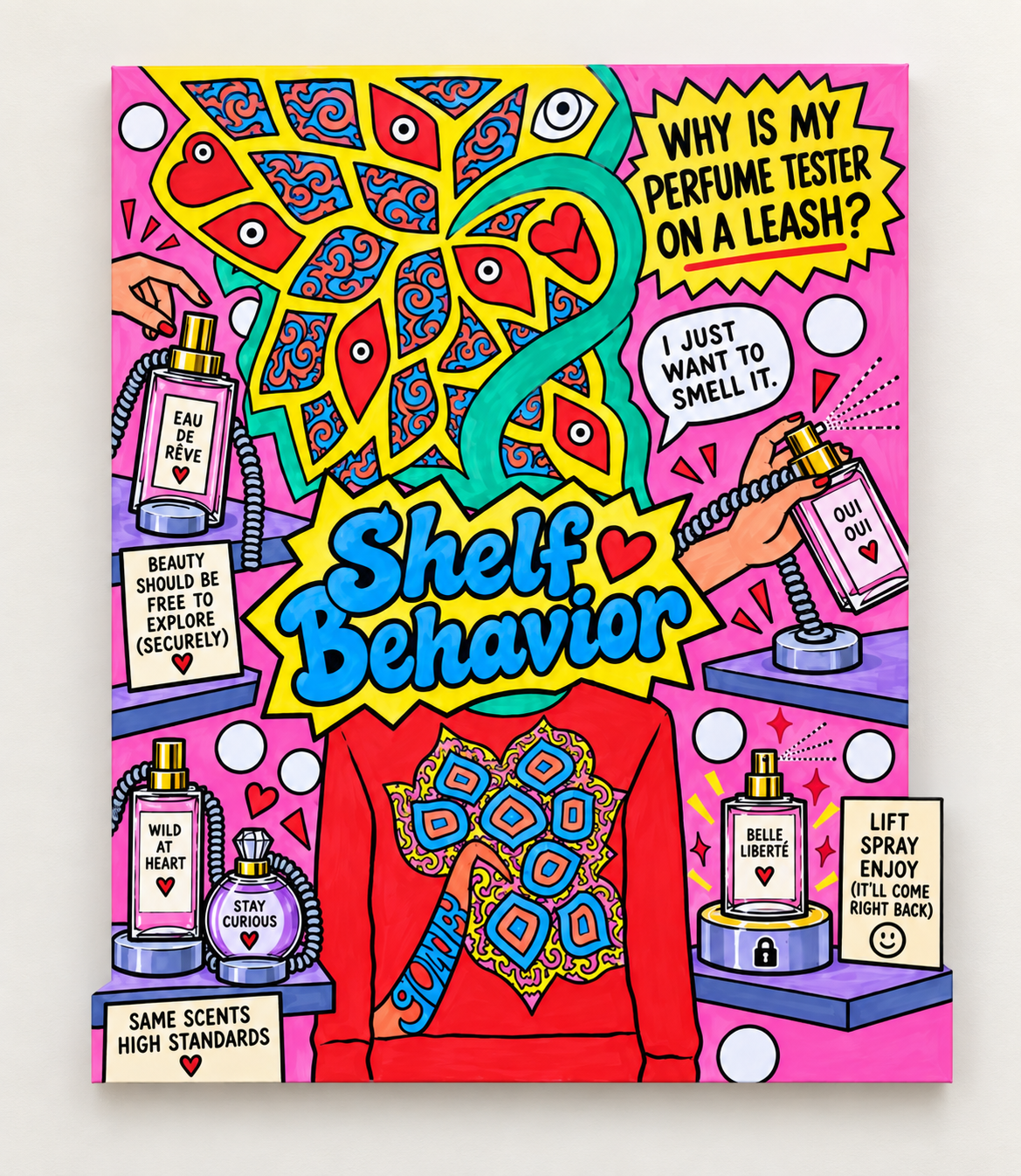
Perfume Security Tethers: Why Is My Tester on a Leash?
I Just Want to Smell the Perfume
Can we talk about perfume security tethers? You find a fragrance you want to try, reach for the beautiful bottle, and then discover that it is attached to the display by a retractable metal cable. You pull. The bottle pulls back. You pull slightly harder. Eventually, you’re standing in the fragrance department engaged in what appears to be a very elegant game of tug-of-war. Obviously, retailers have a legitimate reason for protecting merchandise and testers from theft. Fragrance can be expensive, bottles are relatively portable, and stores have to balance product accessibility with loss prevention. Still, there’s something peculiar about creating an elaborate sensory experience around a fragrance and then attaching the star of the experience to what looks like a tiny leash. Security matters. But perhaps the customer experience matters too.
Perfume Security Tethers Solve One Problem and Create Another
The basic logic behind perfume security tethers is easy to understand: the bottle remains physically connected to the fixture, making it harder for someone to simply pick it up and leave with it.
From a loss-prevention perspective, that is straightforward.
From a fragrance-discovery perspective, however, the experience can become awkward.
Testing perfume normally involves picking up the bottle, looking at it, positioning the nozzle, directing it toward a testing strip or your skin, and spraying it comfortably. A short or strongly retracting tether can interfere with that sequence. Instead of concentrating on the fragrance, the shopper may have to concentrate on how far the bottle will travel before it suddenly decides it has somewhere else to be.
That matters because fragrance is unusually dependent on physical interaction.
You cannot adequately experience perfume by staring at the bottle.
You have to smell it.
Consequently, the tester is not simply a display object. It is part of the product demonstration.
This creates an interesting retail-design challenge: How do you protect a valuable tester without making the security device become part of the shopping experience?
Because once I notice the cable more than the fragrance, the cable has received too much creative direction.
Security Can Affect the Psychology of the Store
From a consumer psychology perspective, visible security measures can communicate more than security.
They can also change the atmosphere.
A beautiful fragrance department typically communicates discovery, pleasure, indulgence, and aspiration. However, prominent physical restraints communicate a different message: this object needs protection.
Neither message is inherently unreasonable. Retailers operate in the real world, and theft prevention is a legitimate operational concern.
However, I do think they can create a subtle feeling of distrust or restriction for some customers.
And luxury or prestige retail has always depended partly on making people feel invited to explore.
That’s the paradox.
The store is essentially saying:
Please discover this beautiful fragrance.
Followed immediately by:
Not that far.
There may also be a practical consumer-psychology issue. Every additional bit of effort creates friction. If one fragrance can be picked up and sprayed naturally while another requires pulling against a cable and maneuvering the bottle awkwardly, that inconvenience can interrupt exploration.
Will one tether cause someone to abandon perfume forever?
Obviously not.
However, that does not mean the current physical experience cannot improve.
The point is not:
Remove the tethers tomorrow.
The better question is:
Can security become less noticeable to the customer?
That seems like a much more interesting design challenge.
The Best Security Might Be the Security We Barely Notice
Ultimately, perfume security tethers represent a perfectly understandable conflict inside modern beauty retail.
The retailer wants customers to interact freely with an expensive product.
The retailer also wants that expensive product to remain in the store.
Both goals are reasonable.
Yet solving the second problem should not automatically mean compromising the first.
Perhaps fragrance retailers could begin treating loss-prevention hardware the same way they treat lighting, shelving, packaging, and signage: as part of the customer experience that deserves thoughtful design.
Security could become more discreet.
Tethers could offer greater movement.
Alarmed fixtures could integrate more elegantly into displays.
Stores could test different systems and examine not only theft outcomes, but also how easily customers can actually sample the fragrance.
Because the goal should not be security or hospitality.
It should be security that preserves hospitality.
A perfume tester should invite you to pick it up.
The bottle should feel accessible.
The customer should feel trusted enough to explore while the retailer remains adequately protected.
And ideally, nobody should have to yank on anything.
We are testing perfume.
Not starting a lawn mower.