Clean Beauty: What Does “Clean” Really Mean?
If Everything Is Clean, What Was the Alternative?
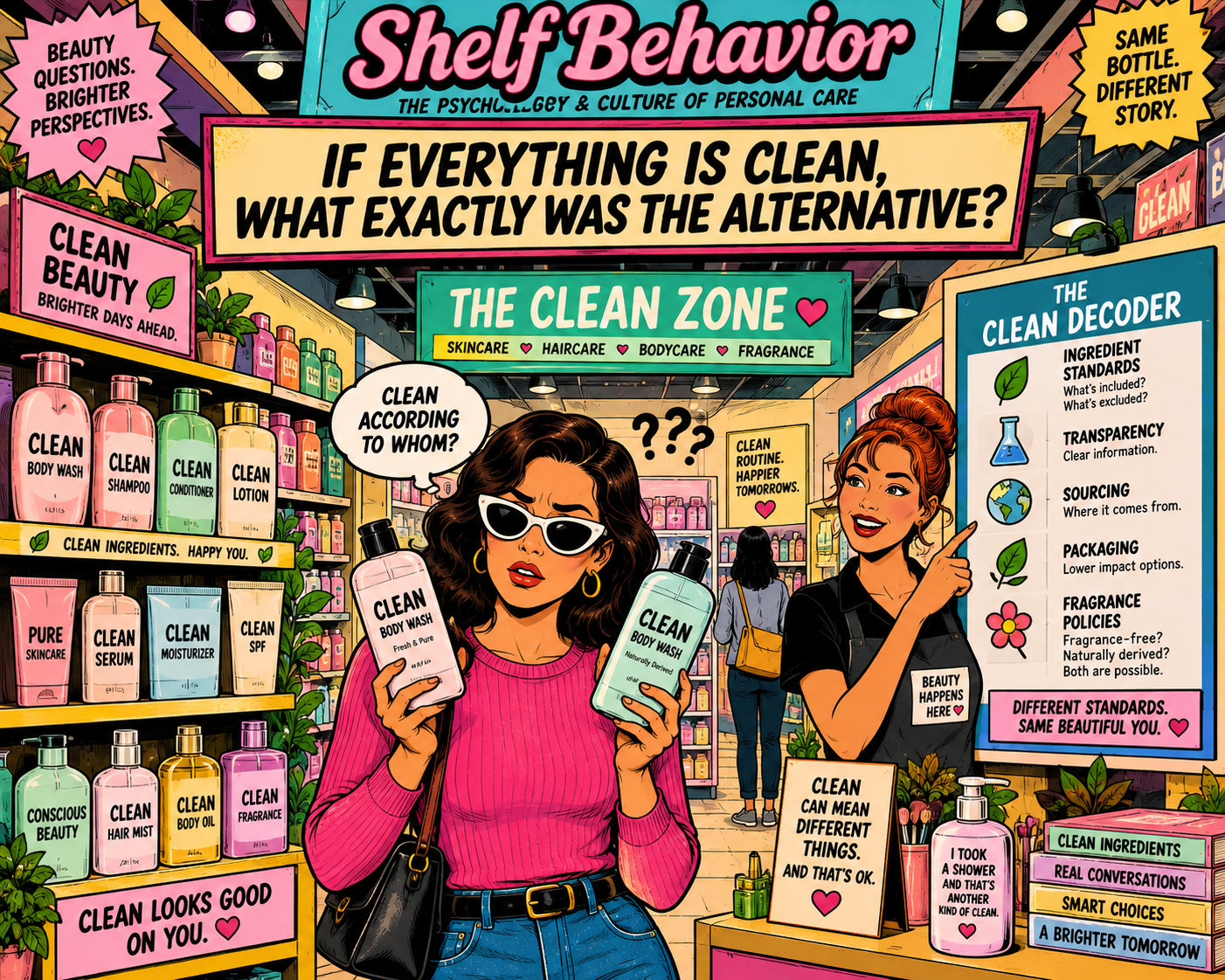
Clean beauty may have one of the most reassuring words in personal care attached to it. Walk through a beauty aisle and “clean” can appear on skincare, shampoo, makeup, fragrance, body wash, lotion, and almost anything else that can reasonably fit inside a bottle. The word sounds simple. Unfortunately, what it means is considerably less simple. In the United States, “clean beauty” is not one standardized regulatory category with a single definition that every brand and retailer must follow. Instead, companies and retailers may create their own standards, often involving particular ingredients they exclude, formulation philosophies, sourcing practices, transparency requirements, or other criteria. Consequently, two products can both call themselves clean while following different rules. That does not make the entire idea meaningless. However, it does raise a perfectly reasonable question: clean according to whom?
Clean Beauty Became More Than an Ingredient List
The rise of clean beauty makes cultural sense. Consumers increasingly want to understand what they are buying, how companies formulate products, and what values brands hold. Therefore, “clean” became a convenient way to bundle several concerns into one approachable word.
However, the meaning can shift considerably.
For one company, clean might primarily mean avoiding a particular list of ingredients. Another retailer may create its own restricted-substance standard. Meanwhile, a different brand might connect clean with ingredient transparency, environmental goals, packaging choices, or sourcing.
Those are not necessarily the same thing.
Moreover, terms such as clean, natural, safe, and sustainable should not automatically be treated as synonyms. A naturally derived ingredient is not inherently safer simply because it comes from nature. Conversely, a synthetic ingredient is not inherently harmful because it was created or modified through chemistry.
Safety depends on factors such as the specific substance, concentration, route and amount of exposure, formulation, and how the product is used.
That distinction matters because personal care can sometimes turn chemistry into a morality play.
Natural enters wearing white.
Synthetic apparently arrives accompanied by ominous music.
Actual formulation science is considerably less cinematic.
The Consumer Psychology of the Word “Clean”
From a consumer psychology perspective, “clean” is an unusually powerful word because people already understand its positive associations.
Clean suggests purity.
Order.
Freshness.
Safety.
Simplicity.
As a result, consumers may form a favorable impression before they understand exactly what a particular clean standard includes. Psychologists sometimes describe related effects as a halo effect: one positive attribute can influence how we perceive other attributes.
Therefore, clear definitions become especially important.
Imagine seeing two moisturizers. One prominently says CLEAN BEAUTY. The other simply says MOISTURIZER.
Without any additional information, the first bottle may feel more reassuring. Yet the word alone does not tell us whether one product is objectively safer or more effective than the other.
That is why the most useful clean-beauty programs explain their criteria rather than relying only on the label.
Instead of simply saying:
CLEAN
a retailer or brand might explain:
Here are the ingredients our standard restricts.
Here is why we created those criteria.
Here is what this designation does—and does not—mean.
Suddenly, the consumer has information rather than just a comforting adjective.
And adjectives, while lovely, have never successfully formulated a moisturizer.
Perhaps We Need a Clean Beauty Decoder
Imagine walking into a beauty store in the future.
You pick up a bottle.
It says:
CLEAN.
A tiny screen beside the shelf asks:
WHAT KIND OF CLEAN?
You select it.
A menu appears:
Ingredient standard?
Yes.
Fragrance policy?
Click here.
Packaging goals?
See details.
Sourcing information?
Right this way.
Does this mean every product outside this program is dirty?
Absolutely not.
Thank you.
Please proceed to the body mist.
That kind of transparency could make clean beauty considerably more useful. Retailers could place QR codes beside clean designations that take shoppers directly to the criteria. Brands could explain why specific ingredients are restricted rather than simply placing them on a concerning-looking restricted-ingredient list.
Moreover, the industry could distinguish different goals instead of squeezing everything beneath one word.
Perhaps a product emphasizes ingredient transparency.
Another focuses on refillable packaging.
A third follows a specific formulation standard.
Meanwhile, another brand simply makes an excellent moisturizer and decides that “clean” is not the most useful way to describe it.
All of those approaches can coexist.
Consumers do not necessarily need fewer choices.
They need clearer information about what those choices mean.
Clean Beauty Could Become More Precise, Not Less Important
Ultimately, the interesting question is not whether clean beauty should disappear. The movement has helped make ingredient transparency, formulation choices, sourcing, packaging, and consumer expectations much more visible topics within the beauty industry.
That conversation has value.
However, “clean” works best when it begins a conversation rather than ends one.
Brands and retailers can tell consumers which standards they use. They can explain what a designation covers. Additionally, they can avoid implying that products outside a particular clean program are automatically unsafe.
Consumers, meanwhile, can ask a wonderfully simple question:
What does clean mean here?
That question does not ruin the marketing.
It improves it.
Perhaps the next phase of clean beauty will therefore involve fewer vague promises and more specific explanations.
Not:
Trust us. It’s clean.
But:
Here is what we mean by clean.
Because if every bottle in the beauty aisle is going to announce that it is clean, the least we can do is ask who did the laundry.