Front-of-Package Nutrition Labels: Global Guide
Fact-checked through July 29, 2026.
Introduction
Front-of-package nutrition labels can turn a complicated nutrition table into an immediate signal: high in sodium, excess sugar, Nutri-Score D, or a red traffic light. France, Brazil, Mexico, Chile, Canada, and many other jurisdictions already use these systems. In contrast, shoppers in the United States still see a detailed Nutrition Facts panel on the side or back of most packages, but no mandatory national interpretive warning on the front.
That difference does not mean the United States has no food-labeling rules. In fact, the country pioneered standardized nutrition disclosure through the Nutrition Facts label. However, it has fallen behind specifically in mandatory interpretive front-of-package nutrition labeling, which explains whether a nutrient level is low, medium, high, or excessive.
Meanwhile, the international trend has shifted from simply publishing numbers to helping shoppers interpret them. The World Health Organization says governments should lead front-of-pack labeling policies and make the information convenient, relevant, and readily understood. Moreover, WHO recognizes product reformulation as an additional benefit because manufacturers may reduce sugar, sodium, or saturated fat to avoid an unfavorable label. (World Health Organization)
This global guide explains how the main systems work, which countries require them, what the research shows, and why the United States has moved more slowly.
Front-of-Package Nutrition Labels at a Glance
The five systems below illustrate the major regulatory differences.
| Market | Main front label | Mandatory? | What it communicates | Current status |
|---|---|---|---|---|
| France | Nutri-Score, A to E with colors | No | Overall nutritional profile per 100 g or 100 mL | Voluntary since 2017; revised algorithm took effect in France in March 2025 |
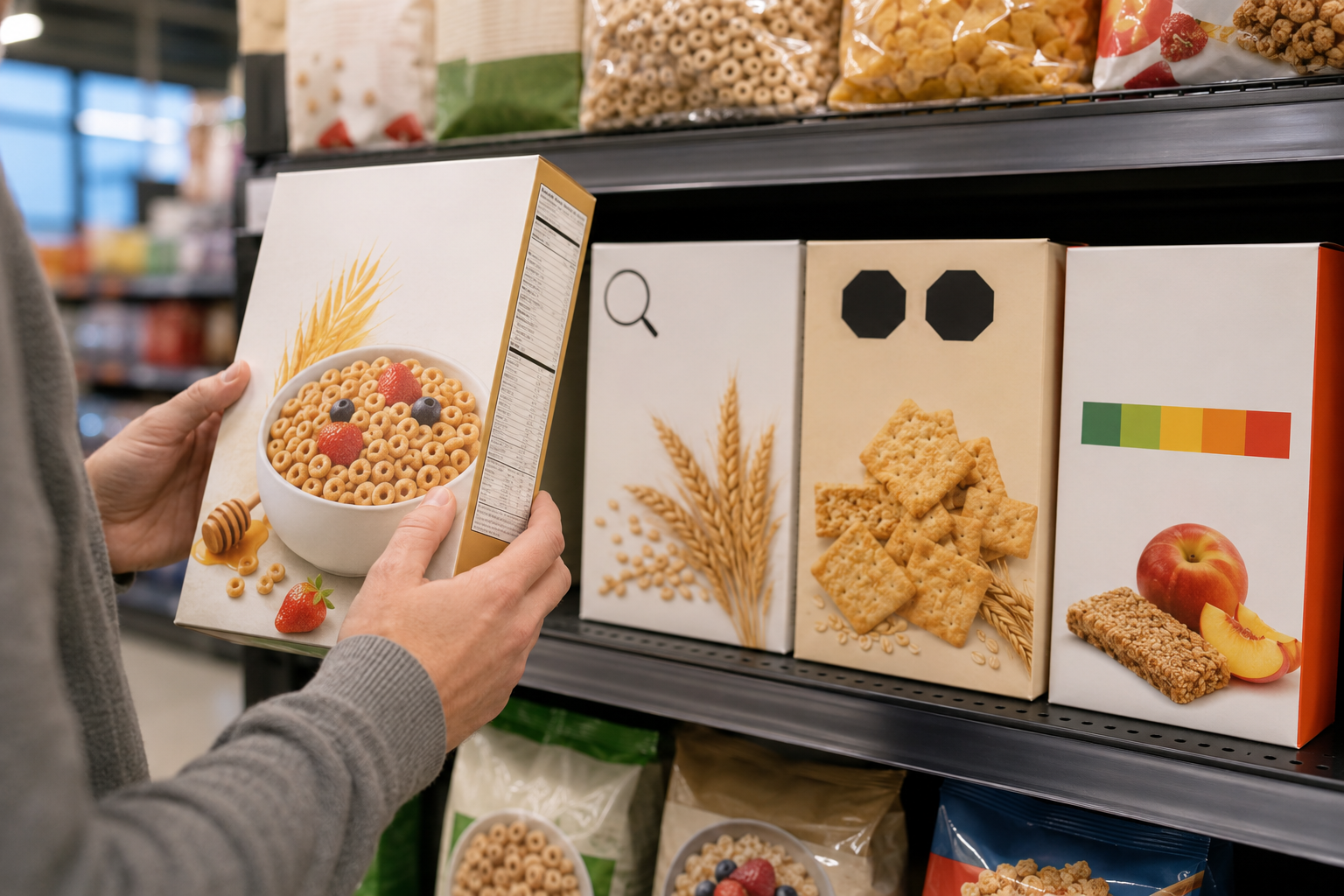
| Brazil | Black-and-white magnifying glass with “High in” | Yes | Added sugars, saturated fat, and sodium | In force since October 2022, with phased compliance |
| Mexico | Black octagonal excess warnings | Yes | Calories, sugars, saturated fat, trans fat, and sodium | In force since October 2020; current second phase continues through 2027 |
| Canada | Black-and-white “High in” magnifying glass | Yes | Saturated fat, sugars, and sodium | Mandatory compliance began January 1, 2026 |
| United States | Proposed Nutrition Info box | Not yet | Proposed Low, Med, or High ratings for saturated fat, sodium, and added sugars | Still a proposed federal rule as of July 29, 2026 |
The core distinction is simple. France offers a voluntary overall grade, while Brazil, Mexico, and Canada require nutrient-specific warnings. By comparison, the United States has proposed an interpretive system but has not finalized it.
What Is Front-of-Package Nutrition Labeling?
Nutrition labeling has several layers. Although people often use the terms interchangeably, each layer performs a different task.
Nutrition Facts or nutrient declaration
A conventional nutrition table lists quantities such as calories, total fat, sugars, protein, sodium, vitamins, and minerals. It offers detail, but it usually expects shoppers to interpret numbers, serving sizes, and percentages.
The European Union, for example, requires most prepacked foods to declare energy, fat, saturated fat, carbohydrates, sugars, protein, and salt. Those values generally appear per 100 g or 100 mL. However, current EU rules do not require interpretive nutrition information on the front of the package. (European Commission)
Front-of-package nutrition labels
A front label repeats or interprets selected information where shoppers can see it quickly. Consequently, it reduces the number of calculations a person must make during a purchase.
Interpretive systems use colors, grades, stars, or warning words. Noninterpretive systems simply move numbers from the Nutrition Facts panel to the front.
Major types of front-of-package nutrition labels
| Label type | Typical example | Main question it answers | Main limitation |
|---|---|---|---|
| Numeric reference intake | US Facts Up Front | “How much is in one serving?” | Shoppers must interpret the numbers |
| Multiple traffic light | United Kingdom | “Is each nutrient low, medium, or high?” | Mixed colors can complicate the final judgment |
| Summary score | France’s Nutri-Score | “How does the overall profile rank?” | A single grade can hide specific strengths and weaknesses |
| Nutrient warning | Mexico or Chile | “Does this product exceed a threshold?” | It does not identify positive nutrients |
| Positive endorsement | Nordic Keyhole | “Is this a better option within its category?” | Products without the symbol are not necessarily poor choices |
| Hybrid grade and restriction | Singapore Nutri-Grade | “How does this beverage rank, and does it face marketing limits?” | The mandatory system mainly targets beverages |
No single format answers every nutrition question. Therefore, effective policies usually combine a visible front label with a complete nutrition table and ingredient list.
Why Nutrition Information on the Front Matters
Food packages compete for attention through colors, mascots, health claims, photographs, and words such as “natural,” “light,” or “made with whole grains.” However, the legally required nutrition information often occupies a less prominent area.
Front labels change that information hierarchy. First, they place standardized information near the brand and product name. Second, they reduce dependence on nutrition literacy. Finally, mandatory labels prevent companies from showing favorable information only on products that receive attractive ratings.
WHO reviewed 180 publications about the implementation of nutrition-labeling policies. Overall, modeling studies found these policies cost-effective. Nevertheless, the review also identified barriers, including conflicts of interest, industry interference, disagreements about how to define an unhealthy product, and the technical complexity of nutrient-profile models. (WHO implementation review)
Thus, a label is not merely a graphic-design feature. It represents a regulatory decision about:
- Which nutrients matter most.
- Whether calculations use a serving or 100 g.
- What counts as high or excessive.
- Which products receive exemptions.
- Whether participation is mandatory.
- How governments restrict competing claims and child-directed marketing.
- Whether manufacturers have an incentive to reformulate products.
France’s Nutri-Score System
France introduced Nutri-Score in 2017 to help consumers compare the nutritional quality of packaged foods. The label combines five colors with letters from A to E. Dark green A represents the most favorable score, while dark orange E represents the least favorable score. (Santé publique France)
How Nutri-Score calculates a grade
The algorithm calculates one overall score per 100 g or 100 mL. It balances elements that the system encourages against elements it limits.
| Elements that can improve the score | Elements that can lower the score |
|---|---|
| Fiber | Energy |
| Protein, under defined conditions | Sugars |
| Fruits | Saturated fat |
| Vegetables | Salt |
| Legumes | Non-nutritive sweeteners under the revised beverage algorithm |
Because Nutri-Score uses a standard 100 g or 100 mL basis, shoppers can compare products without relying on manufacturer-selected serving sizes. Moreover, the label helps distinguish products within the same category, such as two breakfast cereals or two frozen meals.
Nutri-Score is voluntary, not mandatory
This detail matters. French authorities recommend and administer Nutri-Score, but companies choose whether to participate.
Current EU legislation requires back-of-package nutrition declarations but treats front-of-pack nutrition information as voluntary. Therefore, France cannot simply describe Nutri-Score as an EU-wide mandatory requirement under the existing legal framework. (European Commission)
Once a business registers a brand for Nutri-Score, the rules require it to use the logo across all eligible products sold under that registered brand. This requirement reduces, but does not eliminate, selective participation.
The revised Nutri-Score algorithm
France adopted the revised calculation method on March 16, 2025. Companies received a two-year transition period.
According to Santé publique France, the revision will change the grades of approximately 30% to 40% of products. In particular:
- Olive, canola, and walnut oils can move from C to B because the algorithm now better distinguishes oils with lower saturated-fat content.
- Whole-grain starches receive clearer differentiation from refined products.
- Sugary and salty products face stricter scoring.
- Water remains the only beverage eligible for an A.
- Drinks with non-nutritive sweeteners can no longer receive B and instead fall from C to E.
- The beverage algorithm now covers milk drinks, drinkable yogurt, and plant-based beverages.
These changes address several long-standing criticisms of the original model. (Santé publique France algorithm update)
How widely has France adopted Nutri-Score?
As of April 2024, 1,406 companies participated in the French program. Furthermore, participating brands represented an estimated 62% of food sales volume in 2024. (Santé publique France)
That reach is substantial for a voluntary label. Still, a shopper cannot assume that every product without Nutri-Score earned a poor grade. The manufacturer may simply have declined to participate.
Countries participating in Nutri-Score governance
France coordinates Nutri-Score with:
- Belgium
- Germany
- Luxembourg
- The Netherlands
- Spain
- Switzerland
Together, the seven countries maintain a steering committee and scientific committee. However, national implementation remains voluntary. (Nutri-Score transnational governance)
Strengths and limitations of Nutri-Score
Nutri-Score works especially well for quick comparisons among similar packaged products. In addition, colors and letters communicate more intuitively than a row of percentages.
However, an overall score involves trade-offs. A product may contain substantial sugar but receive points for fiber or fruit content. Conversely, nutrient-dense foods with naturally high fat or salt may receive a less favorable grade. The 2025 revision improves several classifications, but no algorithm can fully describe a food’s place in a person’s total diet.
Curiosity: Under the revised system, water is the only beverage that can receive an A. Even artificially sweetened drinks face a lower score because the new beverage algorithm penalizes non-nutritive sweeteners.
Brazil’s Mandatory Magnifying-Glass Warning
Brazil chose a different approach. Instead of giving every food a summary grade, the country requires a black-and-white magnifying-glass symbol when a packaged product reaches defined levels of added sugars, saturated fat, or sodium.
Brazil published RDC 429/2020 and IN 75/2020 in October 2020. The rules began taking effect on October 9, 2022, followed by transition periods for products already on the market and certain smaller businesses. (Anvisa nutrition-labeling rules)
Brazil’s front-label thresholds
| Nutrient | Solid or semi-solid foods | Liquid foods |
|---|---|---|
| Added sugars | 15 g or more per 100 g | 7.5 g or more per 100 mL |
| Saturated fat | 6 g or more per 100 g | 3 g or more per 100 mL |
| Sodium | 600 mg or more per 100 g | 300 mg or more per 100 mL |
Source: Brazilian Health Regulatory Agency, Anvisa.
A qualifying package displays “ALTO EM,” or “HIGH IN,” followed by one or more nutrients. Moreover, the rule places the symbol in the upper area of the front panel, where shoppers can detect it easily.
Why Brazil selected only three nutrients
Anvisa deliberately limited the label to three nutrients. The agency concluded that an exhaustive list could dilute consumer attention. It also selected nutrients supported by evidence about health risks and data concerning Brazilian consumption. (Anvisa questions and answers)
That decision improves simplicity. On the other hand, Brazil’s front label does not warn about calories, total sugars, total fat, or trans fat in the way some Latin American systems do.
Brazil also improved the Nutrition Facts table
The reform went beyond the magnifying glass. New requirements include:
- Black text on a white background.
- Total sugars and added sugars.
- Nutrient and energy values per 100 g or 100 mL.
- The number of servings in the package.
- More specific placement and legibility rules.
- Restrictions on placing the table on distorted or hard-to-see surfaces.
Therefore, Brazilian shoppers can use the front warning for speed and the standardized table for more detailed comparisons.
Restrictions on contradictory nutrition claims
Brazil also limits claims that could contradict a front warning. For example, a product labeled high in sodium cannot advertise that it has reduced sodium merely because it contains less than a previous formula or a competitor. (Anvisa)
This rule addresses the “health halo” problem. A prominent favorable claim should not distract shoppers from a mandatory warning about the same nutrient.
Limitations of the Brazilian model
The magnifying glass tells consumers which thresholds a product reaches, but it does not rank foods below those thresholds. Consequently, two products without a warning may still differ considerably.
Likewise, a manufacturer may reformulate a product to fall just below a cutoff. That change can improve the formulation, but it may also create a sharp distinction between products with almost identical nutrient levels.
Curiosity: Brazil and Canada both use a magnifying-glass design, but their calculations differ. Brazil uses fixed amounts per 100 g or 100 mL, while Canada generally relies on percentages of Daily Value and reference amounts.
Mexico’s Black Octagonal Warning Labels
Mexico implemented one of the world’s most comprehensive packaging policies in October 2020 through its revised NOM-051 standard.
A product may display up to five black octagons:
- Excess calories
- Excess sugars
- Excess saturated fat
- Excess trans fat
- Excess sodium
In addition, packages can carry precautionary statements for added caffeine or non-caloric sweeteners. Products with warning labels also face restrictions on child-directed package advertising and certain nutrition claims. (Peer-reviewed description of NOM-051)
Why the Mexican system stands out
Mexico does not give a product one blended score. Instead, each octagon identifies a specific reason for concern. Therefore, a product cannot offset excess sugar with fiber or protein.
The system also recognizes that package design influences children. Products subject to warnings cannot use certain cartoons, celebrities, mascots, games, or child-focused promotional elements. As a result, the policy regulates both nutrition information and the marketing context surrounding that information.
Important 2026 update: Phase 3 did not begin in 2026
Older summaries often state that Mexico would begin Phase 3 of its nutrient-profile criteria in 2025 or 2026. However, that information is now outdated.
On July 31, 2025, Mexico’s government extended Phase 2 through December 31, 2027. Phase 3 will now begin on January 1, 2028. (Official Mexican Federal Gazette)
This regulatory change matters because Phase 3 will apply the complete calculation requirements in section 4.5.3 and Table 6 of the modified standard.
Evidence of reformulation in Mexico
A 2025 PLOS Medicine study examined about 1,000 leading products representing at least 60% of market share in each included food group. Researchers compared data from 2016-2017, the period after the policy announcement, and the period after implementation.
All food groups reduced at least one type of warning-label exposure. Notable changes included:
- Up to a 63.1 percentage-point reduction in breads and cereals exceeding the sodium threshold.
- Up to a 26.3 percentage-point reduction in salty snacks exceeding the saturated-fat threshold.
- Up to a 29.0 percentage-point reduction in solid dairy products containing non-caloric sweeteners.
Nevertheless, the researchers limited their analysis to top-purchased packaged products. The before-and-after design also cannot isolate every market factor. (PLOS Medicine)
A separate 2026 evaluation associated Mexico’s policy with lower nutrients purchased from packaged foods and beverages. The research team reported estimated reductions of 15% in calories, 25% in added sugars, 12% in saturated fat, and 7% in sodium, equivalent to approximately 65 fewer purchased calories per person per day. However, these figures describe modeled or observational purchase changes rather than proof that labels alone caused every reduction. (Global Food Research Program summary)
Curiosity: Mexico’s sweetener warning may help discourage manufacturers from simply replacing sugar with non-caloric sweeteners. Researchers found that sweetener use fell in several Mexican categories, while some countries without a sweetener warning recorded increases.
Chile: The Pioneer of Modern Octagonal Warnings
Chile became the first country to implement a national black-octagon warning system in June 2016. Products that exceed the applicable criteria can carry warnings for calories, sugars, saturated fat, or sodium.
Furthermore, Chile connected warnings to other policies. Products with warnings face limits on marketing to children and sales in schools. (Chilean Ministry of Health)
What happened to beverage purchases?
A national before-and-after study found that purchases of beverages classified as “high in” fell by 22.8 mL per person per day relative to the projected counterfactual. That represented a 23.7% decline. Calories purchased from high-in beverages fell by approximately 11.9 calories per person per day.
However, Chile implemented warnings, marketing restrictions, and school-sales rules as one policy package. Therefore, the researchers could not attribute the entire change to front labels alone. The observational design also prevented a definitive causal conclusion. (PLOS Medicine)
What happened to product formulations?
A 2025 study tracked best-selling packaged foods through Chile’s increasingly strict phases. The proportion classified as high in at least one critical nutrient fell from 70.8% before implementation to 52.5% after the final phase.
Moreover, reductions grew as the thresholds became stricter. Sugar declined most visibly in sweet foods and drinks, while sodium declined across many savory categories. (PubMed and BMC Medicine)
These findings demonstrate an important secondary mechanism. Front labels can influence not only the product a shopper selects but also the product that a manufacturer decides to sell.
Canada’s Mandatory “High In” Symbol
Canada joined the mandatory warning group nationwide on January 1, 2026. Foods that reach specified levels of saturated fat, sugars, or sodium must now carry a black-and-white magnifying-glass symbol.
The bilingual label reads “High in” and “Élevé en,” followed by the applicable nutrients. It generally appears in the upper half of the package and on the right side when the label is wider than it is tall. (Health Canada)
Canada’s threshold structure
| Product category | Threshold that generally triggers a symbol |
|---|---|
| Most prepackaged foods | 15% Daily Value or more per reference amount or serving basis |
| Foods with a reference amount of 30 g or 30 mL or less | 10% Daily Value or more |
| Main dishes with a reference amount of at least 200 g for older children and adults | 30% Daily Value or more |
Canada generally assesses the serving size or reference amount, whichever is greater. Therefore, its model differs from systems that always calculate values per 100 g. (Health Canada industry guide)
Canadian exemptions
The Canadian rules exempt or specially treat several categories, including:
- Very small packages.
- Plain fruits and vegetables without added nutrients of concern.
- Raw single-ingredient cuts of meat, poultry, and fish that do not require a Nutrition Facts table.
- Certain plain dairy products that provide calcium.
- Butter, sugar, salt, honey, maple syrup, and similar products used for the same basic purpose.
Exemptions prevent misleading comparisons in some categories. Still, they also show why “no front warning” never automatically means “nutritionally ideal.”
Curiosity: Products manufactured, imported, or packaged before January 1, 2026, can remain on Canadian shelves while older inventory sells through. Consequently, shoppers may temporarily see old and new packages beside each other.
Which Countries Have Mandatory Front-of-Package Nutrition Labels?
The global landscape changes frequently. A January 2026 map from the Global Food Research Program at the University of North Carolina identifies mandatory, voluntary, developing, and not-yet-implemented policies. (January 2026 global map)
Countries with mandatory nutrient warnings
| Country | Implementation | Main design |
|---|---|---|
| Chile | June 2016 | Black “High in” octagons |
| Peru | June 2019 | Black high-in octagons |
| Israel | January 2020 | Red warnings for high sugar, sodium, or saturated fat |
| Mexico | October 2020 | Black excess octagons plus precautionary statements |
| Uruguay | March 2021 | Black excess octagons |
| Venezuela | Implemented in 2021; required by December 2024 | Nutrient warnings |
| Argentina | Implemented August 2022; generally required by February 2023 | Black excess octagons |
| Colombia | Implemented December 2022; required by December 2023 | Black excess octagons |
| Brazil | Implemented October 2022; broad compliance followed | Black “High in” magnifying glass |
| Canada | Rules published July 2022; mandatory compliance January 2026 | Black “High in” magnifying glass |
Peru, for example, requires up to four octagons for high sugar, high sodium, high saturated fat, or the presence of trans fat. Its warnings have applied since June 17, 2019. (Government of Peru)
Argentina requires warnings for excess sugars, sodium, saturated fat, total fat, and calories. In addition, it requires statements for sweeteners and caffeine and restricts child-directed characters on products with warnings. (Government of Argentina)
Other mandatory or limited-scope front-label systems
| Jurisdiction | Implementation | System or scope |
|---|---|---|
| Thailand | 2007 | Mandatory Guideline Daily Amount information for specified food categories |
| Ecuador | 2014 | Red, yellow, and green traffic-light system; label may appear on the front, side, or back |
| Iran | Introduced in 2015; mandatory since 2016 | Color-coded nutrient information |
| Sri Lanka | 2016 for sugar in beverages; expanded in 2019 | Color-coded warnings for selected nutrients |
| Singapore | December 2022 | Mandatory Nutri-Grade C or D marks for covered beverages; D advertising restrictions |
| Abu Dhabi | June 1, 2025 | Mandatory front-label policy at the emirate level |
Singapore grades covered beverages from A to D. Products graded C or D must show Nutri-Grade on the front, while advertising for D beverages faces a prohibition with limited exceptions. (Singapore Ministry of Health)
Bolivia adopted a law in 2016, but the January 2026 global map still classifies it as not implemented. Therefore, a law on paper should not be confused with labels consistently appearing in stores.
Government-supported voluntary systems
| Countries or region | Voluntary system |
|---|---|
| France, Belgium, Germany, Luxembourg, Netherlands, Spain, Switzerland | Nutri-Score |
| United Kingdom | Multiple traffic-light label plus reference-intake percentages |
| Australia and New Zealand | Health Star Rating from 0.5 to 5 stars |
| Sweden, Norway, Denmark, and Iceland | Nordic Keyhole |
| Finland | Heart Symbol |
| Lithuania and several neighboring markets | Keyhole or related positive-choice systems |
| South Korea | Recommended options for specified children’s snacks |
| Several Asian, European, African, and Middle Eastern countries | Government-supported voluntary labels with country-specific designs |
The United Kingdom recommends a voluntary label that combines red, amber, and green coding with reference-intake percentages. (UK government guidance)
Australia and New Zealand use the voluntary Health Star Rating. The scale runs from half a star to five stars, and authorities recommend comparing similar foods rather than unrelated categories. (Official Health Star Rating system)
Meanwhile, the Nordic Keyhole identifies foods that meet category-specific criteria for saturated fat, sugar, salt, fiber, and whole grains. Manufacturers choose whether to use it, although authorities enforce the criteria once a company displays the symbol. (Norwegian Directorate of Health)
Why the United States Is Behind on Front-of-Package Nutrition Labels
The United States is behind a growing group of countries in one specific area: mandatory national interpretive front-of-package nutrition labels.
Still, describing the country as completely unregulated would be inaccurate. The United States requires a detailed Nutrition Facts panel on most packaged foods, regulates ingredient and allergen declarations, controls defined nutrition claims, and requires calorie information in certain restaurant chains.
The gap concerns what happens at the immediate point of choice. Unlike Canada, Mexico, or Brazil, the United States does not yet require most packaged foods to identify high or excessive nutrients on the front.
A timeline of US nutrition labeling
| Year | Development |
|---|---|
| 1990 | Congress passed the Nutrition Labeling and Education Act |
| 1994 | The standardized Nutrition Facts label reached most packaged foods |
| 2010 | The Institute of Medicine released the first phase of its front-label review |
| 2011 | The Institute recommended a single standardized front-of-package system |
| 2016 | FDA finalized the first major Nutrition Facts redesign in more than 20 years |
| 2020 | Most large manufacturers completed transition to the revised Nutrition Facts label |
| January 2025 | FDA proposed a mandatory Nutrition Info box |
| July 2025 | The extended public-comment period closed |
| 2026 | FDA began summarizing tens of thousands of comments and preparing options for leadership |
| July 29, 2026 | No final national front-of-package rule had taken effect |
The National Academies had already recommended a standardized federal front-label system more than a decade before the 2025 proposal. (National Academies Phase II report)
1. The United States built a disclosure system, not an interpretation system
The Nutrition Facts label reflects a particular regulatory philosophy: provide standardized information and allow consumers to interpret it.
That approach represented a major advance in the 1990s. Nevertheless, it places a substantial burden on shoppers. A person must find the panel, understand serving sizes, interpret percentages, and compare products.
In 2016, FDA improved the label by enlarging calories, updating serving sizes, and requiring added sugars. However, the redesign still kept the main information panel away from the front on most packages. (FDA Nutrition Facts changes)
2. Federal rulemaking takes years
A national labeling mandate requires research, legal review, economic analysis, a proposed rule, public comments, possible revisions, a final rule, and a compliance period.
FDA’s 2025 proposal illustrates this timeline. The agency extended comments through July 15, 2025. Then, in its 2026 priorities, FDA said it would summarize tens of thousands of comments and prepare regulatory options for leadership. That language confirms that the agency had not yet issued a final rule. (FDA 2026 priorities)
Even after finalization, the proposal would give large businesses three years and smaller businesses four years after the final rule’s effective date to comply. (FDA proposed compliance timeline)
3. Regulatory authority is fragmented
FDA regulates about 80% of the US food supply. However, the US Department of Agriculture oversees most meat, poultry, and certain processed egg products. (FDA Human Foods Program, USDA FSIS)
Consequently, a fully uniform front-label system may require coordination across agencies and separate legal authorities. This structure does not make national action impossible, but it adds administrative complexity.
4. Federal preemption limits inconsistent state rules
The Nutrition Labeling and Education Act established national uniformity for several food-labeling requirements. In broad terms, states cannot impose certain requirements that differ from applicable federal standards. (21 U.S.C. Section 343-1)
Federal uniformity benefits interstate commerce. On the other hand, it can make state-by-state experimentation with package nutrition labels more difficult than local policies in areas without similar preemption.
5. The First Amendment shapes label design
Mandatory labels compel commercial speech. Therefore, regulators must consider how courts might evaluate the government’s evidence, wording, and design.
A legal review of 24 international and six major US front-label systems concluded that nutrient-specific factual disclosures would probably fare better under First Amendment analysis than a logo that offers only an overall judgment without nutrient information. (Pomeranz and colleagues)
This issue does not prohibit mandatory front labels. Instead, it encourages agencies to support the message with strong evidence and choose wording that communicates factual nutrient information. It may also help explain FDA’s preference for a neutral-looking Nutrition Info box rather than dramatic black octagons.
6. Industry costs and opposition create political friction
FDA estimated that its proposed rule could generate annualized costs of $191 million to $530 million over ten years, with a primary estimate of $333 million. That estimate includes approximately $105 million annually for relabeling and $227 million for possible reformulation, although the proposed rule would not require reformulation. (FDA economic analysis)
Manufacturers may also question FDA’s authority, the scientific profile, package space, thresholds, and compliance periods. Consequently, the agency must respond to technical and legal objections before finalization.
The WHO review found that conflicting interests and industry interference can hinder labeling policies internationally. Therefore, the United States is not unique in facing opposition, although its legal and political structure gives opponents several ways to delay or challenge a rule. (WHO)
7. Experts still debate the best design
Researchers generally agree that interpretive labels can help. However, they do not universally agree on the optimal format.
Warning advocates prefer a direct “High in” message. Supporters of summary scores value easy comparisons across products. Meanwhile, FDA’s proposed label includes low, medium, and high information for all three nutrients.
This design debate matters because a national label could remain on packages for decades. As a result, regulators want evidence not only that a label works, but also that the chosen design works better than credible alternatives.
8. Voluntary industry labeling reduced pressure for one immediate standard
US food companies introduced Facts Up Front, a voluntary system that places calories and selected nutrient numbers on the front. However, the system does not usually interpret those numbers as an official warning.
Facts Up Front describes itself as an industry-led voluntary summary of information from the Nutrition Facts panel. (Consumer Brands Association)
Although this program increases visibility, companies choose whether and where to use it. Moreover, a row of numbers does not produce the same effect as a standardized high-in warning.
A careful conclusion about the causes
No single government report ranks these factors or proves that one factor caused the delay. Instead, the documented record supports a combined explanation: the United States inherited a disclosure-oriented system, uses a lengthy rulemaking process, divides food jurisdiction, faces constitutional and preemption questions, considers substantial compliance costs, and continues to debate label design.
Thus, the delay reflects institutions and political choices, not a lack of scientific interest in nutrition labeling.
What the FDA Has Proposed
In January 2025, FDA proposed requiring a Nutrition Info box on most foods that already need a Nutrition Facts label.
The proposed box would list:
- Saturated fat
- Sodium
- Added sugars
Each nutrient would receive a Low, Med, or High description and show its percentage of Daily Value. (FDA proposal)
Proposed FDA interpretation levels
| Percentage of Daily Value per serving | Proposed description |
|---|---|
| 5% or less | Low |
| 6% to 19% | Med |
| 20% or more | High |
Unlike Brazil’s per-100-g thresholds, the FDA proposal uses the declared serving. Therefore, serving-size rules can affect how a product appears on the front.
Potential strength of the FDA design
The box communicates all three nutrient levels, including low and medium amounts. Consequently, it gives more information than a warning-only label.
In addition, the neutral black-and-white design may fit US compelled-disclosure law more comfortably than an overall government grade. FDA’s own consumer research found that its selected format performed well among the designs it tested.
Potential health-halo problem
A product could display two “Low” ratings beside one “High” rating. Shoppers might focus on the two favorable words and perceive the product as healthier than it is.
A 2026 online randomized controlled trial tested this question among 13,929 US adults. All tested front labels improved understanding compared with no front label. However, separate Multi-High-In warnings outperformed FDA’s proposed design for quickly identifying nutrient profiles and reducing selection of high-in products in the virtual shopping tasks. The proposed Nutrition Info design also produced higher perceived healthfulness for some unhealthy products than the Multi-High-In format. (Healthy Eating Research, UC Davis)
Nevertheless, that study measured online experimental behavior rather than long-term grocery purchases. FDA must weigh those findings alongside its own research, legal analysis, public comments, and implementation concerns.
Do Front-of-Package Nutrition Labels Work?
The strongest answer is: generally yes, but the size and type of effect depend on the design, policy package, market, and outcome measured.
Summary of major evidence
| Study or evidence source | Design and scale | Main result | Important caveat |
|---|---|---|---|
| 2021 PLOS Medicine systematic review | 156 studies; 134 included in meta-analysis | Traffic lights, Nutri-Score, and warnings generally improved choices or reduced nutrients selected | About 95% of studies used laboratory rather than real-world settings |
| Chile beverage evaluation | National household purchase data | High-in beverage purchases fell 23.7% relative to the counterfactual | Labels came with marketing and school restrictions |
| Chile reformulation study | Best-selling foods tracked through three phases | Products classified high in fell from 70.8% to 52.5% | Repeated cross-sectional design |
| Mexico reformulation study | About 1,000 leading products | Every food group reduced at least one type of warning exposure | Limited to top-purchased products |
| 2026 US experiment | 13,929 adults | All tested front labels improved understanding; Multi-High-In performed best on several outcomes | Online experiment, not long-term sales |
| WHO implementation review | 180 publications | Modeling generally found nutrition labeling cost-effective | Implementation results depend on politics and design |
The 2021 network meta-analysis found distinct strengths by label type. Color-coded labels performed better at directing shoppers toward healthier options, while nutrient warnings performed better at discouraging less healthy selections. (PLOS Medicine)
That distinction helps explain the international debate. Nutri-Score answers “Which of these options has the better overall profile?” Conversely, a warning answers “Does this product cross a level that the government wants to flag?”
Understanding is the most consistent short-term outcome
Front labels consistently help shoppers identify nutrient quality more quickly than a conventional table alone. In particular, warning words and colors reduce the mental work required to interpret grams and percentages.
Still, improved understanding does not guarantee a permanent dietary change. Price, availability, taste, culture, marketing, and household preferences continue to influence purchases.
Real-world purchasing evidence is promising but less abundant
Chile provides some of the strongest real-world evidence. Yet even there, researchers must separate label effects from reformulation, marketing restrictions, school policies, taxes, and broader trends.
Therefore, the best interpretation is not “labels solve unhealthy diets.” A more accurate conclusion is that labels can improve the information environment and contribute to changes in purchases and formulations.
Reformulation may create the largest population effect
Many shoppers never actively read labels. However, they still benefit if companies reduce sodium or sugar across popular products.
Mexico and Chile both recorded meaningful reformulation near warning thresholds. Consequently, labels can change the food supply even when individual attention varies.
Warning Labels, Nutri-Score, or Traffic Lights: Which Is Best?
Each model makes a different policy trade-off.
| Model | Best at | Main advantage | Main risk |
|---|---|---|---|
| Black warning labels | Identifying products high in specific nutrients | Direct, visible, and difficult to reinterpret | Offers little information about positive nutrients |
| Nutri-Score | Comparing overall profiles | One quick grade; useful within categories | Compensation among nutrients can hide a specific excess |
| Multiple traffic lights | Showing several nutrient levels | Detailed and interpretive | Mixed red, amber, and green signals may slow decisions |
| FDA-style Low/Med/High box | Showing all selected levels | More balanced information | Favorable “Low” words may create a health halo |
| Health Star Rating | Ranking similar products | Familiar rating scale | Voluntary participation can favor better-scoring products |
| Keyhole | Identifying qualifying options | Simple positive endorsement | Absence of the logo gives little information |
If the goal is to expose less healthy products
Nutrient-specific warnings have the clearest advantage. They identify the exact excess and do not let favorable nutrients cancel it.
If the goal is to compare similar products
Nutri-Score or Health Star Rating may offer more guidance. A shopper can compare two cereals or two frozen meals without interpreting several independent warnings.
If the goal is maximum detail
Multiple traffic lights or FDA’s proposed box provide more information. However, additional information can reduce speed and increase the risk of mixed messages.
Mandatory coverage matters as much as graphic design
A theoretically excellent voluntary label may appear mainly on products that earn good results. In contrast, a mandatory system shows unfavorable information precisely where companies might prefer silence.
Therefore, a strong policy needs:
- Mandatory and standardized coverage.
- A transparent nutrient-profile model.
- Prominent placement and readable design.
- Independent monitoring and enforcement.
- Rules against contradictory claims.
- Periodic review as nutrition science and products change.
- Real-world evaluation after implementation.
Common Criticisms and Unintended Consequences
Front labels can improve transparency, but they do not eliminate every problem.
Threshold gaming
Manufacturers may reduce a nutrient just enough to avoid a warning. This response can improve products, yet it may also cluster formulations immediately below the cutoff.
Sugar replacement with sweeteners
A sugar warning can encourage manufacturers to use non-caloric sweeteners. Mexico addresses this possibility with a precautionary sweetener statement. By contrast, systems without such a rule may unintentionally encourage substitution.
Serving-size manipulation
Per-serving systems depend on standardized and realistic servings. If a declared serving is unusually small, nutrient levels may look less concerning.
Per-100-g systems avoid that particular problem. However, they may make small portions of energy-dense foods look worse than the amount people normally eat.
Health halos
An A, five stars, a green symbol, or two “Low” ratings can make a product seem universally healthy. Yet no front label captures processing level, ingredient quality, dietary variety, allergies, affordability, or personal medical needs.
Voluntary selection bias
Companies with favorable scores have a stronger incentive to display voluntary labels. Therefore, voluntary market coverage can remain uneven.
Unequal effects
People with more education or nutrition knowledge may respond more strongly to some labels. Chile’s beverage study, for example, found similar absolute reductions across education groups but larger relative reductions among more highly educated households.
For that reason, labels should use plain language and strong visual signals. Public education, affordable food access, and marketing rules can also improve equity.
False certainty
Nutrient profiles involve value judgments. Governments must choose thresholds, reference amounts, exemptions, and nutrients. Consequently, two scientifically defensible systems can rate the same product differently.
How Consumers Can Use Front-of-Package Nutrition Labels
Front labels work best as shortcuts rather than complete verdicts.
1. Treat a warning as a signal to compare
When a package has one or more high-in warnings, compare it with similar products. Another brand may contain less of the flagged nutrient.
2. Do not assume that no warning means nutritionally perfect
A product may fall just below a threshold, receive an exemption, or contain a nutrient that the system does not cover.
3. Compare products within the same category
Nutri-Score and Health Star Rating work most logically when comparing like with like. For example, compare one cereal with another cereal rather than cereal with olive oil.
4. Check the calculation basis
Brazil and Nutri-Score use 100 g or 100 mL. Canada and the proposed US system rely more heavily on reference amounts and servings. Therefore, the same product may receive different signals across countries.
5. Read the ingredient list when the distinction matters
A front label summarizes selected nutrients. Meanwhile, the ingredient list reveals added sweeteners, oils, whole grains, allergens, and the relative order of ingredients.
6. Use the full nutrition table for specific needs
Someone managing a medically relevant nutrient may need exact quantities rather than a general warning. In those situations, the front label serves as the starting point, not the final answer.
7. Avoid treating food labels as moral grades
Labels evaluate products according to regulatory criteria. They do not define a person’s health, discipline, or worth, and they cannot replace the overall principles of variety, adequacy, balance, and moderation.
What Comes Next for Global Nutrition Labeling?
The global movement now points toward clearer, government-led, interpretive labeling. WHO reported in 2025 that 11 countries in the Americas had implemented mandatory front-of-pack labeling. (World Health Organization)
Several trends will shape the next phase.
More mandatory policies
Countries across Africa, Asia, Central America, and the Caribbean continue developing systems. The January 2026 global map identifies active policy development in markets including the United States, Ghana, Kenya, South Africa, Tanzania, Uganda, Pakistan, Bangladesh, Barbados, Jamaica, Panama, Costa Rica, El Salvador, and Guatemala. (Global Food Research Program)
However, development does not guarantee implementation. Political leadership, legal authority, enforcement capacity, and industry response can alter the final policy.
Stricter links to advertising
Mexico, Chile, Argentina, and Singapore connect nutrition grades or warnings to marketing restrictions. This approach recognizes that a warning competes with the rest of the package.
Future policies may increasingly restrict cartoons, endorsements, digital advertising, or school promotion when a product carries warnings.
Greater attention to sweeteners and processing
Mexico and Argentina already require precautionary statements for sweeteners. Furthermore, several governments are studying ultra-processed foods.
Nevertheless, regulators still lack one internationally harmonized method for turning processing level into a legally robust package warning. Nutrient warnings remain easier to measure and enforce.
Digital and online grocery labels
Online stores do not always show every side of a package. Therefore, governments may require digital retailers to display Nutrition Facts, ingredients, allergens, and front warnings before checkout.
FDA identified online grocery labeling as a 2026 priority because online grocery sales now represent a substantial share of the US market. (FDA 2026 priorities)
Continued debate over one EU-wide system
Several European countries recommend Nutri-Score, while others support different approaches. Current EU law still treats interpretive front labeling as voluntary. Consequently, Europe has not yet created one mandatory harmonized front-of-package system. (European Commission)
Frequently Asked Questions
What are front-of-package nutrition labels?
Front-of-package nutrition labels place simplified nutrition information or guidance on the main display panel. They may show warnings, colors, grades, stars, or selected nutrient values.
Does the United States require front-of-package nutrition labels?
No national interpretive front label is mandatory for most US packaged foods as of July 29, 2026. FDA proposed a Nutrition Info box in January 2025, but the agency was still reviewing comments and preparing final-rule options in 2026.
Is Nutri-Score mandatory in France?
No. France officially recommends Nutri-Score, but manufacturers use it voluntarily under current EU rules.
What does Brazil’s magnifying glass mean?
It means the product reaches Brazil’s threshold for added sugars, saturated fat, sodium, or a combination of those nutrients.
What do Mexico’s black octagons mean?
Each octagon identifies excess calories, sugars, saturated fat, trans fat, or sodium. Separate statements also identify added caffeine or non-caloric sweeteners.
When did Canada’s front label become mandatory?
The transition ended on December 31, 2025. Regulated foods manufactured, imported, or packaged from January 1, 2026, must comply, although older inventory may remain on shelves.
Which country pioneered black octagonal food warnings?
Chile implemented the first national modern black-octagon system in June 2016.
Do front-of-package nutrition labels change purchases?
Research generally finds improvements in understanding and healthier experimental selections. Real-world studies in Chile and Mexico also report changes in purchases or product formulations. However, policy packages, economic trends, and observational study limitations make it difficult to attribute every change to labels alone.
Which label works best?
Warnings appear strongest at discouraging products high in specific nutrients. In contrast, color-coded summary systems help shoppers compare overall nutritional quality. The best design depends on the policy objective.
Can a food without a warning still be high in another nutrient?
Yes. A country’s system may cover only selected nutrients, use exemptions, or set thresholds that the product narrowly avoids.
Conclusion
Front-of-package nutrition labels have evolved from optional rows of numbers into a significant public-health policy. France uses Nutri-Score to summarize overall nutritional quality. Brazil and Canada require magnifying-glass warnings. Mexico, Chile, Peru, Argentina, Colombia, Uruguay, Israel, and Venezuela use more explicit nutrient warnings. Meanwhile, Singapore links beverage grades to both labeling and advertising rules.
The United States has strong back-of-package disclosure, but it remains behind comparable countries in mandatory interpretive front labeling. Its slower progress reflects a disclosure-based regulatory legacy, lengthy federal rulemaking, divided agency authority, economic and industry objections, legal scrutiny of compelled speech, and ongoing disagreement over the best design.
Nevertheless, US policy may be approaching a turning point. FDA’s 2025 proposal placed a national front label into formal rulemaking, while new 2026 research suggests that a simpler high-in design may outperform the proposed Low, Med, and High box on several consumer outcomes.
Ultimately, the international evidence supports a measured conclusion: front-of-package nutrition labels cannot create a healthy food system by themselves, but clear and mandatory labels can improve understanding, discourage misleading health halos, motivate reformulation, and make important nutrition information visible at the exact moment shoppers need it.