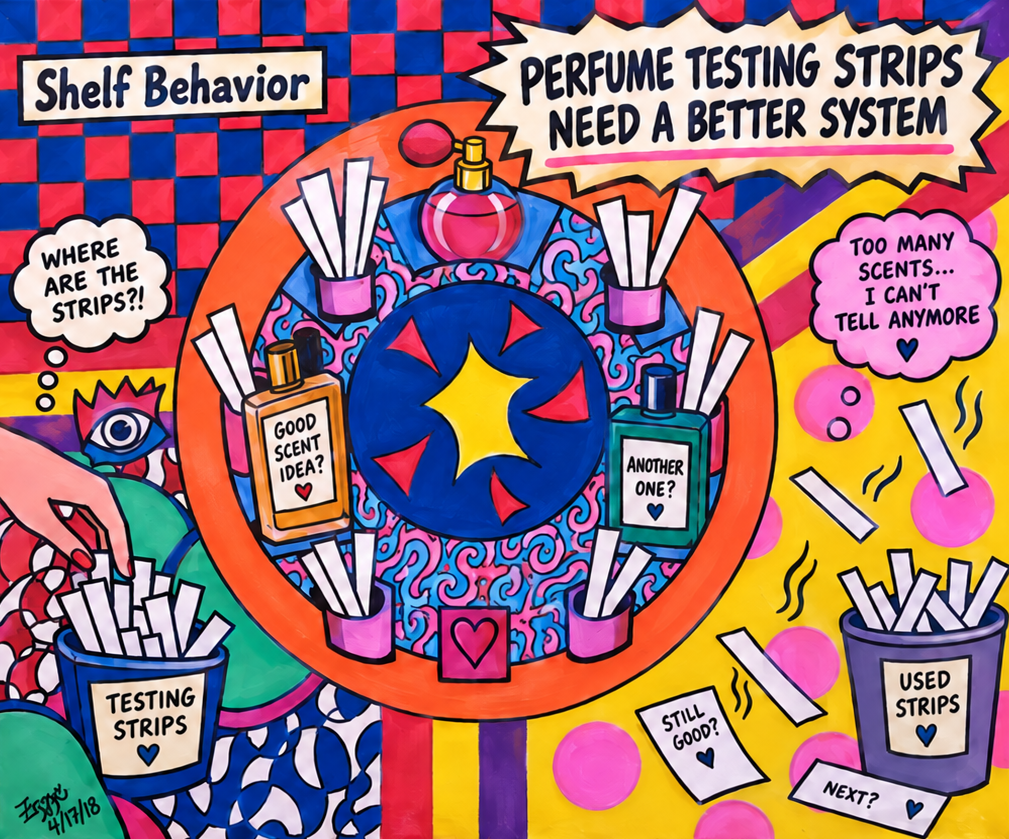
Perfume Testing Strips Need a Better System
We Found the Perfume. Now Where Is the Paper?
Can we talk about perfume testing strips for a minute? I love browsing fragrance in stores such as Sephora and Ulta Beauty, but I’ve noticed something strangely anticlimactic in some of the locations I’ve visited: finding the actual perfume can be considerably easier than finding the tiny paper strip you’re supposed to spray it on. Sometimes the strips are immediately visible. Other times, I’m scanning the display like I’ve been assigned a very low-stakes scavenger hunt. Then, after successfully acquiring one, spraying three fragrances, and developing several opinions, another question appears: Where exactly am I supposed to put these strips when I’m finished? Fragrance stores devote enormous attention to bottles, displays, lighting, launches, and testers. Perhaps the humble little piece of paper deserves a promotion.
Perfume Testing Strips Are Part of the Shopping Experience
Perfume testing strips, often called fragrance blotters or scent strips, have a genuinely useful role. They let shoppers smell a fragrance without immediately applying every perfume they encounter to their skin. That’s particularly helpful when comparing multiple scents, because there are only so many places on one human body where you can responsibly conduct an informal fragrance convention.
Yet the blotter is often treated like background equipment rather than part of the experience itself.
That seems like a missed opportunity.
A fragrance department could have clearly visible strip dispensers positioned directly beside major testing areas. Better yet, stores could create dedicated Fragrance Testing Stations with strips, pencils for writing down fragrance names, a small surface for organizing samples, and a clearly identifiable place to discard strips afterward.
The pencil matters more than it sounds.
After sampling several fragrances, remembering which anonymous white strip contains which scent can become surprisingly difficult. Suddenly you’re holding five identical pieces of paper and conducting interviews.
“Were you vanilla?”
Silence.
“Was this sandalwood?”
Nothing.
The papers refuse to cooperate.
A simple place to write the fragrance name could make comparison much easier.
Small Retail Friction Can Change the Way We Shop
From a consumer psychology perspective, seemingly minor inconveniences can matter because they interrupt a shopper’s momentum.
Someone approaching a fragrance display is already performing several mental tasks. They’re noticing packaging, reading names, evaluating prices, spraying testers, interpreting unfamiliar scent descriptions, comparing options, and trying to remember whether the fragrance they loved three minutes ago was Bottle Number Two or Bottle Number Four.
Therefore, making the sampling tools easy to find reduces unnecessary friction.
Fragrance itself also creates an unusual shopping challenge. Smelling many scents in succession can make them harder to distinguish, and our perception of an odor can change with continued exposure. Consequently, a thoughtful testing environment should encourage a more deliberate pace rather than simply encouraging shoppers to spray everything in sight.
Blotters can help with that process because consumers can spray a scent, label the strip, walk around with it, and return to it later.
However, that creates another logistical problem.
Eventually, you are finished with the paper.
Now what?
If an obvious disposal option isn’t nearby, the customer must either search for one, hand the strip to an employee, leave it somewhere inappropriate, or put it into a pocket or bag.
None of these possibilities feels particularly luxurious.
Give the Fragrance Blotter Its Moment
The solution does not require rebuilding the fragrance department.
It could be remarkably simple.
Create an obvious TRY A FRAGRANCE HERE station.
Keep perfume testing strips consistently stocked.
Provide pencils.
Give shoppers enough space to write fragrance names.
Perhaps add numbered slots where two or three fragrances can sit while someone compares them.
Then—and this is the breakthrough technology—put a small disposal bin nearby.
Retailers could even use the station to teach better fragrance discovery. A simple sign might suggest testing a few scents at a time, labeling each strip, allowing the fragrance to develop for a while, and then applying a favorite to skin if the shopper wants to experience how it smells when worn.
Suddenly, the paper strip stops being an afterthought.
It becomes part of a more thoughtful fragrance experience.
And that is what makes this tiny issue interesting. Beauty retail often spends enormous amounts of creative energy making discovery exciting. Sometimes, however, improving discovery doesn’t require another immersive installation, digital screen, or twelve-foot perfume bottle.
Sometimes the innovation is:
Here are the papers.
Here is a pencil.
And yes, here is where you can throw them away.
Luxury.