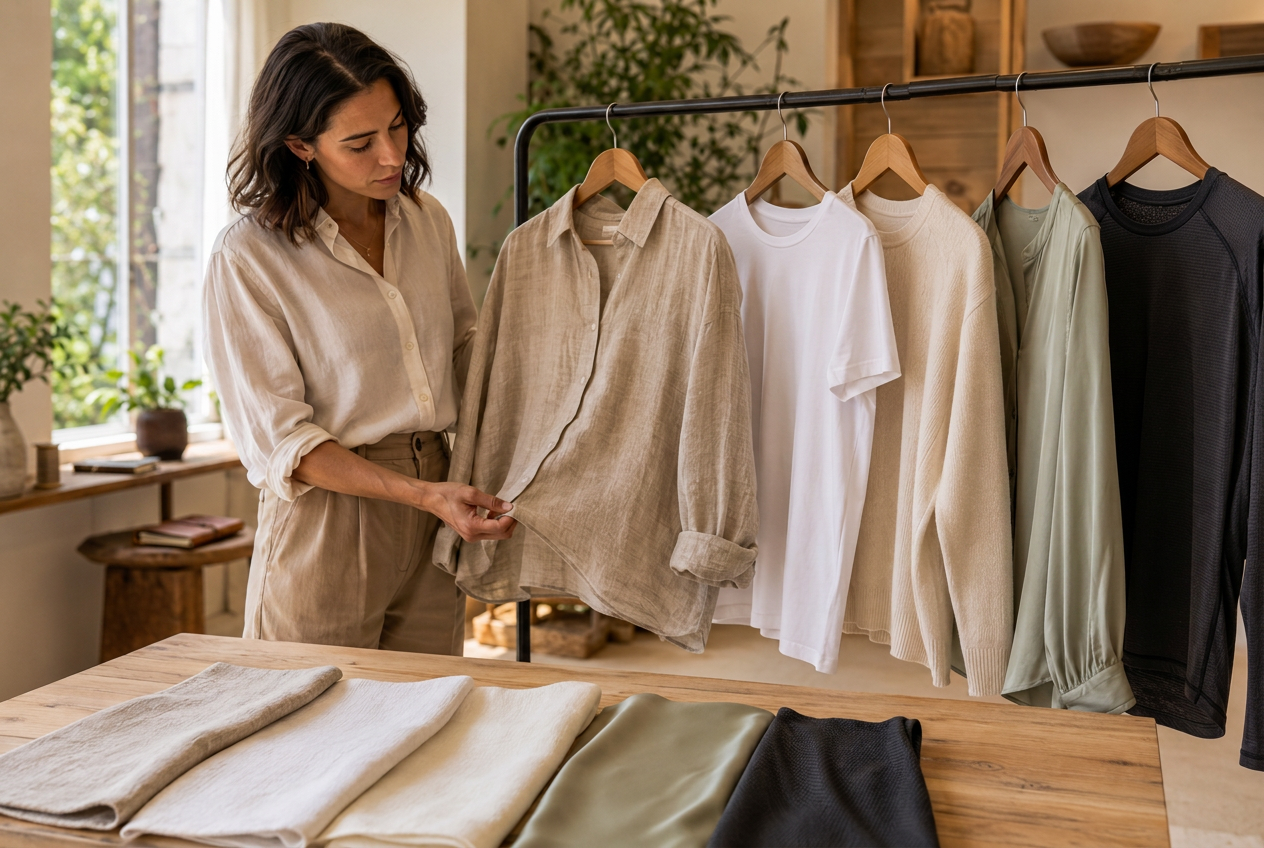
Best Clothing Material: A Science-Based Guide
The best clothing material is not one universal fiber. Cotton often wins for soft everyday wear, linen excels in hot weather, merino wool manages temperature across seasons, and engineered synthetics usually dry fastest during exercise. However, fiber content tells only part of the story. Fabric weight, yarn, knit or weave, fit, dye, finish, lining, sewing quality, climate and care can change how the same fiber feels and performs.
Therefore, the useful question is not simply, “What is the best fabric?” A better question asks, “Best for which person, activity, weather and priority?” This best clothing material guide answers both versions. It compares major fibers, explains health and environmental claims, shows how to spot quality, and gives direct answers to the most searched fabric questions.
The Best Clothing Material in 30 Seconds
If you want one short answer, choose a well-made fabric that fits the job and that you will wear often. In practice, these starting points work well:
| Need | Strong first choice | Also consider | Main caution |
|---|---|---|---|
| Soft everyday T-shirt | Cotton or cotton-rich blend | Lyocell, modal | Heavy cotton dries slowly |
| Sensitive or eczema-prone skin | Soft, undyed or lightly dyed cotton | Smooth silk, verified superfine merino | Seams, dyes and finishes may matter more than fiber |
| Hot, dry weather | Lightweight linen | Loose cotton, hemp blend | Open weaves offer less UV protection |
| Hot, humid weather | Airy linen or quick-dry technical knit | Lightweight lyocell blend | Absorbent fabrics can feel wet once saturated |
| Running or intense workouts | Technical polyester or nylon blend | Merino-synthetic blend | Synthetics can retain odor and shed microfibers |
| Hiking across temperatures | Merino-synthetic blend | Technical polyester | Cotton becomes slow and cold when soaked |
| Cold-weather base layer | Merino wool or technical synthetic | Silk | Coarse wool can itch |
| Rugged pants or workwear | Dense cotton twill, nylon blend or cotton-poly blend | Hemp-cotton canvas | Workplace hazards may require certified protective clothing |
| Underwear | Breathable cotton, merino or moisture-managing blend | Lyocell or modal blend | Fit, wetness and hygiene matter more than marketing terms |
| Low-wrinkle travel | Polyester blend, merino or nylon blend | Modal blend | Check odor, pilling and heat sensitivity |
| Lower-impact purchase | Durable item worn many times, often secondhand | Credibly certified or recycled material | No fiber label proves low total impact |
Consequently, cotton is the safest general-purpose default, not the automatic winner. Meanwhile, linen leads many summer wardrobes, wool leads cold and variable conditions, and synthetics lead many high-sweat activities.
What “Best” Actually Means
Every best clothing material candidate involves tradeoffs. For example, a fiber can absorb moisture without drying quickly, feel cool without blocking much ultraviolet radiation, or last for years while creating a difficult recycling problem.
Fiber is not the same as fabric
A fiber is the raw filament or staple, such as cotton, wool or polyester. Manufacturers spin fibers into yarn, then knit or weave that yarn into fabric. Next, they dye, finish and construct the fabric into a garment. Consequently, any best clothing material comparison must look beyond the fiber name.
As a result, two shirts labeled “100% cotton” can behave very differently. A thin, loose cotton voile allows far more airflow than a thick cotton sweatshirt. Likewise, a compact cotton poplin feels crisper than a cotton jersey, while brushed cotton traps more insulating air.
The practical hierarchy looks like this:
| Layer | Examples | What it changes |
|---|---|---|
| Fiber | Cotton, wool, viscose, polyester | Moisture affinity, heat response, strength tendencies, biodegradability potential |
| Yarn | Fine, bulky, tightly twisted, textured | Smoothness, loft, strength, wicking pathways |
| Fabric structure | Jersey, mesh, poplin, twill, fleece | Airflow, stretch, drape, abrasion resistance, warmth |
| Finish | Softener, wrinkle resistance, water repellency, antimicrobial treatment | Hand feel, care, wetting, odor, possible skin exposure |
| Garment design | Fit, panels, lining, seams, vents | Real comfort, chafing, range of motion, ventilation |
The supplied Misciano material guide makes a useful practical point: fiber is only the starting point. However, this guide goes further by checking health, performance and environmental claims against medical literature, regulators, technical standards and current market data.
Common fabric names that shoppers confuse with fibers
Cotton, wool and polyester name fibers. By contrast, jersey, satin and twill name structures that producers can make from different fibers. This distinction explains why a satin polyester skirt and a satin silk skirt share surface geometry but differ in moisture behavior, heat response and care.
| Fabric or structure | How producers make it | Typical behavior | Common clothing uses |
|---|---|---|---|
| Jersey | Single-knit loops | Soft, drapey, crosswise stretch, edges may curl | T-shirts, dresses, base layers |
| Interlock | Double-knit construction | Smoother, thicker and more stable than basic jersey | Polos, dresses, babywear |
| Rib knit | Alternating knit and purl columns | High crosswise stretch and good recovery | Cuffs, tanks, fitted tops |
| Mesh | Open knitted or woven spaces | High airflow, low coverage and variable snag resistance | Sportswear, ventilation panels |
| Poplin | Fine, balanced plain weave | Smooth, crisp, stable and relatively low bulk | Shirts, dresses, uniforms |
| Oxford cloth | Basket-like plain weave | Textured, substantial and breathable at suitable weights | Button-down shirts |
| Twill | Weave with visible diagonal ribs | Good drape, abrasion resistance and soil masking | Chinos, jackets, workwear |
| Denim | Usually cotton-rich warp-faced twill | Dense, durable and slow to dry at heavy weights | Jeans, jackets |
| Canvas or duck | Heavy, dense plain weave | Tough, structured and often low in airflow | Work trousers, coats, bags |
| Satin | Long yarn floats on the surface | Smooth and lustrous but prone to snagging | Blouses, dresses, linings |
| Fleece | Raised or brushed knit, often polyester | Traps insulating air but can pill and shed | Midlayers, sweatshirts |
| Ripstop | Reinforcement yarns form a grid | Limits tear propagation at low weight | Outdoor trousers, shells |
Therefore, the best clothing material label cannot tell you whether a shopper means a fiber, a fabric structure or a complete garment. Always translate the name into those three levels before comparing products.
The six tests for a useful answer
To identify the best clothing material for a specific garment, judge six dimensions:
- Next-to-skin comfort: Does it feel smooth, non-itchy and comfortable at the expected temperature?
- Moisture performance: Does the garment need to absorb sweat, spread it, move it away or dry fast?
- Thermal performance: Should it release heat, block wind, insulate or work across changing conditions?
- Mechanical performance: Will it resist abrasion, stretching, pilling, tearing and repeated washing?
- Health and safety: Do dyes, finishes, fit or occupational hazards create a concern?
- Environmental fit: How long will it last, how often will you wear it, and what production and disposal impacts matter most?
Thus, no honest fabric chart can crown one winner across all six dimensions. Instead, a good chart exposes the tradeoffs.
Fabric Quality Chart: A Practical Comparison
The following best clothing material quality chart describes common, untreated, medium-to-lightweight versions of each material. Brands can engineer exceptions, so treat the ratings as buying guidance rather than laboratory results.
| Material | Airflow potential | Moisture absorption | Drying speed | Odor resistance | Abrasion durability | Wrinkle resistance | Typical next-to-skin feel |
|---|---|---|---|---|---|---|---|
| Cotton | Medium to high | High | Low | Medium | Medium | Low | Soft |
| Linen/flax | High | High | Medium | Medium | High | Low | Crisp, softens with use |
| Hemp | Medium to high | High | Medium | Medium | High | Low | Crisp unless blended or softened |
| Merino wool | Medium | High vapor buffering | Medium | High | Medium to low | High | Soft when fibers are fine |
| Conventional/coarse wool | Medium | High vapor buffering | Medium | High | Medium | High | Can feel itchy |
| Silk | Medium | Medium to high | Medium | Medium | Low to medium | Low | Smooth |
| Viscose/rayon | Medium to high | High | Low to medium | Medium | Low to medium | Low | Soft, fluid |
| Modal | Medium to high | High | Medium | Medium | Medium | Medium | Very soft |
| Lyocell | Medium to high | High | Medium | Medium | Medium | Medium | Smooth, cool hand |
| Polyester | Low to high, structure-dependent | Very low in the fiber | High | Low to medium | High | High | Variable |
| Nylon | Low to high, structure-dependent | Low | High | Low to medium | Very high | High | Smooth |
| Acrylic | Medium | Low | High | Low | Low to medium | High | Wool-like, sometimes scratchy |
| Polypropylene | Low to high, structure-dependent | Very low | Very high | Low | High | High | Light, technical |
| Elastane/spandex | Not used alone | Low | High | Low | Low under heat/chlorine | High stretch recovery | Stretchy |
“Airflow potential” deliberately avoids the word “breathable” as a fixed fiber property. In fact, the REI breathability guide notes that yarn and fabric construction heavily influence air and moisture-vapor movement. Therefore, a polyester mesh can pass more air than a dense linen canvas.
The Data Behind Clothing Materials
Clothing advice often relies on vague words such as natural, breathable and sustainable. However, a reliable best clothing material recommendation needs precise definitions and current numbers.
Global fiber production in context
Before naming the best clothing material, consider what the market actually produces. The Textile Exchange Materials Market Report 2025 estimates that global fiber output reached about 132 million tonnes in 2024. Polyester alone accounted for 59% of the total, or about 78 million tonnes, and fossil feedstocks supplied 88% of that polyester.
| 2024 market indicator | Reported value | What it means |
|---|---|---|
| Total global fiber production | About 132 million tonnes | Roughly four tonnes entered the market every second |
| Total production in 2023 | About 125 million tonnes | Output grew about 5.6% in one year, based on the reported totals |
| Polyester share | 59% | Polyester dominates global clothing and textile supply |
| Polyester volume | About 78 million tonnes | Volume rose from about 71 million tonnes in 2023 |
| Fossil-based share of polyester | 88% | Recycled and bio-based routes remain a minority |
| All non-polyester fibers combined | About 41% | Cotton, wool, cellulosics and other synthetics share the remainder |
Moreover, the prior Materials Market Report 2024 found that recycled polyester’s share of polyester fell from 13.6% to 12.5% in 2023. Recycled nylon represented only about 2% of nylon. Consequently, “recycled” remains important but far from dominant.
The industry’s environmental scale
The United Nations Environment Programme reports a wide 2% to 8% range for fashion and textiles’ share of global greenhouse-gas emissions. UNEP also cites about 215 trillion liters of annual water use and roughly 15,000 chemicals used across textile manufacturing. Because system boundaries vary, the range matters more than a falsely precise single figure.
| Environmental indicator | Current estimate | Source note |
|---|---|---|
| Global textile waste | About 92 million tonnes per year | UNEP, 2025 |
| Fashion/textile greenhouse-gas share | 2% to 8% globally | UNEP technical overview |
| Annual textile-sector water use | About 215 trillion liters | UNEP technical overview |
| Textile contribution to ocean microplastic losses | About 9% | UNEP technical overview |
| Estimated textile microplastics entering oceans | 200,000 to 500,000 tonnes per year | European Environment Agency |
| EU textile consumption in 2022 | About 19 kg per person | Clothing, footwear and household textiles, EEA |
| EU consumption footprint in 2022 | About 355 kg CO2e per person | Supply-chain estimate, EEA |
Still, these sector totals cannot rank two individual shirts. Farming region, factory energy, dyeing, finishing, garment life, washing and disposal can reverse a simplistic fiber ranking.
Moisture regain is not breathability
Moisture regain frequently appears in best clothing material discussions, yet readers often misinterpret it. The measure expresses the water mass a conditioned dry fiber holds as a percentage of its dry mass. Textile traders use standard commercial values to correct weights, and ASTM D1909 explains that these agreed allowances serve commercial calculations rather than direct performance testing.
| Fiber | Approximate standard moisture regain | Practical interpretation |
|---|---|---|
| Wool | 13.6% | Buffers considerable water vapor before feeling obviously wet |
| Linen/flax | 12% | Absorbs moisture readily |
| Viscose/rayon | 11% | Absorbs much more into the fiber than polyester |
| Silk | 11% | Manages moderate humidity despite a smooth feel |
| Cotton | 8.5% | Absorbs sweat but can hold liquid and dry slowly |
| Nylon | 4.5% | Takes up more moisture than polyester, but still dries quickly in many constructions |
| Acrylic | 1% to 2% | Low uptake supports faster drying but can increase clamminess or static |
| Polyester | 0.4% | Fiber absorbs little water, although fabric engineering can spread liquid effectively |
Nevertheless, this table does not measure airflow, capillary wicking, liquid holding capacity or total drying time. A laboratory study of cotton and polyester found that cotton retained far more of an artificial sweat-sebum mixture by textile mass than polyester, while evaporation rates under that experiment remained similar. Cotton still took longer to finish drying because it started with more retained liquid.
Accordingly, “absorbs sweat” and “wicks sweat” do not mean the same thing. Absorption pulls moisture into a fiber, whereas wicking moves liquid through capillary spaces in yarns and fabric. The REI moisture-wicking explainer notes that manufacturers can give hydrophobic synthetics wicking structures or finishes even though the fibers themselves absorb little water.
How laboratories measure “breathability” and moisture
No single laboratory number captures every meaning of breathable. Instead, labs test air passage, water-vapor resistance, liquid spreading, vertical wicking, drying and thermal resistance separately. Consequently, brands should name both the test method and conditions when they publish a performance number.
| Performance claim | Relevant method | What it actually measures | How to interpret it |
|---|---|---|---|
| Air permeability | ASTM D737 | Airflow through a fabric under a specified pressure difference | More flow usually means more ventilation under that test, but not necessarily better sun or wind protection |
| Thermal and water-vapor resistance | ISO 11092:2026 | Steady-state heat and vapor transfer on a sweating guarded hotplate | Lower vapor resistance generally supports easier vapor transfer under the stated conditions |
| Liquid moisture management | AATCC TM195 | Wetting, spreading and transport on fabric surfaces | Useful for comparing how a fabric handles liquid sweat |
| Vertical wicking | AATCC TM197 | Distance or rate that liquid rises through a textile | Shows capillary movement in a defined direction |
| Drying time | AATCC TM199 | Moisture loss over time with an analyzer | Compares drying under a specific laboratory setup |
| Drying at absorbent capacity | AATCC TM200 | Drying rate after fabrics receive water relative to capacity | Separates uptake capacity from drying behavior |
| Heated-plate drying | AATCC TM201 | Drying under controlled heat | Better reflects one defined warm-surface condition |
| Water-vapor transmission | AATCC TM204 | Vapor passing through a textile | Addresses vapor transfer, not liquid sweat transport |
The AATCC moisture-management program lists these separate methods because each answers a different question. Moreover, the new ISO 11092 edition appeared in May 2026, replacing the 2014 edition for current specifications.
Therefore, never compare two brand numbers unless the method, units and conditions match. Even a valid fabric result cannot fully predict comfort once a designer adds fit, seams, layers, a backpack or changing weather.
Natural, Regenerated and Synthetic Fibers
Marketers often divide materials into “natural” and “synthetic,” then attach moral or health claims to each group. Yet the chemistry and supply chains are more complicated. Accordingly, no best clothing material verdict should rely on that binary alone.
| Family | Main examples | Origin | Key point |
|---|---|---|---|
| Plant fibers | Cotton, flax/linen, hemp | Fibers grow in plants | Renewable feedstock does not erase irrigation, land, pesticide, processing or labor impacts |
| Animal fibers | Wool, cashmere, alpaca, silk | Animals or insects produce the fiber | Renewable and often durable, but land, methane, animal welfare and processing matter |
| Regenerated cellulosics | Viscose, modal, lyocell, cupro | Producers dissolve plant-derived cellulose and regenerate it as fiber | Forest source and manufacturing chemistry matter as much as the plant origin |
| Synthetic fibers | Polyester, nylon, acrylic, elastane, polypropylene | Mostly fossil-derived polymers | Often durable and fast-drying, but fossil inputs, shedding and end-of-life problems matter |
Therefore, “plant-based” does not always mean minimally processed, while “synthetic” does not automatically mean uncomfortable. Use measurable attributes and traceable standards instead of category slogans.
Best Natural Materials for Clothes
Natural fibers offer several excellent options. However, the best clothing material within this group changes with the wardrobe role.
Cotton
Cotton remains the best clothing material for many everyday T-shirts, underwear, pajamas and casual shirts because it feels soft, absorbs moisture and tolerates routine washing. In addition, cotton rarely causes a true fiber allergy. For general-purpose basics, that combination makes cotton a credible best clothing material candidate.
However, cotton holds far more liquid than polyester and can feel heavy after intense sweating. Dense cotton also blocks airflow, while thin cotton may lack durability or sun protection. Therefore, choose lightweight cotton for low-to-moderate heat and choose sturdier ringspun or long-staple fabrics when longevity matters.
Look beyond the word cotton. For example, long, relatively uniform fibers can support smoother, stronger yarns with less fuzz. Even so, spinning, knitting, finishing and garment construction still determine the result.
Best for: everyday tops, underwear, sleepwear, sensitive skin and low-intensity warm-weather wear.
Less suitable for: wet cold, backpacking, endurance training and any situation where a soaked garment creates a safety problem.
Linen, made from flax
Linen usually leads for hot, dry weather because manufacturers can create light, open fabrics that release heat and resist clinging. Moreover, flax fibers offer strong wet and dry performance, so a well-built linen shirt can age beautifully. If airflow dominates the brief, linen may become the best clothing material for the garment.
On the other hand, linen wrinkles easily and may feel crisp at first. Loose weaves can snag, and the same openness that improves airflow can reduce ultraviolet protection. Consequently, use a UPF-rated or more tightly woven garment when sun exposure outweighs maximum airflow.
Best for: summer shirts, dresses, trousers and warm-weather bedding.
Less suitable for: wrinkle-free formalwear, tight athletic clothing and high-abrasion knitwear.
Hemp
Hemp resembles linen in several practical ways. It can create strong, absorbent and breathable fabrics, although raw or poorly finished versions can feel stiff. Blending hemp with cotton or lyocell often softens the hand while retaining structure.
Still, “hemp” alone does not guarantee organic farming, clean retting, good dyes or fair labor. Accordingly, ask for traceability and certification rather than relying on the plant name.
Best for: sturdy shirts, casual trousers, overshirts, canvas and work-inspired clothing.
Less suitable for: buyers who need silky softness without a blend or finishing treatment.
Wool and merino wool
Wool can absorb and release substantial moisture vapor, trap insulating air and resist odor buildup better than many common alternatives. Therefore, fine merino works especially well for base layers, socks, travel clothing and changeable weather. In that context, merino can earn the best clothing material label without winning summer tailoring or rugged abrasion tests.
Fiber diameter matters. A medical review that examined the idea of “wool allergy” concluded that coarse fibers can trigger mechanical irritation, while the evidence does not support wool fiber as a typical allergen. Moreover, reviews of fabrics for atopic dermatitis report that superfine merino may feel non-pruritic for some wearers, although the evidence base remains limited and individual tolerance varies (PubMed review).
Nevertheless, wool can shrink or felt under heat, friction and unsuitable washing. Moths can also damage stored garments. For durability, outdoor brands often combine merino with nylon or polyester, a tradeoff that can improve abrasion resistance but complicate fiber-to-fiber recycling.
Best for: temperature regulation, low-odor travel, socks, base layers and cold weather.
Less suitable for: anyone irritated by the specific fabric, hot machine washing, or very high-abrasion use without reinforcement.
Silk
Silk combines a smooth surface, strength for its weight and moderate moisture absorption. As a result, soft silk can reduce friction against sensitive skin and works well in lightweight base layers or refined clothing.
Yet silk often needs gentle care, loses strength when wet, and can suffer from perspiration, sunlight or abrasion. Furthermore, conventional sericulture raises animal-welfare questions because producers usually kill the pupae before moths break the cocoon. “Peace silk” addresses part of that concern, but inconsistent definitions make verification important.
Best for: smooth next-to-skin garments, occasion clothing, scarves and light insulation.
Less suitable for: rough use, easy-care wardrobes and budget-focused basics.
Regenerated Cellulose: Viscose, Modal, Lyocell and Bamboo
Regenerated cellulosic fibers start with cellulose, commonly from wood. Manufacturers dissolve the cellulose, form new filaments and wash or finish them. Thus, they sit between a raw plant fiber and a conventional synthetic polymer. A serious best clothing material review should evaluate their process as well as their plant origin.
Viscose or rayon
Rayon is a generic US fiber name, while viscose describes the dominant rayon process and often serves as the retail label. Viscose usually feels soft, cool and fluid because it absorbs moisture readily and drapes well.
However, many viscose fabrics wrinkle, stretch or weaken when wet. Manufacturing also deserves scrutiny. The US Environmental Protection Agency regulates hazardous air pollutants from cellulose manufacturing and identifies substances such as carbon disulfide and carbonyl sulfide in viscose production.
Therefore, producer controls and forest sourcing change the environmental profile substantially. The nonprofit Canopy Hot Button Report evaluates man-made cellulosic fiber producers on forest risk, traceability, certified sourcing and lower-impact “Next Generation” feedstocks.
Modal fabric
Modal is a regenerated cellulose fiber, not a completely separate natural category. Manufacturers modify the viscose process and fiber to improve wet strength, dimensional stability and softness. Consequently, modal often works well in underwear, loungewear, T-shirts and soft blends. For pure softness, some buyers call it their best clothing material, although softness alone cannot measure quality.
Still, the word modal does not identify the forest, mill, chemical recovery rate, fabric weight or finish. A cheap, loosely knit modal garment may pill or distort, while a well-engineered version can perform well for years. Therefore, judge the garment as well as the fiber.
Modal in one sentence: it offers very soft, absorbent comfort, but traceability and construction determine whether it represents quality or sustainability.
Lyocell
Lyocell uses a direct-solvent route rather than the conventional viscose pathway. Modern systems often recover most of the solvent, which can reduce some chemical burdens. A peer-reviewed process review explains the manufacturing differences and performance characteristics.
In clothing, lyocell usually feels smooth, absorbs moisture and offers better wet strength than standard viscose. Nonetheless, it can fibrillate, crease or require finishing, depending on construction. Forest origin, energy, solvent management and garment durability still matter.
Is bamboo fabric really bamboo?
Most silky “bamboo” clothing is rayon or viscose made from bamboo cellulose. The US Federal Trade Commission requires accurate labels such as “rayon made from bamboo” and says sellers lack evidence that chemically processed bamboo rayon retains the plant’s claimed antibacterial properties.
Accordingly, do not pay a premium for vague “naturally antibacterial bamboo” claims. Instead, evaluate bamboo rayon as viscose: check softness, construction, forest or plantation sourcing, manufacturing controls and credible product testing.
Synthetic Clothing Materials
Synthetic fibers dominate because they can deliver strength, stretch, low weight, fast drying and low cost. At the same time, most rely on fossil feedstocks and can release persistent microfibers. Thus, a performance-focused best clothing material answer can differ from an environmental one.
Polyester
Polyester is strong, crease-resistant, dimensionally stable and naturally low in moisture absorption. In addition, engineers can texturize yarns, add capillary channels and knit mesh structures that move sweat and dry quickly. Those traits can make polyester the best clothing material for a specific activewear design.
The University of Georgia Extension also notes polyester’s abrasion resistance and easy care. However, polyester attracts oily soils, can build static, may pill and can retain odor. Heat can melt or damage it.
A controlled study of workout shirts found that incubated polyester shirts smelled more intense and less pleasant than cotton shirts after a spin class. Yet that result does not prove that every polyester garment smells worse because finishes, washing, fabric structure and microbiomes vary.
Best for: running, team sports, rain layers, fleece, uniforms, travel and low-wrinkle garments.
Less suitable for: people who strongly dislike retained body odor, buyers avoiding fossil-derived materials, and hot-work hazards without certified protection.
Nylon or polyamide
Nylon offers excellent abrasion resistance, high strength, stretch potential and fast drying. Therefore, manufacturers use it in hiking pants, hosiery, swimwear, shells, bags and reinforced merino garments.
Conversely, nylon relies mainly on fossil feedstocks, can retain odor and releases synthetic microfibers. It may also yellow or weaken with ultraviolet exposure, depending on chemistry and stabilizers.
Best for: rugged lightweight clothing, hosiery, swimwear, outerwear and reinforcement.
Less suitable for: shoppers prioritizing natural feedstocks or mono-material end-of-life options.
Acrylic
Acrylic imitates wool’s lightness and loft at a low price. It dries quickly and resists moths, but many acrylic knits pill, generate static and retain odor.
Moreover, loose fuzzy structures can shed fibers during wear and washing. Consequently, acrylic works better when price and easy-care warmth outweigh longevity and shedding concerns.
Elastane, spandex or Lycra
Elastane gives garments stretch and recovery. A small functional percentage can improve fit, movement and shape retention in jeans, underwear and sportswear.
However, high heat, chlorine, body oils and repeated stress degrade it. Even a small elastane share can also complicate textile recycling. Thus, choose as much stretch as the garment needs, not as much as marketing can add.
Polypropylene
Polypropylene absorbs almost no moisture and weighs very little, so it can move water and dry extremely quickly in the right construction. Some cold-weather base layers and performance garments use it for that reason.
On the other hand, it can retain odor and resists conventional dyeing. It also has a smaller clothing market than polyester, which limits choices and recycling routes.
Is 100% Cotton or 50/50 Better?
Neither composition wins every test. This common best clothing material comparison depends on the intended job. A 100% cotton shirt usually feels softer, absorbs more moisture, tolerates higher ironing temperatures and avoids synthetic microfiber shedding. In contrast, a 50/50 cotton-polyester shirt usually dries faster, wrinkles less, shrinks less and survives repeated institutional washing better.
| Criterion | 100% cotton | 50% cotton / 50% polyester |
|---|---|---|
| Initial hand feel | Usually softer and more natural-feeling | Often smoother or slightly less plush |
| Sweat absorption | High | Moderate |
| Drying time | Slower | Faster |
| Wrinkle resistance | Lower | Higher |
| Shrinkage risk | Higher, especially with heat | Lower |
| Odor after heavy exercise | Often releases body odor more easily | Polyester fraction may retain oily odor |
| Abrasion and wash durability | Good when fabric is substantial | Often very good |
| Heat tolerance | Better for ironing, but cotton can burn | Polyester can melt or glaze under high heat |
| Microfiber concern | Cellulosic lint biodegrades more readily under some conditions | Releases persistent synthetic microfibers |
| Recycling | Mono-material cotton can simplify some routes | Intimate blend remains difficult to separate at scale |
| Best use | Casual wear, sleepwear, sensitive-skin basics | Uniforms, work shirts, travel, frequent washing |
For a soft casual T-shirt, 100% cotton often feels better. Meanwhile, a 50/50 blend may be better for uniforms, screen printing, travel or anyone who values shape retention and quick drying. During intense exercise, a purpose-built 100% polyester or nylon-rich technical fabric usually outperforms both in drying speed.
Therefore, read the composition as a design clue, not a score. A heavy, poorly knit 100% cotton shirt can perform worse than a well-built blend, while a dense, low-grade blend can still feel clammy.
Which Fabric Is Best to Wear?
For daily low-intensity wear, soft cotton is the broadest best clothing material recommendation. Linen becomes the stronger choice in hot weather, while superfine merino works across changing temperatures. Conversely, technical synthetics make more sense when rapid drying and abrasion resistance matter.
| Situation | Best starting material | Why | What to check |
|---|---|---|---|
| Office | Cotton, wool, linen or lyocell blend | Comfort and presentable drape | Wrinkle tolerance, lining and climate |
| Commuting | Merino blend or quick-dry synthetic | Handles temperature changes and sweat | Odor, abrasion and wash care |
| Long flight | Merino, modal blend or polyester blend | Softness, stretch or wrinkle resistance | Seam comfort and odor retention |
| Home | Cotton or modal | Soft and easy to layer | Pilling and dimensional stability |
| Beach | Linen, loose cotton or UPF technical fabric | Airflow or verified sun protection | Coverage and UPF rating |
| Rain | Nylon or polyester shell | Low water uptake and durable weather finishes | Waterproof rating, breathability and PFAS policy |
| Cold | Merino or synthetic base layer plus insulation | Moves moisture and traps heat in layers | Avoid soaked cotton next to skin |
In short, match the material to the failure you most need to prevent. Heat calls for airflow, sweat calls for moisture movement, cold calls for dry insulation, and work may call for certified protection.
What Fabric Is Healthiest to Wear?
No medical evidence supports a universal ranking from “healthy” to “toxic” fibers for everyone. Therefore, health alone cannot identify one best clothing material for every person. Most people safely wear cotton, linen, wool, viscose and synthetics. When textile contact dermatitis occurs, dyes, formaldehyde resins, glues, rubber components or other additives cause problems more often than the base fiber.
The medical reference DermNet explains that textile allergy usually involves finishing resins, dyes, glues and additives. Likewise, a clinical review reports that fibers themselves rarely cause allergic contact dermatitis (Current Allergy and Asthma Reports).
Therefore, the healthiest fabric is usually the one that keeps your skin cool and dry, does not rub, contains no trigger you react to, and receives suitable washing. For many sensitive-skin users, that means soft cotton. Other people find that smooth silk or verified superfine merino works well.
Best clothing material for sensitive skin
Start with a soft, breathable, lightly dyed fabric and a relaxed fit. Cotton earns its usual best clothing material recommendation for sensitive skin because it feels smooth and handles ordinary washing. The National Eczema Society specifically notes that people with eczema commonly tolerate 100% cotton because it feels soft and absorbs sweat.
However, no label can promise a reaction-free garment. Seams, tags, nickel fasteners, elastic, disperse dyes and wrinkle-resistant finishes can still irritate. Therefore, wash new clothing before use with a tolerated, fragrance-free detergent, then stop wearing any item that repeatedly triggers symptoms.
| Skin concern | Better starting choice | Avoid or test carefully | Why |
|---|---|---|---|
| Eczema flare | Soft cotton, smooth silk, sometimes superfine merino | Coarse wool, scratchy seams, overheating | Friction, sweat and heat can worsen itching |
| Suspected dye allergy | White, undyed or pale fabric | Dark, saturated synthetic fabrics until evaluated | Disperse and other dyes can trigger contact dermatitis |
| Sensory sensitivity | Combed cotton, modal or smooth lyocell | Rough linen, coarse wool, bulky seams | Surface texture matters immediately |
| Heavy sweating | Airy or quick-dry fabric | Thick absorbent layers that stay wet | Prolonged dampness increases friction and discomfort |
| Recurrent rash | Temporarily simplify fabrics and finishes | Self-diagnosing a “fiber allergy” | A dermatologist can patch-test likely chemicals |
Are synthetic fabrics unhealthy?
Polyester, nylon and elastane do not become inherently poisonous because they are synthetic. Finished garments can contain residues or finishes, but natural-fiber garments can also carry dyes, resins, biocides or contaminants.
At the same time, synthetics create legitimate environmental concerns. Wearing and washing them can release persistent microfibers, and polyester dominates fossil-based fiber production. Those concerns justify better design, care and policy, but they do not prove that a normal polyester shirt poisons the wearer.
What about PFAS and water-repellent finishes?
Some manufacturers have used per- and polyfluoroalkyl substances, or PFAS, to create durable water, oil or stain repellency. The US Environmental Protection Agency explains that many PFAS persist and that some accumulate in people or the environment.
Nevertheless, a fabric label such as nylon or cotton cannot reveal whether a finish contains PFAS. If water repellency matters, ask the brand for a clear PFAS policy and current treatment information. Otherwise, skip stain-resistant or water-repellent finishes you do not need.
A note on “toxic fabric” lists
Online lists often label polyester, acrylic, conventional cotton, viscose or even wool as categorically toxic. That framing collapses hazard, exposure and dose into one alarming word. It also ignores why a best clothing material decision should consider dyes, finishes, manufacturing emissions, garment quality and individual allergies.
Instead, use four concrete questions:
- Does this fabric irritate my skin in real use?
- Has a credible standard tested the finished product for restricted substances?
- Can the manufacturer disclose functional finishes?
- Will the garment suit the heat, moisture and friction of its intended use?
If a persistent rash develops, seek medical guidance. Marketing articles cannot diagnose contact dermatitis or replace patch testing.
Best Clothing Material for Summer and Hot Weather
The best clothing material for summer combines airflow, low weight, moisture management and a fit that lets warm air escape. Linen often wins for relaxed everyday clothing, while lightweight cotton, hemp blends and smooth cellulosics also work. During hard exercise in humidity, technical polyester or nylon can feel better because it spreads sweat and dries faster.
The US Centers for Disease Control and Prevention advises loose, lightweight and light-colored clothing for people working in heat. Similarly, current textile experts emphasize that weight, weave, fit and color can matter as much as the fiber (Associated Press overview).
| Hot-weather condition | Strong choice | Why | Important tradeoff |
|---|---|---|---|
| Hot and dry, casual | Lightweight linen | High airflow and low cling | Wrinkles and may offer low UV protection when open |
| Hot and humid, casual | Airy linen, thin cotton or lyocell blend | Ventilation plus moisture absorption | Absorbent fabric can feel wet after saturation |
| Hot and humid, active | Lightweight technical polyester or nylon | Spreads sweat and dries quickly | Odor and microfiber concerns |
| Direct sun | Loose UPF-rated shirt | Verified UV protection plus coverage | Some dense fabrics feel warmer |
| Sensitive skin in heat | Soft, light cotton | Low friction and good sweat uptake | Change it if it becomes soaked |
| Formal summer event | Linen, tropical wool or light lyocell blend | Drape and ventilation | Care and wrinkle differences |
Sun protection complicates the advice. An open weave increases airflow but allows more ultraviolet radiation through. Cancer Council Australia explains that fabric construction, coverage and tested UPF all matter; a UPF 50 fabric blocks at least 98% of ultraviolet radiation.
Therefore, choose a loose, lightweight, UPF-rated garment for long sun exposure. For shade or short exposures, a more open linen or cotton weave may maximize comfort.
Best Clothing Material for Working Out
During most high-sweat workouts, a well-engineered polyester or nylon blend offers the best balance of drying speed, low wet weight, stretch and durability. However, the best clothing material may shift to merino or a merino-synthetic blend when odor control, temperature swings or multi-day use matter.
Research does not support every performance-clothing claim. A 2022 scientific review found that clothing can change comfort and some physiological responses, but many material effects remain small, inconsistent or dependent on conditions. Thus, fit, fabric construction, workout intensity and climate remain crucial.
| Activity | Best starting fabric | Useful blend | Avoid when possible |
|---|---|---|---|
| Running in heat | Lightweight polyester or nylon mesh | Polyester-elastane | Thick cotton that becomes heavy |
| Strength training | Nylon-polyester-elastane knit | Cotton-poly with modest stretch | Fragile loose knits |
| Yoga or Pilates | Nylon-elastane or cotton-modal stretch knit | Polyester-elastane | Transparent, low-recovery fabric |
| Day hiking | Polyester or merino blend | Nylon-reinforced merino | Cotton in wet or cold conditions |
| Multi-day trekking | Merino-synthetic blend | Fast-dry polyester | Odor-prone heavy layers |
| Indoor cycling | Light polyester or nylon | Mesh synthetic blend | Thick absorbent cotton |
| Low-intensity walking | Cotton, linen blend or technical synthetic | Almost any comfortable fabric | Restrictive, non-vented design |
| Cold-weather training | Merino or synthetic base layer | Merino-nylon blend | Cotton next to skin once sweating starts |
Cotton does not become dangerous simply because you enter a gym. For a short, low-intensity session indoors, it may feel perfectly comfortable. Yet wet cotton creates a greater problem when cold, wind or long exposure follows the workout.
In addition, wash activewear promptly and avoid excess fabric softener, which can coat some moisture-management surfaces. Follow the garment label because heat can damage elastane and technical finishes.
Best Materials for Cold Weather
Cold-weather clothing works as a system, not a single magic fiber. Therefore, the best clothing material for winter becomes a layered combination. The US Occupational Safety and Health Administration recommends loose layers: an inner wool, silk or synthetic layer to manage moisture, an insulating middle layer, and an outer layer that handles wind or rain while allowing ventilation.
| Layer | Main job | Strong materials | Key rule |
|---|---|---|---|
| Base | Move moisture away from skin | Merino, polyester, polypropylene, silk | Avoid remaining wet |
| Mid | Trap insulating air | Wool, fleece, down or synthetic fill | Adjust loft to activity |
| Shell | Block wind and precipitation | Nylon or polyester laminate/coated fabric | Vent before sweat accumulates |
Cotton can work in dry, low-risk urban conditions. However, the National Park Service warns that cotton and denim hold moisture and can hasten hypothermia in winter backcountry conditions. Consequently, do not rely on cotton as a next-to-skin or insulating layer when getting wet could become dangerous.
Best Clothing Materials by Garment Type
The same person may need five different winners in one wardrobe. Therefore, the best clothing material should always start with the garment’s job.
Underwear
Cotton offers a comfortable default for everyday underwear, while merino, modal and lyocell blends can also feel soft. For hard exercise, a flat-seamed synthetic or merino blend often reduces wet cling and chafing.
Above all, prioritize fit, breathability, prompt changing after heavy sweating and laundering that suits your skin. Fiber marketing cannot compensate for trapped moisture or abrasive seams.
Socks
Merino-nylon blends balance moisture buffering, odor control and reinforcement. Polyester or polypropylene athletic socks also dry quickly, while 100% cotton socks can stay wet after sweat or rain.
Moreover, sock construction matters greatly. Cushion zones, smooth toe seams, arch fit and shoe ventilation can prevent discomfort more reliably than a small difference in fiber percentage.
Pajamas
Soft cotton works for many sleepers, linen helps in hot rooms, and merino suits cool rooms or temperature swings. Modal and lyocell offer smooth drape, although very light knits may pill or stretch.
Because overheating disrupts comfort, choose fabric weight according to room temperature and bedding. Likewise, avoid restrictive fits and scratchy trims.
Workwear and uniforms
Dense cotton twill feels substantial and tolerates abrasion, while cotton-poly blends improve crease resistance, drying and wash life. Nylon blends suit lightweight rugged trousers. Still, ordinary fabric comparisons stop where workplace hazards begin.
The US Consumer Product Safety Commission enforces general wearing-apparel flammability requirements under 16 CFR Part 1610. However, general compliance does not equal protection from arc flash, flame, molten metal or chemicals. Workers should use hazard-specific, employer-approved and properly certified protective clothing.
Travel clothing
Merino handles odor and temperature changes, while nylon and polyester blends dry quickly and resist wrinkles. Modal blends feel soft during long journeys, but they may take longer to dry than performance synthetics.
Therefore, a practical capsule often mixes materials: a merino or blended top, abrasion-resistant nylon-rich trousers, a packable synthetic shell and one comfortable cotton item for low-sweat use.
Is Polyester a Good Material for Clothes?
Yes, polyester can be the best clothing material when the garment needs quick drying, strength, wrinkle resistance or low weight. It can also be a poor choice when the wearer prioritizes odor release, fossil-free feedstocks, high heat tolerance or easy biological degradation.
| Polyester advantage | Polyester limitation |
|---|---|
| Dries quickly because the fiber absorbs little water | Often holds oily soils and body odor |
| Resists wrinkles and dimensional change | Can pill when short fibers or weak construction reach the surface |
| Supports mesh, fleece, waterproof shells and many technical structures | Releases persistent microfibers during production, wear and washing |
| Offers high strength for low weight | Most global production still uses fossil feedstocks |
| Usually costs less than fine wool or silk | Melts under high heat and cannot replace certified protective fabric |
| Recycled feedstock can reduce virgin fossil demand | Most recycled polyester does not yet create true textile-to-textile circularity |
Consequently, polyester is neither a miracle nor a poison. Buy it for a clear function, choose solid construction, wear it for a long time and wash it thoughtfully.
The Best Clothing Material for the Environment
No fiber wins every environmental category. Consequently, the best clothing material for the environment depends on production, function, lifespan, care and disposal. Cotton can involve irrigation, land and agricultural chemicals. Wool can involve methane, land use and animal welfare. Viscose can involve forest loss and hazardous manufacturing chemistry. Polyester and nylon rely mainly on fossil resources and release persistent microfibers.
In addition, life-cycle comparisons can mislead when studies use different regions, allocation rules, factory energy, garment lifetimes or care assumptions. Textile Exchange’s 2026 polyester life-cycle work explicitly warns that its fiber studies should support impact-reduction strategies, not simplistic comparisons between material categories (technical report).
| Material family | Main potential strengths | Main impact hotspots | Better buying questions |
|---|---|---|---|
| Cotton | Renewable, comfortable, established recycling routes | Water stress in some regions, land, pesticides, dyeing | Where did it grow? Which standard applies? Will the fabric last? |
| Linen/flax | Durable, renewable, often needs less irrigation than thirsty crops in suitable climates | Retting, processing, dyeing, land and regional variation | Is the source traceable? Is the weave durable? |
| Hemp | Durable and renewable | Retting, processing, chemistry, limited traceability | Does certification cover farming and processing? |
| Wool | Durable, repairable, lower wash frequency for many users | Enteric methane, land, animal welfare, scouring | Does a credible animal-welfare and land standard apply? |
| Silk | Strong for weight, long-lived in suitable garments | Energy, sericulture, animal welfare, dyeing | How was it produced and how often will you wear it? |
| Viscose/modal | Renewable cellulose feedstock, soft and absorbent | Forest risk, carbon disulfide in viscose, energy, wastewater | Who made the fiber? How does the producer rank on traceability and chemistry? |
| Lyocell | Solvent-recovery systems can reduce chemical emissions | Forest source, energy, finishing | Is the pulp certified and the producer transparent? |
| Polyester | Durable, low washing-temperature needs, fast drying | Fossil feedstock, microfiber release, low textile-to-textile recycling | Virgin or recycled? Does durability justify the function? |
| Nylon | Very durable and lightweight | Fossil feedstock, energy, microfibers | Can a smaller amount or recycled input meet the need? |
| Blends | Can extend life, improve fit and reduce care burdens | Fiber separation and recycling difficulty | Does the blend solve a real durability or performance problem? |
The strongest environmental strategy
First, buy fewer garments and demand useful life. Next, choose a material that will actually perform, because a theoretically lower-impact shirt that sits unworn delivers little value. Then, favor secondhand, repairable construction, credible traceability and low-impact care. In other words, the best clothing material should support long, frequent use.
UNEP reports that global clothing production doubled between 2000 and 2015 while average garment-use duration fell 36% (Zero Waste Day briefing). Consequently, slowing replacement can matter at least as much as switching between two plausible fibers.
Natural does not guarantee biodegradable in real life
Untreated cotton, linen and wool can biodegrade under suitable conditions. However, dyes, resin finishes, polyurethane coatings, synthetic sewing thread, elastic, labels and mixed-fiber construction alter the final product. Landfills also lack the controlled oxygen, moisture and microbial conditions that simple biodegradability claims imply.
Conversely, conventional polyester and nylon persist rather than biodegrade readily. Even so, “compostable fiber” does not justify disposable clothing. Durable use remains the more reliable goal.
Recycled polyester helps, but it does not solve circularity
Recycled polyester usually reduces demand for virgin fossil feedstock. However, much of today’s input comes from plastic bottles rather than old garments. Once producers turn a bottle into a complex blended shirt, another recycling cycle may become harder.
Furthermore, recycled polyester can still shed microfibers and retain odor. Therefore, treat recycled content as one positive attribute, not proof of a fully sustainable garment.
Certifications That Actually Tell You Something
Certifications answer narrow questions. None proves that one item is the best clothing material choice across health, ethics, climate, durability and recycling all at once.
| Label or tool | What it addresses | Useful threshold or feature | What it does not prove |
|---|---|---|---|
| OEKO-TEX Standard 100 | Finished-component testing for restricted/harmful substances | Tests every component against more than 1,000 substances; stricter limits apply with more skin contact | Organic farming, low carbon, living wages or durability |
| Global Organic Textile Standard, GOTS | Organic fiber processing, chemical inputs, wastewater, social criteria and traceability | “Organic” requires at least 95% certified organic fibers; “made with organic” requires at least 70% | Best-in-class durability or zero impact |
| Responsible Wool Standard, RWS | Animal welfare, land management, social criteria and chain of custody | Tracks certified wool through the supply chain | Skin tolerance, chemical safety or garment quality |
| Global Recycled Standard, GRS | Recycled input, chain of custody and processing requirements | GRS requires at least 50% recycled content for product labeling and adds social, environmental and chemical-processing criteria | Fiber-to-fiber circularity, no shedding or long life |
| Canopy Hot Button | Forest risk and producer performance for viscose, modal and lyocell | Ranks producers on traceability, certified sourcing and next-generation inputs | Finished-garment comfort or restricted-substance testing |
| Tested UPF rating | Ultraviolet protection of a fabric or garment | UPF 50 blocks at least 98% of UV under the relevant test claim | Cooling, chemical safety or permanent performance after unlimited wear |
As a result, match the label to your concern. Choose OEKO-TEX for finished-product chemical screening, GOTS for organic textile processing, RWS for wool systems, GRS for recycled claims, and Canopy’s report for cellulosic producer risk.
The standards landscape is also changing. Textile Exchange says its Materials Matter Standard becomes effective on December 31, 2026 and mandatory for relevant Tier 4 audits from December 31, 2027. Therefore, buyers may see both current GRS or RWS claims and the new system during the transition.
Fabrics to Avoid in Clothing, Depending on Context
No mainstream fiber requires a universal ban. Still, some material-and-use combinations create predictable problems. That is why a best clothing material guide should identify bad matches rather than blacklist whole fiber families.
| Avoid or reconsider | In this situation | Better alternative | Reason |
|---|---|---|---|
| Thick 100% cotton | Cold, wet outdoor activity | Merino or technical synthetic | Cotton holds liquid and dries slowly |
| Coarse wool | Eczema or tactile sensitivity | Cotton, silk or verified superfine merino | Large fibers can cause mechanical irritation |
| Heavy polyester | Hot casual wear with little ventilation | Linen or airy cotton | Low-airflow construction can feel clammy |
| Odor-prone polyester knit | Multi-day travel without laundry | Merino or tested odor-control blend | Polyester can retain oily odor compounds |
| Acrylic sweater with early fuzzing | Long-life wardrobe | Wool blend or dense cotton knit | Early surface fuzz often predicts pilling |
| Open, sheer natural fabric | Prolonged direct sun | Loose UPF-rated fabric | Airflow does not equal UV protection |
| High-elastane fashion basic | Long-term shape and recyclability priority | Lower-stretch construction | Heat and use degrade elastane; blends hinder recycling |
| Vague “bamboo” fabric | When antibacterial claims drive the price | Transparent lyocell, modal or viscose | Most bamboo softness comes from rayon processing, not retained plant properties |
| Unnecessary stain-resistant finish | When simple washing meets the need | Untreated fabric | Avoids functional chemistry that provides no personal value |
| Any ordinary fabric | Fire, arc, chemical or molten-metal hazard | Certified task-specific PPE | Everyday labels do not establish workplace protection |
Therefore, the “worst clothing material” depends on the job. Thick cotton can become the worst base layer in cold rain, yet the same cotton can make an excellent everyday sweatshirt. Polyester can feel unpleasant in a dense summer blouse, yet excel in a ventilated running top.
How to Recognize High-Quality Clothing Material
A fiber label cannot tell you whether a garment will twist, pill, shrink, fade or tear. Fortunately, a best clothing material inspection can reveal more through several quick checks.
The 60-second in-store quality test
- Hold the fabric to light. Look for even density unless the design intentionally uses slubs or transparency.
- Rub the surface gently. Immediate fuzz can predict pilling, especially in soft, loosely spun knits.
- Stretch and release it. The fabric should recover without ripples or bagging when recovery matters.
- Scrunch a corner. Decide whether the resulting wrinkles suit the garment and your care habits.
- Inspect seams. Look for even stitches, secure ends, adequate seam allowance and no pulling.
- Match stripes or checks. Careful alignment often signals more deliberate cutting and construction.
- Check the lining and pocketing. A strong outer fabric cannot rescue weak hidden components.
- Read the care label. A garment you cannot realistically maintain is not a quality purchase for you.
- Look for transparency. Verify that stress points and undergarments remain covered in normal movement.
- Smell with caution. A strong chemical odor justifies airing, washing or skipping the garment, but odor alone cannot identify a chemical.
Laboratory tests behind real fabric quality
Reputable brands can test objective performance. However, no universal best clothing material pass number fits every garment because a silk blouse and a work jacket need different targets.
| Quality question | Relevant standard example | What the test measures |
|---|---|---|
| Will rubbing wear it out? | ASTM D4966, Martindale abrasion | Resistance to repeated abrasion |
| Will pills form? | ASTM D4970/D4970M or ISO 12945-2 | Surface fuzzing and pilling under controlled rubbing |
| Will it break under pulling? | ASTM D5034 | Grab breaking force and elongation |
| Will a small cut spread? | ASTM D1424 | Tear strength by falling pendulum |
| Is the fabric substantial enough? | ASTM D3776/D3776M | Mass per unit area, often reported as GSM |
| Will washing shrink it? | AATCC TM135 | Dimensional change of fabric after home laundering |
| Will the finished garment shrink? | AATCC TM150 | Dimensional change after specified wash and dry cycles |
| Will seams or panels twist? | AATCC TM179 and TM207 | Skew and seam twist after laundering |
| Will color transfer or fade? | AATCC crocking and laundering methods | Colorfastness to rubbing and washing |
Consequently, ask brands for test methods and results rather than accepting “premium,” “luxury weight” or “anti-pill” without evidence. A claimed 250 GSM only states mass, not strength, fiber quality or sewing quality.
How to read a fiber-content label
The FTC textile-labeling guide explains that covered US textile products generally must show generic fiber names, percentages by weight, country of origin and the responsible business identity. Manufacturers list fibers in descending order, and they may name a sub-5% fiber when it has a functional role, such as spandex. Even so, the label cannot identify the best clothing material without context.
Still, a label leaves gaps. It usually does not disclose yarn quality, fabric weight, knit density, dye, finish chemistry, sewing thread or the performance of a non-warmth lining. Therefore, use the label as the start of inspection, not the end.
How to Choose the Best Clothing Material
Use this best clothing material decision sequence before buying:
- Name the activity. Daily office wear, a humid run and a winter hike need different fabrics.
- Identify the main failure. Decide whether heat, wetness, odor, abrasion, wrinkles, itching or sunlight creates the biggest problem.
- Choose a fiber family. Select two or three plausible materials rather than one idealized winner.
- Inspect construction. Compare weight, openness, recovery, seams, lining and fit.
- Check relevant evidence. Look for a meaningful certification, UPF test, abrasion result or care trial.
- Predict actual care. Buy only if your washing, drying and ironing habits suit the garment.
- Estimate wears. Prefer the item you can wear frequently, repair and keep.
For example, a summer commuter may value loose linen for the office but prefer a quick-dry polyester top on a bicycle. Likewise, a person with eczema may tolerate soft cotton yet dislike a heavily dyed cotton-poly uniform. Context turns a generic fiber ranking into a sound purchase.
Care That Makes Clothing Last Longer
Care changes both fabric life and environmental impact. Therefore, the best clothing material only delivers value when the routine preserves it. Follow the label first, then use the gentlest effective routine.
| Material | Better routine | Common mistake |
|---|---|---|
| Cotton | Cool wash, reshape, use low heat when possible | Repeated high heat that shrinks and weakens fabric |
| Linen | Cool or warm gentle wash, remove promptly, air-dry or use low heat | Overdrying until fibers feel harsh |
| Wool | Air between wears, spot-clean, use wool cycle and suitable detergent | Heat plus agitation, which can felt and shrink wool |
| Silk | Follow label, use gentle detergent, avoid rubbing and direct sun | Aggressive washing or enzyme products not suited to silk |
| Viscose/modal | Use a gentle cycle, support when wet, reshape | Twisting or hanging a weak wet garment |
| Lyocell | Wash cool, reduce abrasion, follow finish-specific directions | High friction that encourages fibrillation |
| Polyester/nylon | Wash cool, full but not overloaded, air-dry when practical | High dryer heat and delayed washing of sweaty items |
| Elastane blends | Keep away from high heat and excess chlorine | Hot dryers that accelerate loss of stretch |
A peer-reviewed laundering study found that shorter, cooler cycles reduced dye and microfiber release under the tested conditions. It also found lower release per kilogram in fuller loads than in smaller loads, although users should not overload a machine. The study received industry funding, so its transparent methods and limitations deserve attention alongside the results.
In practice, wash only when needed, treat stains locally, close zippers, turn fragile garments inside out and air-dry when the label allows. Moreover, repair loose hems and small holes before they expand.
Common Fabric Myths, Corrected
Before calling any fiber the best clothing material, test the claim behind the slogan.
| Myth | Better answer |
|---|---|
| “Natural fabric always breathes.” | Structure controls airflow, so dense natural fabric can breathe less than synthetic mesh. |
| “Polyester never wicks.” | Polyester absorbs little into the fiber, but engineered yarn and fabric can move liquid by capillary action. |
| “Cotton is always best in heat.” | Cotton can feel good in dry or low-sweat conditions, but it becomes heavy and slow-drying when saturated. |
| “Wool allergy is common.” | Coarse fibers often cause mechanical itch; true allergy to the wool fiber itself lacks strong support. |
| “Bamboo clothing stays naturally antibacterial.” | Most soft bamboo fabric is rayon, and the FTC says evidence does not support retained antibacterial properties after processing. |
| “Recycled polyester is circular.” | It reduces virgin feedstock, but it often comes from bottles, still sheds and rarely returns to equivalent clothing repeatedly. |
| “A high GSM proves quality.” | GSM measures mass per area, not pilling, strength, recovery, colorfastness or workmanship. |
| “A blend is always cheap.” | A purposeful blend can improve stretch, wash life, drying or abrasion resistance, although it may hinder recycling. |
| “Hypoallergenic means no reaction.” | Individual triggers differ, and dyes, finishes, seams or detergents can still cause symptoms. |
| “One sustainable-fabric ranking fits every garment.” | Region, process, energy, lifetime, care and functional performance can change the outcome. |
Interesting Clothing Material Facts
These facts explain why the best clothing material question remains more interesting than a one-word answer:
- Polyester now dominates the world fiber market. In 2024, it represented 59% of global output, according to Textile Exchange.
- Moisture absorption and fast drying can point in opposite directions. Cotton takes up much more water than polyester, so it often needs longer to dry.
- Wool can feel dry while holding water vapor. Its high moisture regain helps buffer humidity before liquid wetness becomes obvious.
- Fabric geometry can beat fiber stereotypes. A thin polyester mesh may pass more air than heavy linen canvas.
- The soft “bamboo” label usually hides a rayon process. Federal guidance requires marketers to identify it accurately as rayon or viscose made from bamboo.
- A tiny amount of elastane can change a garment. Functional percentages below 5% may appear by name on US labels because they materially affect stretch.
- A UPF 50 garment blocks at least 98% of UV in the tested state. Still, wear, stretching and wetness can influence protection, depending on the fabric.
- Odor is partly a microbiology problem. One controlled exercise study found different odor outcomes on polyester and cotton after bacterial incubation.
- “Rayon” describes a fiber class, not one quality level. Viscose, modal and lyocell use distinct processes and can produce very different fabrics.
- Pilling does not always mean the fiber is weak. Strong synthetic fibers can anchor pills to a surface, while pills may fall off more quickly from weaker fibers.
- Wrinkles can signal low elasticity rather than poor quality. Linen wrinkles easily even when the fibers and construction are excellent.
- Sun comfort and sun safety can conflict. The most open weave may feel coolest but allow more UV through.
- Low-temperature care can reward quick-dry fibers. These materials often need less dryer energy, although their production and shedding still matter.
- Long wear changes per-use impact. A durable garment worn hundreds of times distributes its production burden across many more uses.
- Your best wardrobe probably mixes fibers. A single person can rationally choose cotton pajamas, linen shirts, merino socks and polyester running gear.
Frequently Asked Questions
What is the best clothing material?
Cotton is the best all-around starting point for soft everyday clothing. However, linen performs better in many hot-weather garments, merino wool leads for temperature regulation and odor control, and technical polyester or nylon usually leads for intense exercise. Therefore, the best clothing material depends on use.
Which fabric is best to wear?
Wear soft cotton for ordinary low-sweat days, linen for relaxed heat, merino for changing temperatures, and technical synthetics for high-output activity. More importantly, choose an appropriate weight, structure and fit.
What is the best fabric for clothes?
Cotton offers the broadest all-purpose answer because it feels soft, absorbs moisture and appears in almost every garment type. However, the best clothing material changes when linen improves heat comfort, wool adds insulation, or synthetics provide faster drying and higher abrasion resistance.
What fabric is healthiest to wear?
No universal “healthiest” fiber exists. Soft, lightly dyed cotton provides a sensible first choice for sensitive skin, while silk and superfine merino suit some people. Dyes, finishes, seams, heat and trapped moisture often matter more than the fiber itself.
What are the best fabrics to wear for health?
Soft cotton, smooth silk and tolerated superfine merino provide sensible starting points. Nevertheless, healthy wear depends more on avoiding personal triggers, overheating, prolonged dampness and friction than on choosing one supposedly pure fiber.
What are the healthiest and worst clothing fabrics?
The healthiest fabric is comfortable, non-irritating, temperature-appropriate and properly washed. Conversely, the worst fabric is one that traps heat, stays wet, rubs, contains a personal allergen or fails the safety needs of the activity. Avoid categorical “toxic fabric” lists because they rarely evaluate actual exposure or dose.
Is 100% cotton or 50/50 better?
Choose 100% cotton for softness, absorbency and an all-cellulosic composition. Select a 50/50 cotton-polyester blend for faster drying, fewer wrinkles, lower shrinkage and frequent washing. Neither one is universally higher quality.
Is polyester a good material for clothes?
Yes. Polyester works especially well for sportswear, fleece, outerwear, uniforms and travel clothing because it dries quickly and resists wrinkles. Nevertheless, it can retain odor, shed persistent microfibers, melt under high heat and rely on fossil feedstocks.
What is the best clothing material for health?
For most people, comfort and irritation control matter more than a fiber hierarchy. Start with soft cotton if you have sensitive skin, wash new garments, limit unneeded finishes and consult a dermatologist for a persistent rash.
What is the best clothing material for skin?
Soft cotton is the most practical default. Smooth silk, modal, lyocell and verified superfine merino can also feel comfortable. Still, test the complete garment because dyes, elastic, seams and detergent residues can trigger symptoms.
What is the best clothing material for summer?
Lightweight linen usually offers the strongest everyday combination of airflow, low cling and heat release. Loose cotton, hemp blends and lyocell also work. For sweaty activity in humidity, choose a ventilated quick-dry synthetic.
What is the best fabric for hot weather?
Use light, loose and airy fabric. Linen often wins in hot, dry settings, while engineered polyester or nylon can win during hard exercise. For long direct-sun exposure, prioritize a loose UPF-rated garment rather than the most open weave.
What is the best clothing material for working out?
A lightweight polyester or nylon blend usually works best for hard workouts because it dries quickly, stretches and resists abrasion. Merino-synthetic blends work well for cooler weather, odor control and multi-day use.
What is the best clothing material for the environment?
The best environmental choice is usually a durable garment that you will wear often, care for efficiently and repair. Secondhand often avoids demand for a new item. When buying new, compare traceability, certification, construction and intended life instead of trusting the fiber name alone.
What are the best natural materials for clothes?
Cotton offers versatility and softness, linen excels in heat, hemp provides strength, wool regulates temperature, and silk gives smoothness at low weight. Each material also has production, care and durability tradeoffs.
What is modal fabric?
Modal is a regenerated cellulosic fiber related to viscose. It usually feels very soft, absorbs moisture and retains strength better when wet than standard viscose. However, producer practices, fabric construction and garment quality determine its environmental and durability performance.
What is the worst clothing material?
No single fiber is always worst. Acrylic may disappoint when pilling and shedding matter, heavy cotton can create risk in cold wet conditions, coarse wool can irritate sensitive skin, and dense polyester can feel hot. The worst choice is the material that conflicts with the garment’s job.
Which fabrics should I avoid in clothing?
Avoid fabrics that itch, remain wet during the intended activity, show early pilling, fail to recover from stretching or require care you will not provide. Also avoid vague antibacterial, non-toxic, sustainable or bamboo claims without specific evidence.
Is linen better than cotton?
Linen often feels cooler, dries somewhat faster and offers excellent durability, while cotton usually feels softer, costs less and resists wrinkling slightly better. Therefore, linen tends to win for summer tailoring, while cotton wins for versatile basics.
Is modal better than cotton?
Modal often feels smoother and drapes more fluidly than cotton. Cotton generally offers broader quality choices, easier care and potentially simpler end-of-life routes when it remains mono-material. Choose according to construction and use, not softness alone.
Is lyocell better than viscose?
Lyocell production commonly recovers solvent more effectively and avoids the conventional viscose pathway, while the fiber often shows better wet strength. Even so, forest sourcing, factory energy, finishing and garment life still determine the broader result.
Is merino wool itchy?
Fine merino often feels much less itchy than coarse wool because fiber diameter drives mechanical irritation. Individual tolerance still varies, so test the garment against the skin before committing to long wear.
Do natural fabrics contain chemicals?
Yes. Clothing production uses dyes, detergents, softeners, resins, printing pastes and other processing chemicals across both natural and synthetic fibers. Therefore, “natural fiber” does not mean “chemical-free.”
Does washing new clothes help?
An initial wash can remove loose dye, finishing residues, dust and handling contamination. Follow the care label and use a detergent you tolerate. However, washing cannot remove every finish or prevent a true allergy.
Does higher fabric weight mean higher quality?
No. Higher grams per square meter means more fabric mass, not automatically better fibers, stronger seams, lower pilling or better comfort. Match weight to purpose and ask for relevant tests.
Are blends lower quality?
Not necessarily. A thoughtful blend can add stretch, improve abrasion resistance, reduce shrinkage or speed drying. Still, blends can complicate recycling and sometimes disguise weak construction, so inspect the garment.
Final Verdict: Choose for the Job, Then Choose Quality
The best clothing material is a system-level choice. Cotton provides the strongest everyday default, linen leads many hot-weather uses, merino wool handles temperature changes and odor, while polyester and nylon dominate rapid-dry performance. Modal and lyocell add soft, absorbent options, but their producer and construction matter.
Therefore, stop asking one fiber to win every category. Define the job, prevent the most important failure, inspect the fabric, check relevant evidence and choose an item you will wear for years. That approach produces better comfort, better value and a more credible environmental outcome than any simplistic “best” or “toxic” list.
Research Method and Source Quality
This guide prioritizes regulators, public-health agencies, technical standards, peer-reviewed research and industry-wide market datasets. Practical retailer and consumer guides helped identify common questions, but they did not establish medical or quantitative claims.
The research reviewed the supplied references, including COMUNE, REI, Good On You, The Good Trade, Steamery, Merchology, Thread Logic, Alyssa Rudman and the Reddit fabric discussion. Those pages provide useful perspectives, yet brand, affiliate and community claims received less evidentiary weight than primary and peer-reviewed sources.
Editorial cautions
- Comparative ratings describe typical fabrics, not guarantees for every garment.
- Environmental figures use the newest accessible global or regional datasets available at the evidence-review date.
- Medical sections provide general education, not diagnosis or individual treatment.
- Occupational and sun-protection claims require the relevant certified garment, not a fiber assumption.
- Trademarks do not equal generic fiber names. For example, Lycra is a brand of elastane, while TENCEL is a Lenzing trademark used for certain branded lyocell or modal fibers.
Primary evidence links
- Textile Exchange, Materials Market Report 2025
- United Nations Environment Programme, sustainable fashion and textiles
- European Environment Agency, textiles overview
- US Federal Trade Commission, bamboo textiles
- US Federal Trade Commission, textile labeling
- DermNet, textile contact dermatitis
- PubMed, fabric selection in atopic dermatitis
- PubMed, wool allergy review
- Peer-reviewed sports-clothing review
- ASTM textile standards
- AATCC laundering test-method training
- OEKO-TEX Standard 100
- Global Organic Textile Standard
- Responsible Wool Standard
- Canopy Hot Button Report