Biggest Beauty Companies in the World (2026)
The biggest beauty companies in the world also sell far more than lipstick and face cream. They also own portfolios that stretch from $10 shampoo to $500 serum, from pharmacy sunscreen to couture fragrance, and from salon color to viral TikTok makeup. However, a simple question such as “Which beauty company is the biggest?” can produce several different answers. Revenue, beauty-only sales, market capitalization, and brand value therefore measure different things. Consequently, this guide separates those measures before ranking the companies.
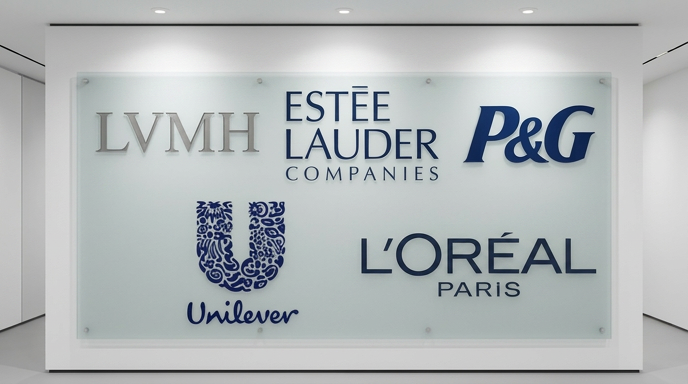
The clearest answer is L’Oréal. Specifically, WWD’s Beauty Inc Top 100 placed the French group first with $49.72 billion in 2025 beauty sales, almost $22.74 billion more than second-ranked Unilever. Meanwhile, the next three companies were Procter & Gamble, The Estée Lauder Companies, and LVMH. As a result, those five generated about $116.02 billion, or 44.8% of the sales reported for the Top 100.
However, scale tells only part of the story. For comparison, Chanel leads the latest brand-value ranking, Galderma ranks second on a beauty-focused market-cap list, and CeraVe holds a documented United States dermatologist-recommendation claim. Meanwhile, L’Oréal remains the broadest answer to the question of the world’s largest skincare company, even though it does not publish one consolidated skincare revenue line.
Overall, this article explains every distinction. It also answers the four questions shown in the search screenshots, lists the top 50 companies, profiles the ten leaders, maps famous brands to their owners, compares skincare and luxury players, and examines the forces likely to change the ranking.
Quick answer: By 2025 beauty-product sales, the five biggest cosmetic companies are L’Oréal ($49.72 billion), Unilever ($26.98 billion estimated), P&G ($15.40 billion estimated), Estée Lauder ($14.70 billion estimated), and LVMH ($9.22 billion estimated). WWD published the ranking in April 2026. Its beauty definition includes fragrance, makeup, skin, body, sun and hair care, deodorant, cellulite products, and shaving products.
Explore the biggest beauty companies in the world
- Global company ranking
- Ranking method
- Top 10 company profiles
- Market capitalization
- Brand value
- Skincare leadership
- Dermatologist-brand claims
- Brand ownership map
- Market growth and trends
- Frequently asked questions
Biggest beauty companies in the world: the 2026 ranking
At this point, the table below uses the newest complete, comparable global league table available at the research cut-off date. Specifically, it follows WWD’s 2025 Beauty Inc Top 100, published on April 16, 2026. Because the original article requires a subscription, the figures were checked against an accessible reproduction of the ranking and its methodology, as well as official company reports for the leaders.
Chart source: WWD Beauty Inc Top 100. WWD marks every displayed value except L’Oréal as an estimate.
Top 50 largest cosmetic companies by revenue from beauty
Ranks 1 to 25 among the biggest beauty companies in the world
| Rank | Company | 2025 beauty sales |
|---|---|---|
| 1 | L’Oréal | $49.72 billion |
| 2 | Unilever | $26.98 billion est. |
| 3 | Procter & Gamble | $15.40 billion est. |
| 4 | The Estée Lauder Companies | $14.70 billion est. |
| 5 | LVMH | $9.22 billion est. |
| 6 | Chanel | $9.18 billion est. |
| 7 | Beiersdorf | $8.89 billion est. |
| 8 | Shiseido | $6.48 billion est. |
| 9 | Coty | $5.81 billion est. |
| 10 | Puig | $5.27 billion est. |
| 11 | Bath & Body Works | $4.63 billion est. |
| 12 | Henkel | $4.39 billion est. |
| 13 | Kao | $4.35 billion est. |
| 14 | Kenvue | $4.11 billion est. |
| 15 | Natura | $3.79 billion est. |
| 16 | Colgate-Palmolive | $3.50 billion est. |
| 17 | Amorepacific | $3.19 billion est. |
| 18 | L’Occitane International | $3.01 billion est. |
| 19 | LG Household & Health Care | $2.47 billion est. |
| 20 | Mary Kay | $2.40 billion est. |
| 21 | Wella Company | $2.40 billion est. |
| 22 | Groupe Clarins | $2.26 billion est. |
| 23 | Kosé | $2.21 billion est. |
| 24 | Revlon Group Holdings | $2.06 billion est. |
| 25 | Laboratoires Pierre Fabre | $1.93 billion est. |
Ranks 26 to 50 among global cosmetic companies
| Rank | Company | 2025 beauty sales |
|---|---|---|
| 26 | Groupe Rocher | $1.91 billion est. |
| 27 | Rituals Cosmetics | $1.88 billion est. |
| 28 | Grupo Boticário | $1.86 billion est. |
| 29 | Victoria’s Secret & Co. | $1.68 billion est. |
| 30 | Proya Cosmetics | $1.57 billion est. |
| 31 | e.l.f. Beauty | $1.52 billion |
| 32 | Yellow Wood Partners | $1.50 billion est. |
| 33 | Interparfums | $1.49 billion |
| 34 | Galderma | $1.45 billion est. |
| 35 | Neora | $1.38 billion est. |
| 36 | Advent International | $1.35 billion est. |
| 37 | Rodan + Fields | $1.35 billion est. |
| 38 | Chicmax | $1.28 billion est. |
| 39 | Belcorp | $1.20 billion est. |
| 40 | Dolce & Gabbana Beauty | $1.17 billion est. |
| 41 | John Paul Mitchell Systems | $1.17 billion est. |
| 42 | Cosnova | $1.12 billion est. |
| 43 | Pola Orbis Holdings | $1.10 billion |
| 44 | Naos | $1.10 billion est. |
| 45 | Godrej Consumer Products | $1.09 billion est. |
| 46 | L Catterton | $1.09 billion est. |
| 47 | Marico | $1.06 billion est. |
| 48 | Amway | $1.06 billion est. |
| 49 | Lush | $1.05 billion est. |
| 50 | EuroItalia | $966.1 million est. |
Note: Dollar values represent 2025 beauty sales as compiled by WWD, not necessarily each company’s total statutory revenue. “Estimate” means WWD marked the figure EST. Currency conversion and different fiscal calendars can create differences from annual reports.
Several conclusions jump out. Firstly, L’Oréal alone supplied 19.2% of the Top 100’s $258.99 billion in sales. Secondly, the top three controlled 35.6% of that total. Moreover, the top seven reached 51.8%, while the top ten reached 58.6%. Beauty may offer thousands of brands, but ownership and revenue remain highly concentrated near the top.
Nevertheless, the middle of the table remains dynamic. In particular, four names crossed $1 billion for the first time: Dolce & Gabbana Beauty, Naos, Chicmax, and Neora. Moreover, 74 of the 100 companies grew, and 29 posted double-digit gains. In contrast, 11 of the top 20 declined, which shows that smaller challengers often grow faster than mature conglomerates.
How we ranked the biggest beauty companies in the world
Rankings become misleading when they combine incompatible numbers. For example, Unilever sells food, P&G sells diapers and detergents, LVMH sells fashion and spirits, and Chanel sells couture and watches. Their total company revenue therefore exaggerates the part generated by cosmetics. Consequently, this guide ranks the biggest beauty companies in the world by beauty-product sales.
What WWD counts as beauty
Specifically, WWD includes fragrance, makeup, skincare, body care, sun care, hair care, deodorant, cellulite products, and shaving products. Conversely, it excludes bar soap, razors, toothpaste, food and diet products, medicines, vitamins, detergents, and appliances. As a result, this boundary creates a more meaningful comparison between pure-play beauty groups and diversified consumer companies.
Even so, no cross-company ranking can become perfectly uniform. For example, private businesses disclose fewer details, diversified groups use broader reporting segments, and fiscal years end in different months. Furthermore, exchange rates can move a company up or down without changing the number of products it sells. For that reason, the table identifies estimates and the profiles pair WWD figures with company-reported numbers.
The four “biggest” metrics are not interchangeable
| Metric | What it measures | Best use | Main weakness |
|---|---|---|---|
| Beauty sales | Annual manufacturer sales from defined beauty categories | Ranking operating scale | Private-company figures often require estimates |
| Total corporate revenue | All company sales across every business | Understanding the whole group | Inflates diversified companies with non-beauty sales |
| Market capitalization | Share price multiplied by shares outstanding | Comparing investor valuations | Changes daily, excludes private firms, and values the entire listed group |
| Brand value | Modeled economic value of a name and related intangible assets | Comparing brand equity | Relies on assumptions and does not equal sales or company value |
Therefore, “largest cosmetic companies by revenue” should usually mean beauty-only revenue. Meanwhile, “largest by market cap” answers an investor question. Finally, “top cosmetic brands” compares names such as Chanel, Nivea, and Lancôme rather than parent companies.
Top 10 profiles among the biggest beauty companies in the world
Overall, the ten leaders generated about $151.65 billion in 2025 beauty sales. However, the biggest beauty companies in the world use sharply different business models. Among them, L’Oréal also spans every price tier, Estée Lauder concentrates on prestige, P&G mixes daily-use hair and skin care with deodorant, Chanel protects luxury scarcity, and Puig relies heavily on fragrance.
1. L’Oréal: $49.72 billion in beauty sales
Overall, L’Oréal is the largest beauty company in the world by a decisive margin. Specifically, the group reported €44.052 billion in 2025 sales, up 4.0% on a like-for-like basis and 1.3% as reported. Then, WWD converted and standardized that performance to $49.72 billion for its ranking. Separately, L’Oréal’s own market review rounds its position to $47.0 billion when it compares global players, which illustrates how reference exchange rates affect dollar totals.
Above all, L’Oréal balances categories, channels, regions, and price points. Its Consumer Products Division generated about €16.1 billion in 2025, while L’Oréal Luxe reached €15.6 billion. In addition, Dermatological Beauty contributed €7.204 billion, and Professional Products added about €5.2 billion. The official 2025 results also show a 74.3% gross margin, a 20.2% operating margin, and €7.2 billion in net cash flow.
In particular, its portfolio provides the underlying engine. For example, consumer brands include L’Oréal Paris, Maybelline New York, Garnier, NYX Professional Makeup, essie, and Mixa. Likewise, luxury names include Lancôme, Yves Saint Laurent Beauté, Giorgio Armani Beauty, Kiehl’s, Prada Beauty, Valentino Beauty, and Aesop. Meanwhile, the dermatological division houses La Roche-Posay, CeraVe, Vichy, SkinCeuticals, and Skinbetter Science.
Scale also funds a scientific moat. According to the L’Oréal 2025 Annual Report, the company invested more than €1.3 billion in research and innovation, employed about 4,000 researchers, and filed 725 patents. In addition, ecommerce passed 30% of sales. Therefore, those capabilities help explain why L’Oréal can move discoveries, content, and retail tools across 40 global brands.
Why it ranks first: L’Oréal is almost entirely focused on beauty, competes from mass to luxury, leads across several regions, and reinvests at a level that smaller specialists cannot easily match.
Curiosity: L’Oréal distributes more than seven billion products a year through 37 plants and 160 fulfillment centers, according to its operations overview.
2. Unilever: $26.98 billion estimated beauty sales
Unilever takes second place, although its reporting structure requires care. Specifically, in 2025 the company reported €12.8 billion of Beauty & Wellbeing turnover and €13.2 billion of Personal Care turnover. Overall, those divisions reached €26.0 billion. However, they contain some products outside WWD’s beauty scope, including wellbeing supplements and oral care. WWD therefore estimated $26.98 billion after applying its own category boundary.
In particular, the portfolio rests on enormous everyday brands. For example, Dove spans cleansing, deodorant, hair care, and body care. Vaseline brings global skin-health reach, while Sunsilk, TRESemmé, Clear, and Nexxus cover hair. Moreover, Paula’s Choice, Dermalogica, Hourglass, Tatcha, Living Proof, and K18 give the group higher-priced prestige and professional exposure. Liquid I.V. and Nutrafol sit inside Beauty & Wellbeing; however, WWD excludes vitamins and similar products from its comparison.
Geographic breadth strengthens the model. The United States, India, China, Brazil, and Mexico form Beauty & Wellbeing’s five largest country markets, according to Unilever’s latest results materials. Meanwhile, Personal Care counts the United States, India, Brazil, the United Kingdom, and Indonesia among its biggest markets. As a result, Unilever can sell both premium actives and affordable daily essentials at global scale.
Why it ranks second: Few companies match Unilever’s distribution, mass-market penetration, and strength in personal care. Still, category overlap makes WWD’s standardized estimate more useful than a simple sum of segment revenue.
Curiosity: Unilever’s two beauty-adjacent divisions each exceed the total beauty sales of every company below second place.
3. Procter & Gamble: $15.40 billion estimated beauty sales
Overall, P&G combines hair care, skincare, deodorant, grooming, and prestige skincare. For example, its key beauty names include Pantene, Head & Shoulders, Herbal Essences, Olay, SK-II, Native, Old Spice, Secret, and Safeguard. Furthermore, Gillette contributes powerful shaving equity, although WWD includes shaving products but excludes razors themselves.
Specifically, the company’s fiscal 2026 results provide the newest official check. P&G generated $87.0 billion in total net sales, while Beauty sales rose 7% to approximately $16.0 billion. Organic Beauty sales increased 4%, according to the FY2026 results release and annual report. By comparison, WWD’s $15.40 billion estimate reflects calendar 2025 and its narrower product definition.
In particular, hair care supplies much of P&G’s reach. For example, the company’s own leadership page describes Pantene as the world’s largest hair-care brand and Head & Shoulders as the largest shampoo brand. It also calls Olay the fifth-largest skincare brand. Because these are P&G’s claims, readers should treat them as corporate market-position statements rather than independent rankings.
Why it ranks third: P&G turns focused category leadership, retail execution, and recurring daily routines into enormous volume. However, the wider corporation remains much larger than its beauty unit, so total P&G revenue cannot serve as a cosmetic-sales figure.
Curiosity: Beauty represents less than one-fifth of P&G’s total sales, yet the segment alone would still rank among the world’s largest standalone cosmetics businesses.
4. The Estée Lauder Companies: $14.70 billion estimated beauty sales
Overall, Estée Lauder built one of the most concentrated prestige-beauty portfolios in the industry. For example, its more than 20 brands include Estée Lauder, Clinique, M·A·C, La Mer, Jo Malone London, Le Labo, Tom Ford, The Ordinary, Aveda, Bobbi Brown, Dr Jart+, Origins, Too Faced, and Kilian Paris. Consequently, the company offers far less mass-market exposure than L’Oréal, Unilever, or P&G.
Specifically, WWD estimates $14.70 billion of calendar-2025 beauty sales. Meanwhile, Estée Lauder reported $15.049 billion in net sales for fiscal 2026, up 5% from $14.326 billion. Moreover, organic sales rose 3%, skincare organic sales grew 4%, fragrance gained 10%, makeup was nearly flat, and hair care declined 1%. The official FY2026 release also reported a 75.5% gross margin and an 11.2% adjusted operating margin.
Overall, prestige concentration creates both appeal and risk. On one hand, La Mer, Le Labo, Jo Malone London, and Tom Ford can sustain premium prices and high gross margins. Conversely, travel retail, China, and department stores can produce volatility when tourism or luxury demand weakens. Therefore, the company has been diversifying distribution and rebuilding profitability through its Beauty Reimagined strategy.
Why it ranks fourth: Estée Lauder remains the leading US-headquartered prestige-beauty specialist, with a portfolio that reaches makeup, skincare, fragrance, and hair care across more than 20 brands.
Curiosity: Estée Lauder owns the Tom Ford brand itself, not only its beauty license. The official portfolio also includes both The Ordinary and NIOD through Deciem.
5. LVMH: $9.22 billion estimated beauty sales
In particular, LVMH’s beauty business combines heritage fragrance houses, couture names, and specialist brands. For example, Parfums Christian Dior, Guerlain, Givenchy Parfums, Kenzo Parfums, Benefit Cosmetics, Fresh, Make Up For Ever, Maison Francis Kurkdjian, Acqua di Parma, Fenty Beauty, and Kendo sit within its Perfumes & Cosmetics maisons.
Specifically, that business group generated €8.174 billion in revenue in 2025, roughly consistent with WWD’s $9.22 billion estimate after currency conversion. However, the full LVMH group generated €80.8 billion, because fashion, leather goods, watches, jewelry, wines, spirits, and selective retailing dominate the wider corporation. Therefore, using €80.8 billion as “cosmetics revenue” would overstate LVMH’s beauty scale almost tenfold.
Meanwhile, Sephora adds another common source of confusion. LVMH owns the retailer, but it reports Sephora inside Selective Retailing, not Perfumes & Cosmetics. Accordingly, the core company ranking should compare the manufacturer portfolio without adding the sales of third-party brands sold through Sephora.
Why it ranks fifth: LVMH uses luxury storytelling, controlled distribution, fashion-house licenses, and fragrance expertise to command high value per unit. Nevertheless, beauty remains only one part of a much larger luxury group.
Curiosity: Guerlain began in 1828, which gives LVMH one of the oldest continuously influential perfume and cosmetics houses in the top ten.
6. Chanel: $9.18 billion estimated beauty sales
By comparison, Chanel sits only $40 million behind LVMH in WWD’s estimate, a difference too small to treat as structurally permanent. Moreover, the private company combines fragrance, makeup, and skincare with couture, ready-to-wear, watches, and fine jewelry. However, it does not publish the same category detail as a public pure-play group.
Specifically, WWD estimates $9.18 billion in 2025 beauty sales. Meanwhile, Chanel’s total company revenue reached about $19.3 billion, and operating profit reached $4.7 billion, according to coverage of its 2025 financial report. Those figures imply that beauty contributed close to half of group revenue, although the precise mix comes from WWD rather than Chanel’s segment disclosure.
Chanel No. 5 remains the emblem, but Bleu de Chanel, Coco Mademoiselle, Chance, Les Exclusifs, Sublimage, N°1 de Chanel, and Les Beiges broaden the franchise. In addition, private ownership allows the house to prioritize long-term desirability and controlled distribution over quarterly expansion.
Why it ranks sixth: Chanel combines one of beauty’s strongest names with unusually high luxury pricing power. Still, limited public segmentation makes standardized outside estimates necessary.
Curiosity: Chanel ranks sixth as a company by beauty sales, yet the Chanel name ranks first as a cosmetics brand by estimated brand value in 2026.
7. Beiersdorf: $8.89 billion estimated beauty sales
In contrast, Beiersdorf offers a more skincare-focused model than most top-seven peers. Nivea supplies mass scale, while Eucerin and Aquaphor lead the fast-growing Derma unit. Meanwhile, La Prairie competes at the luxury end, and Chantecaille adds prestige beauty. Moreover, Hansaplast and Elastoplast connect the Consumer segment to healthcare-adjacent skin needs.
Specifically, Beiersdorf reported €8.2 billion in Consumer sales in 2025, up 2.5% organically. Furthermore, skincare grew 3.7%, Nivea produced roughly €5.5 billion, and Derma reached €1.5 billion after 11.7% organic growth. In contrast, La Prairie declined 4.5% to €478 million. Accordingly, these figures come from Beiersdorf’s official full-year results.
Specifically, the company calls itself the fastest-growing skincare company globally. That wording reflects Beiersdorf’s own analysis, so it should not replace a neutral market ranking. Nevertheless, the double-digit Derma performance supports the broader conclusion that clinically positioned brands can outgrow conventional premium skincare.
Why it ranks seventh: Beiersdorf combines a century of Nivea recognition with rapid Eucerin and Aquaphor growth. As a result, it offers one of the purest large-scale skincare comparisons in the top ten.
Curiosity: Nivea alone generated more 2025 sales than several entire companies in WWD’s top 15.
8. Shiseido: $6.48 billion estimated beauty sales
Initially founded in Tokyo in 1872, Shiseido connects Japanese beauty science with global prestige. For example, its portfolio includes Shiseido, Clé de Peau Beauté, NARS, Drunk Elephant, Anessa, Elixir, Issey Miyake Parfums, Narciso Rodriguez Parfums, and Serge Lutens. Therefore, the company spans sunscreen, skincare, makeup, and fragrance while retaining a strong Asian identity.
Shiseido reported ¥970.0 billion in 2025 net sales and ¥44.5 billion in core operating profit, according to its official shareholder materials. Accordingly, WWD translated the relevant beauty activity to $6.48 billion. Exchange rates matter especially here, because a weaker yen can reduce the dollar ranking even when local-currency sales remain stable.
Meanwhile, China and travel retail have challenged the company in recent years. At the same time, sunscreen, prestige skincare, and fragrance offer recovery paths. In addition, Brand Finance valued SK-II, owned by P&G, and Clé de Peau Beauté among the notable Japanese prestige names in 2026, showing that Japanese brand influence extends beyond the parent-company table.
Why it ranks eighth: Shiseido combines 150 years of heritage, strong Asian distribution, proprietary science, and a global prestige portfolio. However, regional concentration and currency translation create volatility.
Curiosity: Shiseido began as Japan’s first Western-style pharmacy, long before “J-beauty” became an international category.
9. Coty: $5.81 billion estimated beauty sales
In particular, Coty has one of the industry’s largest fragrance-license platforms. For example, its Prestige portfolio includes Burberry, Calvin Klein, Chloé, Davidoff, Hugo Boss, Jil Sander, Marc Jacobs, and philosophy. Likewise, Consumer Beauty includes CoverGirl, Max Factor, Rimmel, Bourjois, Sally Hansen, and adidas body care. Thus, the company combines designer fragrance economics with mass color cosmetics.
Specifically, Coty reported $5.807 billion in fiscal-2026 net revenue, down 2% as reported and 5% like for like. Prestige generated $3.806 billion, or 66% of the total, while Consumer Beauty supplied $2.001 billion, or 34%. Consequently, the official results closely match WWD’s $5.81 billion calendar-2025 estimate.
Licenses accelerate scale but create renewal risk. For instance, a beauty group can build decades of equity around a fashion name without owning that name forever. Consequently, investors and readers should distinguish owned brands from licensed ones when assessing portfolio durability.
Why it ranks ninth: Coty pairs global fragrance production and distribution with mass cosmetics reach. Yet its dependence on licenses and pressure in Consumer Beauty make the business less diversified than L’Oréal’s.
Curiosity: Coty identifies itself as the world’s number-two fragrance company and number-two mass color-cosmetics company. Those are company-supplied category claims, not the same as its ninth-place overall beauty-sales rank.
10. Puig: $5.27 billion estimated beauty sales
Overall, Puig is the fastest-growing member of the top ten on the 2025 table. Specifically, the Spanish group reported €5.042 billion in 2025 revenue, up 7.8% like for like and 5.3% as reported. Adjusted EBITDA reached €1.045 billion, with a 20.7% margin, according to Puig’s full-year results.
In particular, fragrance drives the center of gravity. For example, Rabanne, Carolina Herrera, Jean Paul Gaultier, Nina Ricci, Byredo, Penhaligon’s, Dries Van Noten, and L’Artisan Parfumeur give Puig exceptional perfume reach. Meanwhile, Charlotte Tilbury leads its makeup activity, and Uriage, Apivita, Dr Barbara Sturm, Kama Ayurveda, and Loto del Sur expand skincare. The official brand portfolio also identifies Christian Louboutin, Banderas, and Adolfo Domínguez licenses.
Unlike some license-heavy competitors, Puig generated 93% of revenue from owned brands in 2025. Therefore, its growth creates lasting portfolio equity. Moreover, the company’s 2024 stock-market listing gave investors a direct way to value a premium-beauty specialist.
Why it ranks tenth: Puig combines fragrance momentum, founder-led prestige brands, and a growing makeup and skincare platform. As a result, it has become the most visible challenger to the established top tier.
Curiosity: Puig reached more than €5 billion in annual revenue after reporting less than half that level only a few years earlier.
Companies ranked 11 to 25: the next global tier
Overall, the next group contains retailers-turned-brand specialists, heritage manufacturers, direct sellers, and dermocosmetics companies. Although they sit below the top ten biggest beauty companies in the world, several lead a specific category or region.
| Rank | Company | Key beauty assets | Strategic identity |
|---|---|---|---|
| 11 | Bath & Body Works | Bath & Body Works | Fragrance-led body care and home scent |
| 12 | Henkel | Schwarzkopf, Syoss, Dial, got2b, Authentic Beauty Concept | Hair care, salon, and personal care |
| 13 | Kao | Bioré, Jergens, Curél, Kanebo, Molton Brown | Japanese mass and prestige beauty |
| 14 | Kenvue | Neutrogena, Aveeno, OGX, Maui Moisture | Consumer-health-led skin and hair care |
| 15 | Natura | Natura, Avon | Latin American direct and omnichannel beauty |
| 16 | Colgate-Palmolive | EltaMD, PCA Skin, Filorga | Professional and science-led skincare within a broader group |
| 17 | Amorepacific | Sulwhasoo, Laneige, Innisfree, Hera, Etude | Korean prestige and mass beauty |
| 18 | L’Occitane International | L’Occitane en Provence, Sol de Janeiro, Elemis, Erborian | Natural-positioned and premium body/skincare |
| 19 | LG H&H | The History of Whoo, CNP, Belif, Su | Korean luxury and dermocosmetics |
| 20 | Mary Kay | Mary Kay | Direct-selling skincare and color cosmetics |
| 21 | Wella Company | Wella Professionals, OPI, ghd, Briogeo | Professional hair and nail care |
| 22 | Groupe Clarins | Clarins, myBlend | Family-controlled premium skincare |
| 23 | Kosé | Decorté, Sekkisei, Tarte | Japanese prestige, skincare, and makeup |
| 24 | Revlon | Revlon, Elizabeth Arden, American Crew | Mass color, prestige beauty, and professional hair |
| 25 | Pierre Fabre | Avène, Ducray, Klorane, René Furterer | Pharmacy-led dermocosmetics |
Ownership changes below the biggest beauty companies in the world
Kenvue deserves special attention because old ownership charts still call Neutrogena and Aveeno Johnson & Johnson brands. Therefore, that information is no longer current. Kenvue completed its separation from Johnson & Johnson in August 2023, so it now ranks independently.
For example, Amorepacific, LG H&H, and Kosé show the depth of Asian beauty beyond Shiseido. Likewise, Natura and Grupo Boticário demonstrate Brazil’s importance. Meanwhile, Pierre Fabre, Clarins, Naos, and L’Occitane reinforce France’s leadership in pharmacy, premium, and natural-positioned skincare.
Companies ranked 26 to 50: challengers and specialists
Overall, the lower half of the top 50 often contains the fastest strategic change. For example, these challengers can pressure the biggest beauty companies in the world through rapid product development, digital relevance, specialized dermatology, or regional insight. Specifically, e.l.f. Beauty moves quickly, Galderma bridges dermatology and aesthetics, Rituals scales experiential retail, and Proya represents China’s rising domestic brands.
| Company | Rank | Main route to scale |
|---|---|---|
| Groupe Rocher | 26 | Botanical and direct-to-consumer beauty |
| Rituals | 27 | Premium body care, fragrance, and stores |
| Grupo Boticário | 28 | Brazilian omnichannel portfolio |
| Victoria’s Secret | 29 | Accessible fine fragrance and body care |
| Proya | 30 | Chinese skincare innovation and ecommerce |
| e.l.f. Beauty | 31 | Fast, value-led makeup and skincare |
| Yellow Wood Partners | 32 | Portfolio ownership, including Suave and Byoma |
| Interparfums | 33 | Licensed prestige fragrances |
| Galderma | 34 | Cetaphil plus injectable and prescription dermatology |
| Neora | 35 | Direct-selling skincare and wellness |
| Advent International | 36 | Private-equity beauty holdings |
| Rodan + Fields | 37 | Direct-to-consumer skincare |
| Chicmax | 38 | Chinese beauty portfolio and digital channels |
| Belcorp | 39 | Latin American direct selling |
| Dolce & Gabbana Beauty | 40 | In-house luxury fragrance and makeup |
| John Paul Mitchell Systems | 41 | Professional hair care |
| Cosnova | 42 | Value color cosmetics through Essence and Catrice |
| Pola Orbis | 43 | Japanese prestige skincare |
| Naos | 44 | Bioderma, Institut Esthederm, and Etat Pur |
| Godrej Consumer Products | 45 | Emerging-market hair and personal care |
| L Catterton | 46 | Private-equity beauty investments |
| Marico | 47 | Hair and personal care in South Asia and emerging markets |
| Amway | 48 | Direct-selling beauty through Artistry and Satinique |
| Lush | 49 | Fresh handmade cosmetics and owned stores |
| EuroItalia | 50 | Licensed luxury fragrance |
How ownership changes the biggest beauty companies in the world
However, not every row represents a conventional operating company. For example, Yellow Wood Partners, Advent International, and L Catterton are investment owners whose included beauty assets can change. Similarly, Interparfums and EuroItalia depend heavily on licensing. Consequently, the ranking measures the sales footprint under each owner at that moment, not the permanence of every brand relationship.
Who are the Big 7 of the beauty industry?
In fact, there is no official, permanent “Big Seven” in beauty. The phrase circulates because a 2017 Business Insider ownership graphic showed that seven conglomerates controlled 182 familiar beauty brands. Specifically, that historical list named Estée Lauder, L’Oréal, Unilever, P&G, Shiseido, Johnson & Johnson, and Coty. Therefore, it described brand ownership, not a revenue league table.
Moreover, an even older version used a different roster that included Avon and Revlon. Therefore, anyone who presents “the Big 7” without a year or method is offering a convention, not an industry standard. In addition, Johnson & Johnson no longer owns the consumer-beauty portfolio shown in the widely shared graphic, because Kenvue became independent in 2023.
Legacy Big 7 versus the current revenue-based Big 7
| Position | Legacy seven from the 2017 ownership graphic | Current seven by 2025 beauty sales |
|---|---|---|
| 1 | L’Oréal | L’Oréal |
| 2 | Estée Lauder | Unilever |
| 3 | Unilever | Procter & Gamble |
| 4 | Procter & Gamble | Estée Lauder |
| 5 | Shiseido | LVMH |
| 6 | Johnson & Johnson | Chanel |
| 7 | Coty | Beiersdorf |
Therefore, for a current article about the biggest beauty companies in the world, the right-hand column offers the more defensible answer. Overall, those seven companies generated $134.09 billion, or 51.8% of all Top 100 beauty sales. However, the legacy list remains useful when explaining why so many apparently independent labels share corporate owners.
Biggest beauty companies in the world by market cap
Market capitalization changes the order of the biggest beauty companies in the world because it answers a different question: how much does the stock market value a listed company’s equity today? Specifically, it equals share price multiplied by shares outstanding. Therefore, it can rise or fall even when annual beauty sales do not change.
Specifically, the following snapshot comes from CompaniesMarketCap’s cosmetics and beauty screen on September 3, 2026. Prices on that site can be delayed, so readers should treat the values as a dated snapshot rather than permanent facts.
| Rank on screen | Listed company | Market cap | What the business mainly represents |
|---|---|---|---|
| 1 | L’Oréal | $233.40 billion | Global beauty manufacturer |
| 2 | Galderma | $47.39 billion | Dermatology, aesthetics, and Cetaphil |
| 3 | Givaudan | $37.52 billion | Fragrance and flavor ingredients supplier |
| 4 | Estée Lauder | $36.59 billion | Prestige beauty manufacturer |
| 5 | Ulta Beauty | $23.59 billion | Beauty retailer |
| 6 | International Flavors & Fragrances | $22.18 billion | Ingredients supplier |
| 7 | Kao | $20.55 billion | Beauty and diversified consumer products |
| 8 | Beiersdorf | $19.53 billion | Skincare and adhesives group |
| 9 | Puig | $11.91 billion | Premium beauty manufacturer |
| 10 | APR | $11.18 billion | Korean beauty and devices group |
| 11 | Shiseido | $8.75 billion | Prestige beauty manufacturer |
| 12 | Amorepacific | $7.22 billion | Korean beauty manufacturer |
| 13 | e.l.f. Beauty | $6.33 billion | Makeup and skincare manufacturer |
| 14 | Coty | $2.55 billion | Fragrance and cosmetics manufacturer |
| 15 | Natura | $2.51 billion | Latin American beauty group |
Why market-cap rankings look different
However, this screen should not replace the sales ranking. Firstly, Chanel, Mary Kay, L’Occitane, and other private companies have no public market cap. Secondly, the list mixes manufacturers with Ulta, a retailer, and Givaudan and IFF, ingredient suppliers. Thirdly, diversified giants such as Unilever, P&G, and LVMH have stock-market values for their entire businesses, not for beauty alone. Consequently, excluding them from a beauty screen does not make them smaller beauty operators.
L’Oréal still leads both comparisons. Nevertheless, Galderma’s second-place equity value contrasts sharply with its 34th place in WWD beauty sales. Investors value its injectable aesthetics, prescription portfolio, growth prospects, and margins, while WWD counts only eligible beauty sales. Therefore, that gap perfectly demonstrates why market cap and revenue cannot be used as synonyms.
Top 10 cosmetic brands in the world by brand value
A company can own dozens of brands, while a brand is one commercial identity. Therefore, the biggest beauty companies in the world do not automatically own the highest-ranked individual name. Specifically, Brand Finance estimates the economic value of those identities through a royalty-relief model. In essence, it estimates what a company might theoretically pay to license the name, then discounts expected brand-related earnings. The method follows ISO 10668, while its Brand Strength Index follows ISO 20671.
According to Brand Finance’s Cosmetics 50 2026, the top 50 names held $149.8 billion in combined brand value, down 6% from the prior year. Moreover, the consultancy conducts more than 6,000 brand valuations and surveys over 175,000 respondents across 41 countries and 31 sectors.
| Brand rank | Cosmetic brand | 2026 brand value | Parent company |
|---|---|---|---|
| 1 | Chanel | $24.4 billion | Chanel |
| 2 | L’Oréal | $13.5 billion | L’Oréal |
| 3 | Gillette | $8.4 billion | Procter & Gamble |
| 4 | Nivea | $7.9 billion | Beiersdorf |
| 5 | Guerlain | $6.6 billion | LVMH |
| 6 | Dove | $5.5 billion | Unilever |
| 7 | Lancôme | $5.1 billion | L’Oréal |
| 8 | Estée Lauder | $4.9 billion | Estée Lauder Companies |
| 9 | Pantene | $4.9 billion | Procter & Gamble |
| 10 | Garnier | $4.9 billion | L’Oréal |
Chanel leads because its name spans beauty and a powerful luxury ecosystem. However, its $24.4 billion brand value is not annual sales, nor is it Chanel Limited’s total equity value. Likewise, L’Oréal appears twice in the broader picture: once as a parent company and once as a consumer-facing brand within that company.
Why French cosmetic brands lead in value
French brands dominate this measure. Specifically, they contributed about 47%, or $68.5 billion, of the Cosmetics 50’s aggregate value. US names supplied roughly 35%, while German names supplied 6%. In addition, Chanel achieved the highest Brand Strength Index score at 89.8 out of 100 and an AAA+ rating. Lancôme followed among the strongest brands with 86.1, while Bioré jumped 29 places to third at 85.7.
Top luxury cosmetic brands in the world
Although “luxury” has no single regulated price boundary, the Brand Finance results allow a transparent high-end shortlist based on disclosed valuations rather than subjective prestige.
| Luxury or prestige brand | 2026 brand value | Why it stands out |
|---|---|---|
| Chanel | $24.4 billion | Highest cosmetics brand value and strength score |
| Guerlain | $6.6 billion | Heritage fragrance, makeup, and skincare house |
| Lancôme | $5.1 billion | Global luxury skincare, makeup, and fragrance |
| Estée Lauder | $4.9 billion | Flagship prestige skincare and makeup name |
| SK-II | $3.0 billion | Japanese-origin super-premium skincare brand |
In contrast, a list of the “best” luxury brands would require product testing, consumer preferences, price bands, and category-specific criteria. Therefore, this table says which disclosed luxury names carry the greatest modeled brand value, not which products work best for every person.
<a id=”skincare”></a>
Skincare leaders among the biggest beauty companies in the world
L’Oréal is the most defensible answer. Among the biggest beauty companies in the world, it combines the highest global sales with one of the broadest skincare portfolios across mass, luxury, professional, and pharmacy channels. However, it does not report one consolidated “skincare revenue” figure because skincare appears in all four divisions.
Specifically, the closest clean disclosure is Dermatological Beauty, which generated €7.204 billion in 2025 sales, grew 5.5% like for like, and earned a 26.1% operating margin. For example, that division includes CeraVe, La Roche-Posay, Vichy, SkinCeuticals, and Skinbetter Science. Moreover, SkinCeuticals passed €1 billion in annual sales. L’Oréal Luxe adds Lancôme, Kiehl’s, Aesop, Helena Rubinstein, and premium skincare from fashion-house brands, while Consumer Products adds L’Oréal Paris, Garnier, and Mixa.
Beiersdorf offers the strongest alternative if “skincare company” means a large group whose portfolio concentrates on skin. Meanwhile, its Consumer segment reached €8.176 billion in 2025, Nivea reached roughly €5.5 billion, and Eucerin plus Aquaphor drove Derma to €1.5 billion. Still, the Consumer total includes a small healthcare component, and it remains far below L’Oréal’s overall beauty scale.
Major global skincare owners compared
| Company | Relevant disclosed scale | Major skincare brands | Important caveat |
|---|---|---|---|
| L’Oréal | €7.204B Dermatological Beauty sales, plus skincare in three other divisions | CeraVe, La Roche-Posay, SkinCeuticals, Vichy, Lancôme, Kiehl’s, Aesop, Garnier | No consolidated group skincare total |
| Beiersdorf | €8.176B Consumer sales; €1.5B Derma | Nivea, Eucerin, Aquaphor, La Prairie, Chantecaille | Consumer segment includes €299M Health Care |
| Estée Lauder | $15.049B total FY2026 beauty sales; skincare organic sales +4% | Estée Lauder, Clinique, La Mer, The Ordinary, Dr. Jart+, Origins | Category dollar sales not disclosed in the results release |
| Unilever | €12.8B Beauty & Wellbeing; €13.2B Personal Care | Dove, Vaseline, Pond’s, Simple, Paula’s Choice, Dermalogica, Tatcha | Both segments include non-skincare categories |
| Kenvue | $4.114B Skin Health & Beauty in 2025 | Neutrogena, Aveeno, Clean & Clear | Pure segment, but smaller global scale |
| Shiseido | ¥970.0B group sales | Shiseido, Clé de Peau Beauté, Drunk Elephant, Elixir | Group includes makeup and fragrance |
| Pierre Fabre | $1.93B estimated beauty sales | Avène, Ducray, Klorane, A-Derma | Private-company beauty estimate |
| Naos | $1.10B estimated beauty sales | Bioderma, Institut Esthederm, Etat Pur | Private-company beauty estimate |
Overall, this table avoids a false precision that many search results create. For example, a company might disclose a skincare segment, a broad personal-care segment, or only total beauty revenue. Therefore, the available public data cannot support a perfectly audited global skincare-only league table.
How large is the skincare market?
Specifically, L’Oréal estimates that skincare accounted for 39% of a global beauty market worth more than €290 billion in 2025. That mix implies more than €113 billion, although the exact result depends on the company’s underlying definition. Meanwhile, its beauty-market review places hair at 21%, makeup at 16%, fragrance at 14%, and hygiene at 10%.
By comparison, proprietary research firms use wider or narrower boundaries. For example, Mordor Intelligence estimates that dermocosmetics rose from $50.32 billion in 2025 to $54.41 billion in 2026 and could reach $80.29 billion by 2031, an 8.12% compound annual growth rate. Specifically, it assigns facial care a 77.62% share and Europe a 34.42% regional share in 2025.
However, those numbers should be treated as modeled estimates, not audited sales. In fact, market-research pages can contain stale ownership references or data-entry mistakes even when their headline model is useful. Consequently, the article uses Mordor’s top-line forecast only, labels it clearly, and relies on company reports for ownership and transactions.
What is the No. 1 dermatologist brand?
There is no universal, independently certified No. 1 dermatologist skincare brand. Even the biggest beauty companies in the world must limit such claims by geography, surveyed professional group, question wording, and measurement period. Additionally, “dermatologist-recommended,” “developed with dermatologists,” “dermatological brand,” and “most prescribed” are not equivalent claims.
The strongest documented US answer: CeraVe
Specifically, CeraVe calls itself the number-one dermatologist-recommended skincare brand in the United States. Crucially, a July 2026 CeraVe release identifies the support: IQVIA ProVoice rolling 12-month data through December 2025. The same release says more than 90,000 dermatologists recommend CeraVe worldwide and that the brand operates in more than 100 countries, although those broader figures remain company supplied.
Moreover, an advertising review adds useful context. In 2022, the National Advertising Division accepted revised support involving IQVIA ProVoice and a separate survey of 300 dermatologists for a CeraVe recommendation claim, according to MediaPost’s report on the appeal. Therefore, CeraVe provides the most transparent current answer for the US, not an all-country clinical championship.
The worldwide marketing claim: La Roche-Posay
Meanwhile, La Roche-Posay’s official page calls it the number-one dermatological skincare brand worldwide and says more than 100,000 dermatologists recommend it. The page also cites more than 800 clinical studies across phototypes and ages. However, the current L’Oréal brand page does not display the underlying market-ranking methodology next to the worldwide number-one claim.
Accordingly, the precise FAQ answer is: CeraVe has the clearest substantiated US dermatologist-recommendation claim, while La Roche-Posay uses the current worldwide number-one dermatological-brand claim. Both belong to L’Oréal. Neither slogan proves that one product will suit every skin condition, so consumers should choose by diagnosis, formulation, tolerance, and professional advice.
Why the distinction matters
Neutrogena’s US site also displays a “recommended 2X more” message. Yet the visible page does not show current methodology, and a 2021 National Advertising Division decision reported that Johnson & Johnson Consumer had permanently discontinued materially similar wording after the evidence fell short. New substantiation may exist, but readers cannot verify it on the current page. As a result, this article does not promote that claim as the answer.
Furthermore, dermatologist recommendation measures familiarity or professional preference, not necessarily head-to-head clinical efficacy. For example, a fragrance-free cleanser and a prescription-adjacent acne treatment solve different problems. Therefore, a single winner across every skin type would make little medical sense.
Which company owns which cosmetic brand?
Overall, beauty shelves can create an illusion of endless independent choice. In reality, the biggest beauty companies in the world often place several sister brands next to one another. Specifically, the following ownership map uses official portfolios from L’Oréal, Estée Lauder, LVMH, P&G, and Puig, together with current corporate disclosures.
Global beauty brand ownership table
| Parent company | Selected owned or controlled beauty brands |
|---|---|
| L’Oréal | L’Oréal Paris, Maybelline, Garnier, NYX, Lancôme, YSL Beauté, Armani Beauty, Kiehl’s, Aesop, CeraVe, La Roche-Posay, Vichy, SkinCeuticals, Matrix, Redken, Kérastase |
| Unilever | Dove, Vaseline, Pond’s, Sunsilk, Clear, TRESemmé, Nexxus, Paula’s Choice, Dermalogica, Tatcha, Hourglass, Living Proof, K18 |
| Procter & Gamble | Pantene, Head & Shoulders, Herbal Essences, Olay, SK-II, Native, Old Spice, Secret, Safeguard, Gillette |
| Estée Lauder Companies | Estée Lauder, Clinique, M·A·C, La Mer, Jo Malone London, Le Labo, Tom Ford, The Ordinary, NIOD, Dr. Jart+, Bobbi Brown, Aveda, Origins, Too Faced, Kilian Paris |
| LVMH | Dior Beauty, Guerlain, Givenchy Parfums, Kenzo Parfums, Benefit, Fresh, Make Up For Ever, Fenty Beauty, Maison Francis Kurkdjian, Acqua di Parma |
| Chanel | Chanel Fragrance & Beauty |
| Beiersdorf | Nivea, Eucerin, Aquaphor, La Prairie, Chantecaille |
| Shiseido | Shiseido, Clé de Peau Beauté, NARS, Drunk Elephant, Anessa, Elixir, Narciso Rodriguez Parfums, Issey Miyake Parfums |
| Coty | CoverGirl, Rimmel, Max Factor, Sally Hansen, Bourjois, philosophy, Burberry Beauty, Calvin Klein fragrances, Chloé fragrances, Hugo Boss fragrances, Marc Jacobs fragrances |
| Puig | Rabanne, Carolina Herrera, Jean Paul Gaultier, Charlotte Tilbury, Byredo, Dr. Barbara Sturm, Uriage, Apivita, Penhaligon’s, Kama Ayurveda |
| Kao | Bioré, Jergens, Curél, Kanebo, Sensai, Molton Brown, Goldwell |
| Kenvue | Neutrogena, Aveeno, OGX, Maui Moisture, Clean & Clear |
| Natura | Natura, Avon in Latin America |
| Amorepacific | Sulwhasoo, Laneige, Innisfree, Hera, Etude, Aestura, Illiyoon |
| L’Occitane Group | L’Occitane en Provence, Sol de Janeiro, Elemis, Erborian, Melvita |
| Kosé | Decorté, Sekkisei, Tarte |
| Pierre Fabre | Eau Thermale Avène, Ducray, Klorane, A-Derma, René Furterer |
| Naos | Bioderma, Institut Esthederm, Etat Pur |
| Grupo Boticário | O Boticário, Eudora, Quem Disse Berenice?, Vult, Truss |
| e.l.f. Beauty | e.l.f. Cosmetics, e.l.f. Skin, Naturium, Well People, Keys Soulcare, Rhode |
Owned brands versus beauty licenses
Crucially, the words “owned,” “licensed,” and “distributed” matter. Coty, Interparfums, and Puig operate several fashion-house fragrance licenses, while LVMH owns both the beauty operations and many underlying luxury houses. Similarly, L’Oréal manufactures beauty for several fashion brands under long-term licenses. Consequently, a logo can stay on the bottle even when the operating company behind it changes.
Regional powerhouses among the biggest beauty companies in the world
France holds an exceptional position among the biggest beauty companies in the world. Specifically, L’Oréal ranks first, LVMH fifth, and major French or French-rooted groups include Clarins, L’Occitane, Pierre Fabre, Groupe Rocher, Naos, and Interparfums. Moreover, Brand Finance attributes almost half of its Cosmetics 50 brand value to French names.
Meanwhile, the United States combines giant diversified companies with prestige and challenger brands. P&G, Estée Lauder, Bath & Body Works, Kenvue, Colgate-Palmolive, Mary Kay, Revlon, e.l.f. Beauty, and several direct sellers all appear in the WWD top 50. In contrast, Brazil contributes Natura and Grupo Boticário, two of Latin America’s most important portfolio owners.
Likewise, Japan remains central through Shiseido, Kao, Kosé, and Pola Orbis. South Korea contributes Amorepacific and LG H&H, while APR’s equity valuation shows investor enthusiasm for newer K-beauty models. In addition, China now fields Proya, Chicmax, and other fast-growing domestic companies that can compete through ecommerce and rapid innovation.
The largest regional beauty markets
L’Oréal’s 2025 global market estimate divides beauty spending as follows:
| Region | Share of 2025 global beauty market |
|---|---|
| North America | 28% |
| North Asia | 27% |
| Europe | 24% |
| South Asia Pacific, Middle East, North Africa, and Sub-Saharan Africa | 12% |
| Latin America | 9% |
North America leads narrowly, but North Asia nearly matches it. Furthermore, emerging-market population and income growth could add more than 600 million potential beauty consumers and more than 400 million middle-class consumers by 2030, according to the same company forecast.
Europe alone generated €110 billion in cosmetics and personal-care retail sales in 2025, according to Cosmetics Europe. Specifically, Germany led with €18.0 billion, followed by the United Kingdom at €14.7 billion and France at €14.5 billion. Meanwhile, Italy reached €12.8 billion, Spain €11.8 billion, and Poland €6.4 billion.
| European category | 2025 retail sales |
|---|---|
| Skincare | €32.3 billion |
| Toiletries | €26.4 billion |
| Hair care | €20.3 billion |
| Fragrance and perfume | €17.1 billion |
| Decorative cosmetics | €13.6 billion |
Europe also exported €29.8 billion of cosmetics in 2025. Specifically, France and Spain supplied nearly half of that value. Additionally, the sector directly employed more than 265,000 people and supported 2.78 million jobs across its value chain.
How concentrated are the biggest beauty companies in the world?
Overall, consumers see enormous assortment, yet the sales pyramid narrows quickly. The Top 100 generated $258.99 billion, and the following concentration ratios come directly from the WWD values.
| Company group | Combined 2025 beauty sales | Share of Top 100 sales |
|---|---|---|
| L’Oréal alone | $49.72 billion | 19.2% |
| Top 3 | $92.10 billion | 35.6% |
| Top 5 | $116.02 billion | 44.8% |
| Top 7 | $134.09 billion | 51.8% |
| Top 10 | $151.65 billion | 58.6% |
However, this does not mean ten companies control 58.6% of the entire global retail market. Specifically, the denominator is WWD’s Top 100 company sales, not every local brand, private label, retailer margin, or informal-market transaction. Still, the calculation reveals substantial concentration among large manufacturers.
L’Oréal’s lead over the other biggest beauty companies in the world is especially striking. It generated 1.84 times Unilever’s beauty sales and more than the combined beauty sales of companies ranked fourth through seventh. Even so, a large base makes rapid growth harder. Puig and Amorepacific were the only top-20 companies whose 2025 growth exceeded the mid-single-digit range, according to the ranking summary.
The global beauty market: size, categories, and growth
Market totals affect how readers interpret the biggest beauty companies in the world, yet research firms define beauty differently. For example, some include bath, oral care, devices, salon services, or wellness. Others count only skin, hair, makeup, and fragrance. Currency choices, retail prices, and manufacturer prices add further variation. Therefore, readers should compare a forecast with its own history rather than splice unrelated totals into one growth series.
Specifically, McKinsey expects the four core categories of skincare, hair care, color cosmetics, and fragrance to grow about 5% annually and reach $590 billion by 2030. Its State of Beauty 2026 report uses 2025 exchange rates and covers regions, channels, and price tiers. Meanwhile, L’Oréal estimates a narrower 2025 market above €290 billion that includes hygiene and uses its own industry model.
In fact, those two figures do not automatically conflict. One may emphasize manufacturer sales, while another models consumer-market value and different category boundaries. Likewise, a broad beauty-and-personal-care estimate will exceed a core-beauty estimate. Consequently, any article that cites a market total without the source’s definition creates false precision.
Category mix in 2025
| Category | Share in L’Oréal’s global market estimate | Strategic implication |
|---|---|---|
| Skincare | 39% | Largest pool, with mass, luxury, dermocosmetic, and professional competition |
| Hair | 21% | High-frequency routines and salon influence |
| Makeup | 16% | Trend-driven, visual, and highly social-media friendly |
| Fragrance | 14% | Premium pricing, emotional storytelling, and strong current momentum |
| Hygiene | 10% | Everyday volume and broad household penetration |
Skincare remains the largest category. Nevertheless, McKinsey reports that fragrance has overtaken color cosmetics to become the third-largest of its four core categories. Fragrance also shows strength across price tiers, from luxury and niche to masstige. Meanwhile, hybrid makeup-skincare products are helping color cosmetics regain momentum.
Eight forces reshaping the biggest beauty companies in the world
Scale protects the biggest beauty companies in the world, but it does not freeze the market. Consequently, the next ranking will reflect channel shifts, scientific claims, consumer value pressure, and portfolio deals.
1. Ecommerce now leads global beauty distribution
Ecommerce accounts for about 28% of global beauty sales, ahead of grocery at 19% and specialty beauty stores at 18%, according to McKinsey. Moreover, the channel should capture most global beauty growth through 2030. L’Oréal already generates more than 30% of its sales online, which shows how a century-old company can operate as a digital-scale retailer partner.
Yet ecommerce is not one channel. It includes brand websites, retailer sites, marketplaces, social commerce, and emerging agent-assisted shopping. Therefore, companies must manage pricing, content, inventory, reviews, and customer data across several economic models.
2. TikTok has become a sales channel, not only a media channel
McKinsey estimates that TikTok beauty sales in the United States could reach $4 billion in 2026. The platform represents only about 2% of US beauty today, but its sales have grown roughly 260% annually since 2023. Skincare led that surge with nearly 300% growth, based on Charm.IO data cited in the report.
Shoppable video supplies 66% of platform beauty sales, while livestreams contribute about 22%. Consequently, product texture, visible results, packaging, and creator demonstration now shape commercial performance. However, commissions, promotion, and customer-acquisition costs can make viral revenue less profitable than it looks.
3. Value has become more important than prestige alone
Consumers increasingly reject the old assumption that premium price always equals superior performance. McKinsey notes that dermatologist-backed and K-beauty players can offer visible results and clinical credibility without traditional luxury pricing. As a result, mass and masstige brands can take share from prestige skincare.
Luxury still matters, particularly in fragrance. Nevertheless, a high price now needs a clearer formula story, sensory benefit, exclusivity, or service layer. This shift helps explain the momentum behind CeraVe, La Roche-Posay, The Ordinary, e.l.f., and Korean skincare challengers.
4. Dermocosmetics is outgrowing parts of conventional beauty
Mordor’s proprietary model forecasts an 8.12% annual dermocosmetics growth rate from 2026 to 2031. It also expects sensitive-skin products to grow 9.86% annually and online dermocosmetics retail to grow 10.05%. Although those forecasts remain estimates, company results point in the same direction: Beiersdorf’s Derma unit grew 11.7% in 2025, while L’Oréal’s Dermatological Beauty division grew 5.5%.
Science-led positioning works because it links efficacy, trust, and routine. However, brands must substantiate claims and avoid turning “dermatologist tested” into an empty badge. Therefore, research quality and transparent survey footnotes matter more as the category expands.
5. Fragrance has become a growth engine
Fragrance supports Puig, LVMH, Chanel, Coty, Interparfums, and EuroItalia. Consumers can also enter luxury through a bottle of perfume at a far lower price than a handbag. Moreover, layering, travel sizes, flankers, niche houses, and social discovery increase purchase frequency.
Puig’s top-ten growth and Estée Lauder’s 10% fiscal-2026 organic fragrance growth illustrate the opportunity. Still, fragrance businesses face license concentration, launch volatility, and the challenge of sustaining heat after a viral moment.
6. Beauty is expanding toward wellness and aesthetics
Consumers increasingly connect beauty with confidence, mental wellbeing, longevity, and medical aesthetics. In McKinsey’s 13-market survey, just over half associated beauty with feeling confident, while about 26% chose looking attractive to others or staying young. Additionally, households using GLP-1 weight-loss treatments reportedly spend about 30% more on beauty than non-GLP-1 households, partly because of hair and skin concerns.
The corporate response is visible. L’Oréal increased its Galderma stake to 20%, while large groups explore devices, supplements, injectables, and post-procedure skincare. Yet broader adjacencies can blur revenue comparisons. Consequently, rankings need stable category rules even as the consumer definition expands.
7. Regional challengers can scale faster through digital channels
Chinese, Korean, Brazilian, and Indian groups no longer need decades of department-store distribution to reach global audiences. Proya, Chicmax, APR, Grupo Boticário, and Godrej illustrate different regional routes. Likewise, Medicube gained prominence through TikTok Shop and Amazon, according to McKinsey’s 2026 report.
Local insight can become a global advantage. Korean sunscreen textures, Brazilian fragrance habits, Chinese livestream commerce, and Indian hair-oiling traditions can inspire differentiated products. Therefore, Western incumbents increasingly acquire, invest in, or imitate regional innovators.
8. Regulation raises the cost of scale
The United States Modernization of Cosmetics Regulation Act expanded federal authority over cosmetics. Accordingly, the FDA’s current legal overview highlights serious-adverse-event reporting, facility registration, product listing, and safety substantiation, as well as future good-manufacturing-practice and fragrance-allergen rules. Moreover, facilities generally need to renew registration every two years.
Large companies can spread compliance costs across billions of dollars in sales. Smaller brands, by contrast, may need outside laboratories, regulatory software, and manufacturing partners. As a result, regulation can improve safety while also favoring scale and operational discipline.
Major deals changing beauty ownership
Acquisitions matter because today’s independent challenger can become tomorrow’s conglomerate growth engine. Yet licenses can also move without a brand sale, so deal headlines require close reading.
The largest recent strategic shift among the biggest beauty companies in the world involves L’Oréal and Kering. In October 2025, the companies announced a beauty and wellness alliance valued at €4 billion in cash plus royalties, including Creed and long-term beauty rights for Kering houses. L’Oréal completed the Kering Beauté acquisition in March 2026 and signed 50-year Bottega Veneta and Balenciaga licenses.
Furthermore, L’Oréal’s 2026 half-year results say a new 50-year worldwide Gucci beauty license will take effect on July 1, 2027. That agreement can strengthen L’Oréal Luxe while reducing Coty’s future exposure to Gucci. Therefore, the top-company ranking may shift even when the consumer still sees the same fashion name on the package.
Other deals follow a portfolio logic. Groups buy science, community, category access, or geographic reach. L’Oréal acquired Aesop to deepen luxury skincare; Estée Lauder bought Deciem and Tom Ford; e.l.f. added Naturium and Rhode; Puig added Charlotte Tilbury, Byredo, and Dr. Barbara Sturm. Consequently, the best acquisition targets usually offer something the buyer cannot build quickly through its existing brands.
Biggest beauty companies in the world based in the US
Searches for the “top 100 cosmetic companies in USA” often lead to global lists or business directories rather than a verified US-only revenue ranking. No public source applies WWD’s full top-100 method only to US-headquartered companies. Therefore, the table below extracts US-based operating companies from the global Top 50. The sales figures remain worldwide beauty sales, not US domestic revenue.
| Global rank | US-headquartered beauty company | 2025 global beauty sales |
|---|---|---|
| 3 | Procter & Gamble | $15.40 billion estimated |
| 4 | The Estée Lauder Companies | $14.70 billion estimated |
| 11 | Bath & Body Works | $4.63 billion estimated |
| 14 | Kenvue | $4.11 billion estimated |
| 16 | Colgate-Palmolive | $3.50 billion estimated |
| 20 | Mary Kay | $2.40 billion estimated |
| 24 | Revlon Group Holdings | $2.06 billion estimated |
| 29 | Victoria’s Secret & Co. | $1.68 billion estimated |
| 31 | e.l.f. Beauty | $1.52 billion |
| 33 | Interparfums | $1.49 billion |
| 35 | Neora | $1.38 billion estimated |
| 37 | Rodan + Fields | $1.35 billion estimated |
| 41 | John Paul Mitchell Systems | $1.17 billion estimated |
| 48 | Amway | $1.06 billion estimated |
P&G and Estée Lauder dominate the US-based subset of the biggest beauty companies in the world. However, their models differ: P&G sells mass, daily-use products across enormous retail networks, while Estée Lauder focuses on prestige. Meanwhile, e.l.f. represents the digitally accelerated challenger model, and Bath & Body Works combines owned retail with fragrance-led body care.
How to use beauty-company rankings correctly
A ranking of the biggest beauty companies in the world creates value only when it answers the reader’s real question. Specifically, consumers, founders, suppliers, job seekers, and investors should not all use the same column.
For consumers
Start with the owner map, especially when comparing brand ethics, customer service, or corporate policies. However, do not assume sister brands use identical formulas or quality standards. Each brand can target a different price, channel, and consumer need.
Next, treat dermatologist claims as scoped survey statements. Look for the country, sample, period, and exact question. Finally, choose products by ingredients, evidence, packaging stability, skin tolerance, and professional advice rather than parent-company size.
For founders and marketers
Study growth rates and channel shifts, not only total revenue. A smaller brand can win by owning one problem, one community, or one format. Moreover, clinical substantiation, creator economics, repeat purchase, and retail productivity matter more than raw follower counts.
Use the company profiles to identify whitespace. For example, L’Oréal already covers most price tiers, while Puig remains fragrance heavy and Estée Lauder remains prestige heavy. Therefore, acquisition logic often starts where a portfolio has a category, price, or geography gap.
For suppliers and job seekers
Match the company to the capability. Packaging suppliers may value companies with billions of physical units, while digital specialists may prefer fast social-commerce challengers. Likewise, scientists might compare R&D intensity, professional distribution, or dermatological portfolios.
Financial resilience also matters. Large groups can fund multi-year research and global launches, but specialists may give teams more category ownership. Consequently, the “best” employer or customer does not always sit highest in the revenue table.
For investors
Separate operating size from valuation. Compare growth, margins, free cash flow, geographic exposure, license duration, and brand concentration. In addition, normalize fiscal years and currencies before calculating multiples.
Private companies require another approach because no public share price exists. Chanel may generate more beauty sales than Beiersdorf, yet only Beiersdorf has a continuously quoted market cap. Therefore, a public-equity screen cannot describe the entire competitive landscape.
Data curiosities about the biggest beauty companies in the world
Scale and finance facts
- One company supplies nearly one-fifth of Top 100 sales. L’Oréal’s $49.72 billion equals 19.2% of WWD’s aggregate.
- The top seven cross the halfway mark. Their $134.09 billion represents 51.8% of Top 100 beauty revenue.
- L’Oréal is almost twice the size of Unilever in the ranking. Its lead equals $22.74 billion, and its sales are 1.84 times higher.
- Chanel nearly ties LVMH in beauty. WWD’s estimates differ by only $40 million, less than one-half of one percent.
- A brand can outrank its owner on another metric. Chanel is sixth among companies by beauty sales but first among brands by modeled value.
- A retailer can appear in a market-cap list without appearing in a manufacturer-sales ranking. Ulta ranks high in equity value, yet it mainly sells other companies’ products.
- Galderma shows the reverse revenue-valuation gap. It ranks 34th in eligible beauty sales but second on the beauty-focused market-cap screen.
- L’Oréal spent about one-third of sales on advertising and promotion. Its 2025 results report €14.178 billion, or 32.2% of sales, alongside €1.381 billion in research and innovation.
- SkinCeuticals became a billion-euro brand. L’Oréal reported that milestone inside Dermatological Beauty in 2025.
Brand, channel, and history facts
- Nivea alone rivals a top-ten company. Its roughly €5.5 billion in sales approaches the total revenue of Coty or Puig after currency differences.
- Prestige fragrance can reshape a ranking quickly. Puig grew faster than the other top-ten companies in WWD’s 2025 comparison.
- Four businesses crossed $1 billion for the first time. Dolce & Gabbana Beauty, Naos, Chicmax, and Neora joined the billion-dollar group.
- Most top-100 companies still grew. Seventy-four percent increased sales, even though 11 of the top 20 declined.
- European skincare is larger than European fragrance. Cosmetics Europe reports €32.3 billion for skincare versus €17.1 billion for fragrance in 2025.
- Social commerce compresses discovery and purchase. Roughly one in five livestream viewers in McKinsey’s survey bought something in every or almost every session.
- The oldest houses coexist with digital newcomers. Guerlain dates to 1828, Shiseido to 1872, while e.l.f. launched in 2004 and CeraVe in 2005.
- The historic Big Seven no longer maps cleanly to ownership. Kenvue, not Johnson & Johnson, now owns Neutrogena and Aveeno.
- Beauty scale does not require one price tier. L’Oréal leads through mass, professional, dermatological, and luxury divisions rather than one dominant label.
<a id=”faq”></a>
FAQs about the biggest beauty companies in the world
Who are the big 7 of the beauty industry?
There is no official Big Seven. The widely shared legacy list names L’Oréal, Estée Lauder, Unilever, P&G, Shiseido, Johnson & Johnson, and Coty. However, the current seven largest by 2025 beauty sales are L’Oréal, Unilever, P&G, Estée Lauder, LVMH, Chanel, and Beiersdorf. Kenvue’s 2023 separation also makes the old Johnson & Johnson entry outdated.
What is the largest skincare company in the world?
L’Oréal is the most defensible answer because it leads global beauty sales and owns the broadest large-scale skincare portfolio. Its Dermatological Beauty division alone generated €7.204 billion in 2025, while skincare also appears in Consumer Products, Luxe, and Professional Products. Nevertheless, no public dataset provides a fully comparable audited skincare-only total for every company.
What is the No. 1 dermatologist brand?
No universal title exists. CeraVe documents a number-one dermatologist-recommended skincare claim in the United States using IQVIA ProVoice rolling data through December 2025. Meanwhile, La Roche-Posay calls itself the number-one dermatological skincare brand worldwide, but its current page does not show the ranking method. Both brands belong to L’Oréal.
What are the top 5 cosmetic companies?
By 2025 beauty sales, the top five are L’Oréal ($49.72 billion), Unilever ($26.98 billion estimated), Procter & Gamble ($15.40 billion estimated), The Estée Lauder Companies ($14.70 billion estimated), and LVMH ($9.22 billion estimated).
What is the biggest beauty company in the world?
L’Oréal is the biggest beauty company in the world by beauty sales. It reported €44.052 billion in official 2025 group sales, while WWD converted and standardized the figure to $49.72 billion. Furthermore, L’Oréal leads the current cosmetics-focused public-company market-cap screen.
What are the top 5 cosmetic brands in the world?
By Brand Finance’s 2026 brand-value method, the five are Chanel ($24.4 billion), L’Oréal ($13.5 billion), Gillette ($8.4 billion), Nivea ($7.9 billion), and Guerlain ($6.6 billion). These are brands, not parent-company revenue rankings.
What are the top 10 cosmetic brands in the world?
The 2026 brand-value top ten are Chanel, L’Oréal, Gillette, Nivea, Guerlain, Dove, Lancôme, Estée Lauder, Pantene, and Garnier. However, this list measures modeled intangible value rather than product quality or annual sales.
What are the largest cosmetic companies by revenue?
Using beauty-only sales, the leaders are L’Oréal, Unilever, P&G, Estée Lauder, LVMH, Chanel, Beiersdorf, Shiseido, Coty, and Puig. Total corporate revenue would produce a distorted order because several groups sell food, household goods, fashion, jewelry, or other non-beauty products.
What are the top 5 cosmetic brands in the world by revenue?
Comparable brand-level revenue is rarely public. Therefore, no reliable global top-five brand revenue table exists. The most defensible substitutes are the parent-company sales ranking and Brand Finance’s separate brand-value ranking. Any article that labels brand value as revenue mixes two different concepts.
What are the top luxury cosmetic brands in the world?
On disclosed 2026 brand value, Chanel leads luxury beauty, followed among high-end names by Guerlain, Lancôme, Estée Lauder, and SK-II. Nevertheless, a product-quality ranking would need category-specific testing and cannot be inferred from financial value.
Is Sephora one of the biggest beauty companies?
Sephora is one of the world’s most influential beauty retailers, but it is not a standalone manufacturer in the WWD company ranking. LVMH owns Sephora and reports it under Selective Retailing. Consequently, this article does not add Sephora’s third-party retail sales to LVMH Perfumes & Cosmetics revenue.
Is Ulta Beauty a cosmetic manufacturer?
Ulta primarily operates as a beauty retailer. It appears high on some market-cap screens because those lists mix retailers and manufacturers. However, it does not belong in a beauty-manufacturer sales ranking on the same basis as L’Oréal or Estée Lauder.
Why do different beauty rankings disagree?
They use different category boundaries, currencies, fiscal periods, and metrics. One list may rank company sales, another total retail spending, another market cap, and another brand value. Moreover, private-company data often require estimates. The method and date therefore matter as much as the rank.
How fast is the global beauty market growing?
McKinsey expects roughly 5% annual growth through 2030 for core beauty, reaching $590 billion. Meanwhile, L’Oréal estimated approximately 3.5% market growth in 2025. The figures address different time frames and models, so readers should not treat them as contradictory.
Which beauty category is the largest?
Skincare is the largest category. L’Oréal estimates a 39% share of the 2025 global beauty market, while Cosmetics Europe reports €32.3 billion in European skincare retail sales. Hair, makeup, fragrance, and hygiene follow in L’Oréal’s global mix.
Which beauty company is growing fastest?
Growth changes each year and depends on the comparison set. Among the 2025 top ten, Puig posted the strongest like-for-like growth at 7.8% in its official results. However, smaller challengers can grow much faster from a lower base, so “fastest” requires a defined universe and period.
Final verdict on the biggest beauty companies in the world
The biggest beauty companies in the world are best ranked by comparable beauty-product sales, not by total corporate revenue or a live stock-market snapshot. On that basis, L’Oréal stands clearly first, followed by Unilever, P&G, Estée Lauder, and LVMH. Chanel and Beiersdorf complete a current revenue-based Big Seven.
Nevertheless, no single ranking captures every kind of power. Chanel owns the most valuable cosmetics brand, Galderma commands a high public-equity valuation, Beiersdorf offers unusual skincare concentration, and Puig brings top-tier growth. Meanwhile, CeraVe and La Roche-Posay show why even a simple dermatologist-brand question needs geographic and methodological context.
Ultimately, the most useful answer starts with the metric. Beauty sales reveal operating scale, market cap reveals investor expectations, brand value estimates intangible equity, and clinical or professional claims require their own evidence. Once those measures stay separate, the industry’s hierarchy becomes both clearer and more interesting.
Research notes and selected sources
This guide uses information available through September 3, 2026. The core league table of the biggest beauty companies in the world covers calendar-year 2025 sales because that is the latest complete WWD global ranking. Company profiles add later fiscal-2026 results where available, but those newer figures do not replace the calendarized ranking order.
- WWD: The 2025 Top 100 Beauty Companies
- DIARY directory: accessible WWD ranking summary and category definition
- L’Oréal: 2025 Annual Report
- Unilever: latest results and reporting materials
- P&G: fiscal 2026 results
- Estée Lauder: fiscal 2026 results
- LVMH: 2025 full-year results
- Chanel: financial results
- Beiersdorf: 2025 full-year results
- Shiseido: investor reporting library
- Coty: fiscal 2026 results
- Puig: 2025 full-year results
- Brand Finance: Cosmetics 50 2026
- McKinsey: State of Beauty 2026
- Cosmetics Europe: 2025 European market data
- FDA: cosmetics and US law