Red Light Therapy Masks: Do They Work? Science & Safety
Red light therapy masks can improve some fine lines and other measures of skin aging. In addition, certain LED devices can help mild to moderate acne. However, results depend on the device, the light it delivers, the treatment schedule, and the condition you want to address. Consequently, a glowing mask alone tells you very little about its clinical value.
The appeal makes sense. You spend a few minutes wearing a device at home, without needles or the recovery associated with more intensive procedures. Meanwhile, advertisements promise collagen, clearer skin, a firmer neck, brighter eyes, and sometimes better vision. However, those claims draw on very different kinds of research.
For example, a trial measuring wrinkles cannot establish that a mask treats dry eye. Likewise, a study of a scalp laser cannot prove that a face mask grows hair. The useful question is therefore specific: Which device improved which outcome, compared with what, and at what cost or risk?
This guide follows that question through clinical trials, regulatory records, practical buying decisions, and the limitations behind impressive percentages. It also examines the recent study of a cosmetic mask for dry eye, where promising findings deserve careful interpretation.
Health information in this guide supports informed discussion with a qualified clinician. It does not provide an individual treatment prescription.
Do red light therapy masks work? The quick answer
Yes, some devices have produced measurable benefits, particularly for fine wrinkles and mild to moderate acne. Nevertheless, the evidence does not support every claim attached to the category. Improvements usually develop over repeated use, and a trial result does not guarantee a visible change for every buyer.
The American Academy of Dermatology recognizes potential cosmetic benefits while emphasizing variable results, continued treatment, and device-specific precautions. Its guidance also highlights the limited knowledge of long-term effects. American Academy of Dermatology.
Red light therapy masks: benefits and evidence at a glance
The judgments below describe the evidence discussed in this article. They are an editorial assessment of its strength and relevance, rather than formal GRADE ratings.
| Goal | What the evidence supports | Main limitation | Practical expectation |
|---|---|---|---|
| Fine facial wrinkles | Several controlled trials show improvement in selected wrinkle measurements | Devices, scales, and schedules differ | Gradual softening of some fine lines |
| Skin texture | Some studies report smoother measured skin | Small samples and inconsistent endpoints | A possible modest improvement |
| Mild to moderate acne | Trials support certain red, blue, and combined devices | Results do not cover every mask or acne type | A possible addition to an acne plan |
| Major skin tightening | Cosmetic studies sometimes report firmness changes | Limited evidence for substantial structural lifting | Set conservative expectations |
| Neck wrinkles | A plausible application with less direct evidence than facial wrinkles | Face studies cannot establish neck-specific effects | Possible texture benefit; uncertain line reduction |
| Rosacea | Early clinical and laboratory findings suggest potential | Limited strong evidence for home masks | Discuss a trial with a dermatologist |
| Under-eye bags | Little direct evidence for correcting structural bags | Wrinkle outcomes measure a different problem | Do not expect removal of protruding fat |
| Dark circles | Evidence remains uncertain and cause-dependent | Pigment, vessels, and shadows differ | Diagnosis matters more than color claims |
| Pattern hair loss | Dedicated scalp devices have supporting trials | Face masks deliver light to a different site | Choose an appropriate scalp treatment |
| Dry eye | A small 2026 cosmetic-mask cohort reported improvement | No control group and very short follow-up | An investigational application |
| Better eyesight | Certain specialized ophthalmic devices have evidence for selected conditions | Treatment depends on diagnosis and precise optics | Seek professional eye care |
Sources for these judgments include the 2025 home-mask trial, 2025 acne meta-analysis, 2025 rosacea review, hair-device trial, and 2026 dry-eye study.
Who is most likely to find a mask worthwhile?
A reasonable candidate has a defined goal, realistic expectations, and a routine they can maintain. For instance, someone who wants a small improvement in fine lines may value convenience and minimal disruption. Conversely, a person seeking a dramatic change in loose skin will probably judge the same result differently.
Budget also matters. For example, an expensive device makes less sense when it displaces sunscreen, appropriate acne treatment, or a consultation for an unexplained rash. Consequently, the best purchase decision starts with your concern and existing care.
What are red light therapy masks?
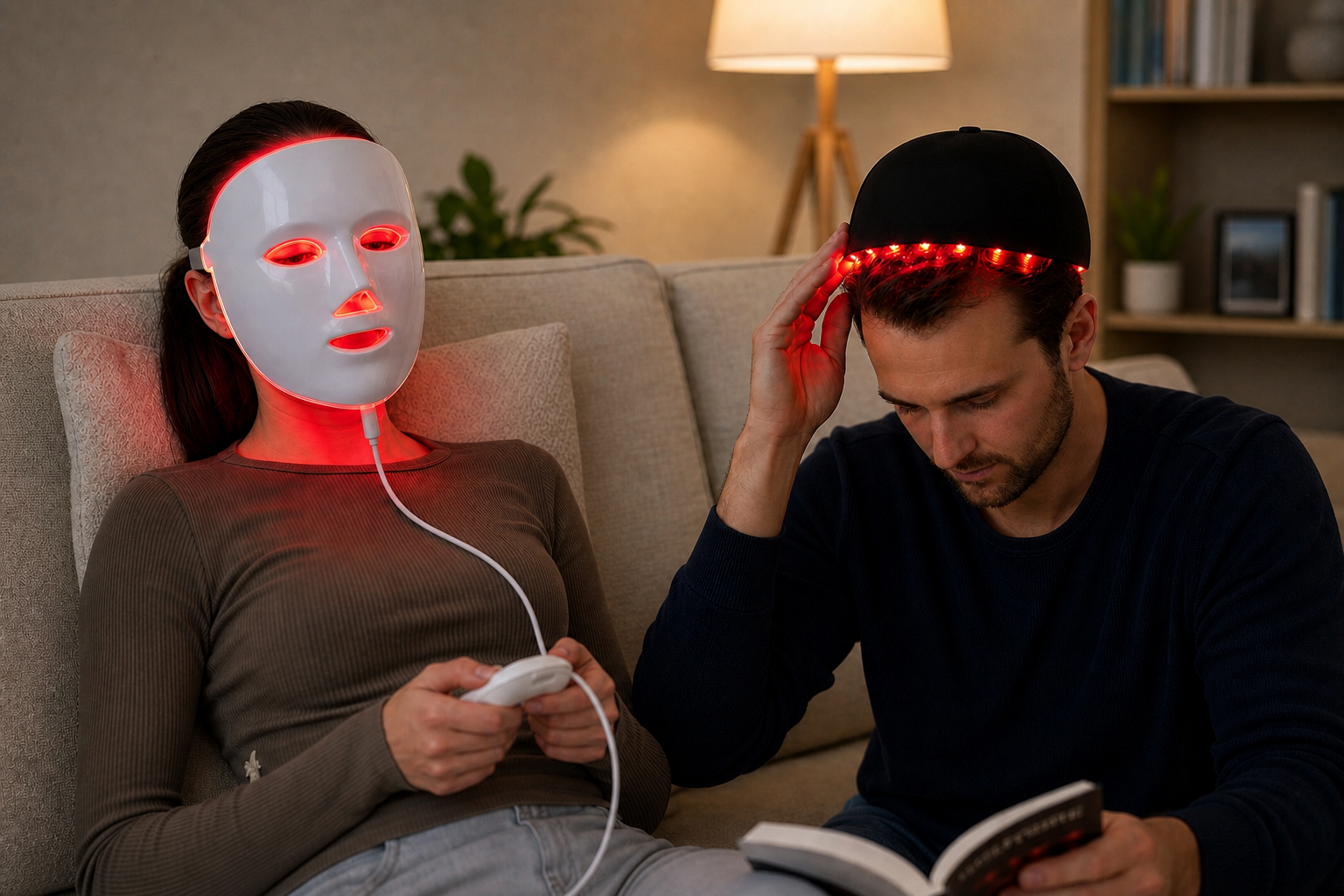
Red light therapy masks use light-emitting diodes, or LEDs, to illuminate facial skin. Many combine visible red light with invisible near-infrared light. In addition, some include blue light for acne or additional wavelengths with other advertised purposes.
Researchers often use the term photobiomodulation, abbreviated PBM. You may also encounter low-level light therapy, low-level laser therapy, or LLLT. However, an LED mask contains a different light source from a laser, even when both fall within the broader PBM literature.
Why red light therapy masks differ from other PBM devices
A flexible silicone mask, a rigid shell, a tabletop panel, and a handheld wand can all deliver light. Yet their output, beam geometry, coverage, and distance from skin can differ substantially.
The distinction becomes especially important when a seller cites a successful trial. Ask whether the researchers tested the same product, an earlier model, a professional system, or a completely different light source. Therefore, matching a wavelength alone cannot establish equivalent treatment.
The 2026 product review makes this identification problem explicit: papers sometimes omit device names, and regulatory searches may not reveal every associated trial. Therefore, evidence evaluation requires more than searching a brand name. Spongberg and colleagues, 2026.
LED therapy, lasers, IPL, and photodynamic therapy
| Technology | Basic approach | Typical context | Why the distinction matters |
|---|---|---|---|
| LED photobiomodulation | Delivers selected wavelengths at a defined exposure | Cosmetic skin care and other studied applications | Benefits depend on the specific protocol |
| Low-level laser therapy | Uses a laser source for PBM | Some scalp and clinical devices | Beam properties and eye hazards can differ |
| Intense pulsed light, or IPL | Uses filtered pulses from a broad light spectrum | Selected vascular, pigment, and other treatments | Its effects cannot automatically validate LED masks |
| Ablative laser resurfacing | Removes controlled amounts of tissue | More intensive treatment of photoaging and scars | Recovery and risk differ substantially |
| Nonablative energy treatment | Targets tissue without surface ablation | Selected rejuvenation procedures | Thermal remodeling differs from typical low-level PBM |
| Photodynamic therapy, or PDT | Combines light with a photosensitizing medication | Specific medical indications | A drug changes both mechanism and precautions |
The National Cancer Institute explanation of photodynamic therapy describes the medication-plus-light approach. Meanwhile, the AAD discussion of rosacea light treatments illustrates why professional vascular treatments require their own evidence.
Why “noninvasive” still requires judgment
Noninvasive describes how a treatment reaches the body. It does not establish effectiveness or make incorrect exposure harmless. Similarly, an absence of recovery time does not mean a product suits every skin condition.
For example, a mask can create discomfort, provoke a reaction, or direct light toward vulnerable eyes without puncturing skin. Appropriate instructions therefore remain part of the treatment itself.
How red light therapy masks may affect skin cells
The leading explanation involves cellular responses to absorbed light. Certain molecules can absorb photons and influence signaling inside cells. Researchers then study changes in energy metabolism, inflammation, repair pathways, and the extracellular matrix that supports skin.
However, a plausible cellular mechanism represents one stage of evidence. For instance, it does not tell us how much a wrinkle will change in a person wearing a particular mask.
Cellular energy and mitochondrial signaling
Mitochondria help cells make adenosine triphosphate, or ATP. PBM research often focuses on cytochrome c oxidase, an enzyme within the mitochondrial respiratory chain. In addition, proposed effects involve nitric oxide, reactive oxygen species, calcium signaling, and other light-sensitive targets.
These explanations continue to develop. In fact, a laboratory study found that a proliferative response to 660 nm light did not require functional cytochrome c oxidase. That result challenges an overly simple account in which one enzyme explains every PBM response. Lima and colleagues, 2019.
For readers, the useful conclusion is straightforward: light can influence biology, but device marketing often presents a more settled mechanism than the experiments justify.
Collagen is a relevant target, with several measurement traps
Fibroblasts produce components of the dermal matrix, including collagen. Experimental studies can examine gene expression, protein production, or tissue structure after light exposure. Clinical studies instead may assess wrinkles, firmness, or ultrasound signals.
However, those endpoints answer different questions. More collagen-related gene activity in a tissue experiment does not equal a measured percentage increase in facial collagen. Likewise, a denser ultrasound image does not directly count new collagen molecules.
A human-skin laboratory study examined collagen and elastin expression after combined red and near-infrared exposure. Its findings support biological plausibility, while the experimental setting limits direct consumer predictions. Li and colleagues, 2021.
Why more exposure can change how red light therapy masks work
PBM research often describes a biphasic dose response: increasing exposure may eventually reduce a beneficial effect or produce a different response. However, no universal curve tells every consumer where that point lies.
The relationship varies with wavelength, irradiance, tissue, timing, and the outcome under study. Therefore, doubling a session cannot reliably double the benefit. The 2026 product review emphasizes this dosing problem and the lack of standardized cosmetic protocols.
The practical lesson for red light therapy masks is to follow the tested instructions. After all, a stronger setting, an extra session, or a second device creates a new exposure pattern.
Red light therapy masks: what the wrinkle studies show
The strongest way to evaluate a cosmetic claim is to examine individual studies before combining their conclusions. First, identify the participants and comparison group. Then check the outcome and the treatment period.
The following studies help explain both the promise and the uncertainty. Their percentages use different scales, so the rows do not form a product ranking.
Clinical studies relevant to red light therapy masks
| Study | Participants and design | Light and schedule | Main finding | Key limitation |
|---|---|---|---|---|
| Lee, 2007 | 76 participants; randomized, sham-controlled, split-face study | 633 nm, 830 nm, combinations, or sham; twice weekly for 4 weeks | Reported maximum wrinkle reduction of 36% and elasticity increase of 19% | Professional study settings; maxima are not average expectations for masks |
| Wunsch and Matuschka, 2014 | 136 volunteers; 113 treated and 23 untreated controls | Polychromatic light; 30 sessions | Improved roughness, photographic assessments, and ultrasound collagen-density measures | Used gas-discharge light systems; no treatment in the control group |
| Mota, 2023 | 137 women; randomized comparison of two active wavelengths on opposite sides | Red 660 nm and amber 590 nm; 10 sessions | Wrinkle volume decreased 31.6% and 29.9%, respectively | No untreated or sham side; hydration and viscoelasticity did not improve |
| Couturaud, 2023 | 20 volunteers; uncontrolled home-mask study | Approximately 630 nm; 12 minutes twice weekly for 84 days | Reported progressive improvements in several cosmetic measurements | Small sample, commercial affiliations, and reporting inconsistencies |
| Park, 2025 | 60 enrolled; 59 in the full analysis; randomized home-mask trial | 630 nm plus 850 nm; 9 minutes, 5 times weekly for 12 weeks | At week 12, 25/29 active-device users and 5/30 controls improved at least one wrinkle grade | Small, manufacturer-funded trial; participant-rated global improvement did not clearly separate groups |
Sources: Lee, 2007; Wunsch and Matuschka, 2014; Mota, 2023; Couturaud, 2023; Park, 2025.
What the recent home-mask trial adds
The Park trial matters because participants used a consumer-style mask at home and had a comparison device. Specifically, the sham emitted weaker red light and no near-infrared light. Consequently, the trial compared two defined exposures rather than treatment against complete inactivity.
The week-12 responder difference was approximately 69.5 percentage points. However, a responder needed a decrease of at least one grade on a wrinkle scale. The result does not mean wrinkles disappeared by 86.2%.
The methods specify 12 weeks of treatment followed by four weeks of observation. Although the abstract describes 16 weeks loosely, week 16 was a follow-up. The authors also reported no significant group difference in participant-rated global improvement. Park and colleagues, 2025.
Why the famous 136-person study needs context
The Wunsch study frequently appears in articles about LED masks. Yet the researchers tested large-area systems using gas-discharge lamps. Those results contribute to PBM research, while their relevance to a small wearable LED mask remains indirect.
In addition, the study used 30 sessions, which is different from promising results after 30 days. Its broader spectrum did not show a clear advantage over the red-light spectrum. Wunsch and Matuschka, 2014.
This example shows why the phrase “clinically proven wavelengths” needs qualification. A manufacturer can choose familiar wavelengths without reproducing the exposure or trial conditions behind the citation.
Reading the 2023 luxury-mask study carefully
The Couturaud paper reported a 38.3% decrease in measured crow’s-feet depth and a 47.7% increase in ultrasound dermal density at day 84. However, it had no control group and included only 20 people.
Its abstract describes 20 women, whereas the methods describe 15 women and five men. Authors also had affiliations with Dior and Lucibel. Nevertheless, those details do not automatically invalidate the measurements, but they reduce confidence in broad conclusions. Couturaud and colleagues, 2023.
Most importantly, dermal density is not a direct measurement of collagen quantity. Claims that this study proves a particular percentage of “new collagen” go beyond its endpoint.
What do the percentages actually mean?
Beauty research uses several kinds of percentages. Unfortunately, advertising often removes the denominator, the comparison, or the measurement method. As a result, numbers that look similar can describe very different benefits.
Before comparing red light therapy masks, translate the claim into plain language.
A guide to common research numbers
| Wording | What it can mean | What you still need to know |
|---|---|---|
| “86% improved” | The proportion meeting a defined response threshold | The threshold, timing, and control response |
| “30% fewer wrinkles” | A change in a measured count, depth, volume, or score | Which measurement and whether the result exceeds control |
| “100% satisfied” | Everyone in a sample gave a favorable questionnaire answer | Sample size, question wording, blinding, and sponsorship |
| “47% higher density” | A change in a device-generated tissue metric | Whether the metric directly measures the claimed biology |
| “Statistically significant” | The analysis met a prespecified statistical threshold | Effect size, uncertainty, and practical importance |
| “Up to 36%” | A maximum or selected result | The average, range, and number of people benefiting |
| “No serious adverse events” | The study did not observe that category of harm | Sample size, duration, surveillance, and mild events |
Percentage points versus percent improvement
Suppose 80% of one group improves and 20% of another group improves. The difference is 60 percentage points. That number describes a difference in response rates; it says nothing about how deep an individual wrinkle became.
Similarly, a wrinkle-volume decrease is different from a satisfaction rate. Comparing the two as though they measure the same benefit can make a weak result look stronger than it is.
The same caution applies to red light therapy masks advertised with multiple outcomes. A study can succeed on one measure while showing little change on another.
Why within-group improvement is insufficient
Skin can change during a study for several reasons. Participants may moisturize more regularly, avoid sunlight, or follow instructions more carefully. In addition, natural fluctuation and measurement variability can contribute.
A control group helps estimate those changes. Therefore, the question is usually whether treatment performs better than its comparator, with enough precision to make the difference believable.
An uncontrolled study can still identify a useful signal. However, its results should guide further testing rather than serve as a final verdict for every buyer.
Red light therapy masks for acne
Some home light devices can reduce acne lesions. However, the acne category includes red-only, blue-only, and combined systems, and their evidence should remain distinct.
Acne also involves several processes: follicular plugging, oil production, inflammation, and the activity of Cutibacterium acnes. Consequently, a treatment that affects one process may leave others insufficiently controlled.
Why many acne masks combine blue and red light
Blue light can interact with porphyrins associated with C. acnes, producing a photochemical response. Red light has a different proposed contribution, including modulation of inflammation. Therefore, a combination can have a rationale beyond adding another attractive color.
A randomized Korean trial assigned 35 participants to a home blue-red device or sham treatment. At the final 12-week visit, the treatment group showed reported decreases of 77% in inflammatory lesions and 54% in noninflammatory lesions. However, the sample was small and the result applies to its particular protocol. Kwon and colleagues, 2013.
This finding should not turn every anti-aging mask into an acne recommendation. Instead, check the device’s intended use, since a red-plus-infrared product may have a different purpose and instructions.
What the 2025 acne meta-analysis found
Ershadi and Barbieri combined six randomized studies covering 216 participants with mild to moderate acne. The included devices used red and/or blue light, with substantial differences in protocols.
| Outcome | Reported pooled advantage over control in percent change | 95% confidence interval | Studies contributing |
|---|---|---|---|
| Inflammatory lesions | 45.3% | 25.1% to 65.5% | 5 |
| Noninflammatory lesions | 47.7% | 18.0% to 77.4% | 4 |
| Investigator Global Assessment | 45.7% | 29.1% to 62.4% | 4 |
These figures summarize differences in percentage-change outcomes. They are not clearance rates or a forecast for a specific buyer. Moreover, heterogeneity was particularly high for noninflammatory lesions, with I² of about 83%. Ershadi and Barbieri, 2025.
A closer look at the 2016 acne-mask study
The Nestor trial enrolled 105 people, with 35 in each treatment group. It compared a 445 nm blue/630 nm red mask, 2.5% benzoyl peroxide, and the mask with a salicylic-acid/retinol regimen. Participants used the mask for 15 minutes daily, and 92 completed the trial.
The table below uses the paper’s reported mean percentage improvements at week 12. However, these values should not be recalculated from the displayed group-average lesion counts, because averages of individual percentage changes can differ from changes in group means.
| Week-12 outcome | Mask alone | Benzoyl peroxide | Mask plus salicylic acid/retinol |
|---|---|---|---|
| Inflammatory lesions | 24.4% improvement | 17.2% improvement | 22.7% improvement |
| Noninflammatory lesions | 19.5% improvement | 6.3% improvement | 4.8% improvement |
| Total lesions | 22.8% improvement | 11.4% improvement | 15.3% improvement |
| Investigator Global Assessment | 19.0% improvement | 4.7% improvement | 13.9% improvement |
Source: Nestor and colleagues, 2016.
The chart compares the paper’s reported mean improvements. However, numerical differences alone do not establish that one regimen outperforms another statistically.
What that comparison can and cannot establish
The mask-alone group had the largest reported numerical improvement on these outcomes. Nevertheless, within-group statistical significance does not establish superiority over every alternative. The study also lacked a sham-mask group and disclosed manufacturer support.
Attrition deserves attention as well. At week 12, the table includes 27 mask-only participants, 33 benzoyl-peroxide participants, and 32 combination participants. Consequently, different follow-up numbers can influence the apparent results.
Another useful lesson concerns combination care. Adding a topical regimen did not automatically improve every outcome in this trial. However, that finding does not justify a blanket claim that acne medicines interfere with light. The particular products, adherence, irritation, and study design all matter. Nestor and colleagues, 2016.
Why dermatology guidelines remain cautious
The 2024 AAD acne guidelines found insufficient evidence to make recommendations for several procedures, including laser and light-based devices. Meanwhile, they supported established topical and systemic options for appropriate patients. AAD acne guideline announcement.
The newer positive meta-analysis does not make that earlier guideline irrational. Its scope is narrower, and it appeared later. Similarly, the older Cochrane review covered 71 studies and 4,211 participants, but combined a much broader range of light interventions with major evidence limitations. Cochrane review.
A sensible interpretation is that selected home devices may help, while uncertainty remains about optimal protocols and comparison with standard treatment.
When acne needs more than a mask
Painful nodules, developing scars, extensive acne, and major emotional distress deserve timely clinical care. Therefore, a consumer device should not delay that assessment. Likewise, persistent bumps may represent a condition other than acne.
For a person already receiving treatment, the next question is compatibility. Specifically, ask the clinician whether the exact device and regimen fit the plan. Because drug labels and mask instructions can differ, avoid assembling a combination from unrelated online routines.
Red light therapy masks are most useful when the target is clear. Photographing comparable areas and recording irritation can help determine whether an addition is worthwhile.
Red light therapy masks for rosacea and redness
Rosacea creates a difficult marketing environment because “redness” describes several different problems. A person may have persistent vessels, flushing, inflammatory bumps, eye symptoms, or irritation from skin care. Therefore, a general promise to calm redness may miss the main cause.
Promising mechanisms need stronger human confirmation
Laboratory work has explored PBM effects on inflammatory pathways in rosacea-like models. For example, researchers observed changes in inflammation and vascular markers in experimental systems. However, a mouse model cannot establish that a retail face mask treats human rosacea. Experimental rosacea study, 2022.
A 2025 review considered possible applications but also called attention to the need for better clinical evidence. Thus, red light therapy masks remain a cautious, individualized consideration in this setting. Rosacea PBM review.
Visible vessels require a different discussion
Dermatologists use specific lasers and light treatments for visible blood vessels and persistent rosacea redness. Those technologies target a different therapeutic problem from the usual home PBM routine. Consequently, results from vascular laser treatment should not appear as proof that a red LED mask removes broken capillaries.
The AAD explains how treatment selection depends on the feature of rosacea that needs attention. Some patients also need medications and a gentle skin-care plan. AAD rosacea diagnosis and treatment.
Heat and comfort matter more than a “calming” label
If a device makes the face noticeably hot or repeatedly worsens flushing, that experience deserves attention. Do not assume every reaction represents a beneficial adjustment period. Instead, stop and reassess the device with a clinician.
Because rosacea can affect the eyes, burning or gritty eyes require particular care. After all, a mask marketed for facial redness cannot diagnose the source of ocular symptoms.
A practical trial, when appropriate, should keep other products stable. Otherwise, changes in cleanser, acids, weather exposure, and light use can become impossible to separate.
Red light therapy masks, melasma, and dark spots
Dark spots are another area where claims can run ahead of evidence. Pigmentation after acne, melasma, sun spots, and an unexplained changing lesion have different implications. Therefore, identifying the condition comes before choosing a light color.
Visible light can worsen some pigmentation
The AAD advises people with melasma to protect against visible sunlight, including with tinted sunscreen containing iron oxides. However, a finding about visible sunlight does not mean every red-light device produces the same exposure or effect. AAD melasma guidance.
The concern remains relevant because people with pigment-prone skin need evidence that reflects their skin type and condition. For example, a general “suitable for all skin tones” statement provides less information than a trial reporting actual enrollment and pigment outcomes.
Skin tone representation in trials
| Study example | Reported representation | What remains uncertain |
|---|---|---|
| Park home-mask trial | Asian participants with Fitzpatrick types II to V | Results across other populations and type VI |
| Mota active-wavelength trial | Women with Fitzpatrick types II to IV | Generalization to darker phototypes and men |
| Nestor acne-mask trial | Fitzpatrick types I to VI | Subgroup precision in a small trial |
| Scuderi dry-eye cohort | 20 postmenopausal women | Generalization across sex, age, and ocular conditions |
Sources: Park, Mota, Nestor, and Scuderi.
Why a tone claim does not prove melasma treatment
A participant saying their complexion looks brighter is a subjective outcome. A dermatologist diagnosing and measuring melasma uses a different clinical framework. Similarly, an improvement in overall color uniformity cannot establish treatment of every kind of dark spot.
For this reason, avoid buying red light therapy masks primarily to treat an undiagnosed pigment problem. A dermatologist can distinguish cosmetic discoloration from a lesion that needs closer examination.
If new pigmentation develops during use, stop and document it. After all, continuing longer to “push through” a pigment reaction has no established rationale.
Can red light therapy masks tighten skin?
Some studies report better firmness, elasticity, or wrinkle scores. Yet these changes do not automatically mean a visibly lifted jawline. Different tissue layers contribute to the shape of a face, so one measurement cannot describe them all.
Surface lines and structural laxity
Fine surface lines may respond to changes in skin quality. In contrast, pronounced laxity can involve deeper support, tissue volume, and anatomy. Therefore, a small shift on a firmness instrument cannot establish the same change as a procedure designed to reposition tissue.
When evaluating red light therapy masks, define the outcome in the mirror. Are you hoping for less roughness, softer crow’s feet, a tighter jawline, or reduced fullness under the chin? Those goals need different evidence.
The distinction can prevent disappointment. For example, someone might obtain smoother skin while seeing little change in the outline of the lower face.
How long does red light take to tighten skin?
There is no reliable universal deadline. Clinical research has evaluated different changes at checkpoints spanning several weeks to a few months. Moreover, the studies use specific devices and often measure subtle effects.
A reasonable way to assess a labeled cosmetic course is to choose a review date that matches its instructions. Then compare standardized photographs and the concern you identified at the start. Avoid assuming that extra exposure will accelerate remodeling.
The most useful question at review is whether the change matters to you. A statistically favorable trial can still describe an improvement that some people find too small for the cost.
Red light therapy masks for neck wrinkles
The neck deserves its own evidence discussion. Facial studies cannot establish how well a collar treats horizontal neck lines, chest texture, or loose neck skin. Nevertheless, the overlap in skin biology provides a reason to investigate those uses.
What neck-device claims should demonstrate
A convincing neck study would report the exact device, treated area, comparison group, and outcome. It would also separate texture improvement from line depth and skin laxity. In addition, standardized positioning matters because neck extension can change how a crease looks.
The same problem affects before-and-after photos. For instance, raising the chin, altering light direction, or changing shoulder position can make neck folds look smaller without a treatment effect.
Consequently, red light therapy masks designed for the face should not automatically be repositioned over the neck. A dedicated product may have different contact geometry and instructions.
Newer neck evidence remains product-specific
ClinicalTrials.gov lists a 12-week study of an LED face mask and neck/chest mask with a single-group design. Registration makes the research traceable, but it does not itself establish a favorable result. Registered neck-and-face study.
Manufacturers also publish testing reports for neck products. These can provide useful details, although a commercial report and a peer-reviewed controlled trial carry different evidentiary weight.
The practical conclusion remains measured: a collar may be a reasonable cosmetic option for selected users, but dramatic correction of deep lines or laxity needs stronger support.
What about the thyroid?
The front of the neck contains the thyroid, which makes broad safety statements inappropriate. Research on targeted low-level laser treatment has investigated thyroid function itself. Those medical protocols differ from cosmetic neck-device exposure. Höfling and colleagues, follow-up study.
Therefore, neither “light never affects the thyroid” nor “every neck device harms it” follows from the available evidence. Follow the device’s intended placement and exclusions. A person with thyroid disease, nodules, prior thyroid treatment, or an unexplained neck lump should discuss use with their clinician.
Ultimately, a cosmetic wrinkle goal does not justify experimenting with a thyroid-treatment protocol.
Red light therapy masks for under-eye bags and dark circles
The eye area attracts some of the broadest promises in beauty technology. However, crow’s feet, puffiness, dark circles, and dry eye are separate concerns. A study addressing one cannot settle the others.
Match the treatment to the actual concern
| Concern | What may contribute | Relevance of mask evidence |
|---|---|---|
| Crow’s feet | Skin aging and repeated facial movement | Some trials measure these wrinkles directly |
| Temporary puffiness | Fluid retention, sleep changes, or allergy | Limited evidence that ordinary PBM masks address the cause |
| Persistent under-eye bags | Changes in supporting tissues and protruding fat | Wrinkle studies do not establish correction |
| Brown discoloration | Pigmentation and other skin factors | Requires a pigment-specific assessment |
| Shadowing below the eye | Facial contours or tissue volume | Surface wrinkle improvement may leave the shadow unchanged |
| Burning or gritty eyes | Possible ocular-surface disease | Requires an eye-health assessment |
Mayo Clinic explains that under-eye bags can involve weakened support, displaced fat, and accumulated fluid. Therefore, a device that changes skin texture may leave the main anatomical cause intact. Mayo Clinic: bags under eyes.
Why a cooling feature complicates the claim
Some masks combine LEDs with cooling near the eyes. If puffiness changes after use, the cooling component may contribute. Consequently, the result cannot automatically be attributed to red light.
The same reasoning applies to vibration, massage, electrical stimulation, and a supplied serum. A combined product requires a study capable of separating its components if a brand wants to identify which one caused the benefit.
For red light therapy masks, this is a useful shopping question: did the trial test the complete product, and did it isolate the effect advertised?
Do not move LEDs closer to the eyes
Attempts to reach a crease by shifting a mask can change the exposure reaching the eye. Therefore, keep the device in its intended position and use its specified protection. Likewise, do not remove shields to illuminate more skin.
If eyelid swelling comes with pain, significant redness, or visual symptoms, seek clinical assessment. A cosmetic experiment can otherwise delay recognition of an eye problem.
Can red light therapy masks help dry eye?
A paper published on August 29, 2026 examined a commercial cosmetic mask in women with dry eye disease and meibomian gland dysfunction. It is directly relevant to the question, although its design places strong limits on what we can conclude.
Dry eye can involve tear-film instability and problems with the oil-producing meibomian glands. However, improving an ocular-surface measurement is different from improving retinal function or correcting eyesight.
What the 2026 study actually did
Researchers retrospectively examined 20 postmenopausal women, with one eye per person included in the analysis. Their mean age was 63.4 years. Participants already used a Koled beauty mask for cosmetic purposes.
The reported course involved 11 planned sessions over three weeks, followed by an assessment two weeks after treatment ended. The paper describes a red-light mode at 630 nm and states that the device also keeps 850 nm near-infrared illumination active in its modes. Therefore, describing the exposure as isolated red light would be incomplete.
The investigators reported 219 of 220 planned sessions completed. However, adherence depended on participant reporting. They did not randomize patients, provide a sham device, or include an untreated comparison group. Scuderi and colleagues, 2026.
The reported dry-eye measurements
The following table uses the means in the paper’s Table 3. Baseline discrepancies elsewhere in the article require caution, as explained immediately below.
| Outcome | Baseline | After 3 weeks | Two weeks after treatment ended | Reported overall P value |
|---|---|---|---|---|
| Tear osmolarity, mOsm/L | 314.8 | 286.9 | 287.3 | <0.001 |
| Tear break-up time, seconds | 7.6 | 10.4 | 10.3 | 0.001 |
| OSDI symptom score, 0–100 | 17.0 | 10.6 | 8.8 | <0.001 |
| Schirmer I test, mm over 5 minutes | 20.6 | 21.2 | 17.8 | 0.29 |
OSDI stands for Ocular Surface Disease Index; lower scores indicate fewer symptoms. Tear break-up time measures tear-film stability, while the Schirmer test assesses tear production. Thus, these measurements describe different aspects of the ocular surface. Scuderi and colleagues, Table 3.
The chart follows Table 3 and shows means with standard deviations. However, the absence of a control group prevents a causal conclusion.
Reporting problems and other limitations
Table 2 gives different baseline means for OSDI and osmolarity: 19.3 and 312, respectively. By comparison, Table 3 gives 17.0 and 314.8. Its final visit heading also differs from the visit label in the methods. Consequently, the safest approach is to identify the source table and avoid mixing values.
The study reported no significant change in the Schirmer test. Four eyes also produced osmolarity readings below the measurable range, creating a potential measurement-floor issue. Meanwhile, the absence of a control group leaves natural variation, expectations, and other influences unresolved.
No participant reported discomfort or an adverse event. Nevertheless, 20 people followed for a short period cannot establish long-term eye safety. The findings justify controlled investigation, while broader clinical recommendations require stronger evidence. Scuderi and colleagues, 2026.
Why this study does not prove better eyesight
All included eyes had 20/20 best-corrected visual acuity at baseline. The study’s main outcomes concerned tears and symptoms. Therefore, it cannot support a headline claiming that cosmetic red light therapy masks restore lost vision.
It also does not establish that any mask sold online can treat dry eye. The device, participant selection, follow-up, and optical exposure all matter.
If you already have dry eye, bring the specific paper and device instructions to your eye-care professional. They can assess whether the evidence applies to your condition and whether an established treatment needs adjustment.
Red light therapy masks and vision: separate the evidence
The eye-health literature covers several distinct research programs. Some investigate color sensitivity in adults without diagnosed eye disease. Others study myopia in children or vision loss from dry age-related macular degeneration.
Combining them into a general promise of “better eyes” hides the clinical differences. The table below keeps their targets separate.
Four very different eye-related applications
| Research area | Main target | Relevant outcome | What it cannot establish |
|---|---|---|---|
| Cosmetic eye-area treatment | Skin around the eye | Wrinkle grade or skin texture | Treatment of an eye disease |
| Dry-eye PBM | Ocular surface and related glands | Symptoms and tear-film measures | Correction of refractive error |
| Myopia research | Progression of nearsightedness | Axial growth and refractive change | Safety of a cosmetic mask |
| Retinal PBM | Selected retinal conditions | Visual acuity or other retinal outcomes | A general home treatment for healthy eyes |
The small study behind “17% better vision”
UCL researchers reported an average improvement of about 17% in color-contrast sensitivity after a defined deep-red exposure in a small experiment. The morning group included 20 adults, and a subset returned for testing a week later.
However, color-contrast sensitivity is a specific visual function. A 17% improvement on that test does not mean a 17% reduction in an eyeglass prescription or reversal of an eye disease. Nor did the experiment test a general-purpose beauty mask. UCL research report, 2021.
The result is scientifically interesting. It also illustrates why an accurate endpoint matters more than an exciting percentage.
An FDA-authorized eye device is a different category
The FDA granted De Novo authorization for the Valeda Light Delivery System on November 4, 2024. Its prescription indication covers selected patients with dry age-related macular degeneration and specified visual-acuity and retinal findings. FDA authorization record.
The system uses 590 nm, 660 nm, and 850 nm light under a defined clinical protocol. The FDA review also describes exclusions, precautions, and limits to generalizability. Consequently, its authorization does not extend to consumer face masks or all causes of vision loss. FDA Valeda review.
What newer myopia-device safety research found
A 2026 laboratory evaluation tested four devices marketed for myopia. Two laser-based instruments reached the evaluated ANSI group-1 exposure limits within 2.8 seconds and 1.4 seconds, respectively, under the specified 7 mm pupil condition. Those times were shorter than their typical 180-second treatment exposure.
The LED-based instrument had a very different optical result. Therefore, the study reinforces the importance of beam characteristics and independent testing. Crossing a modeled safety limit also does not prove that every exposed patient sustains an injury. Ostrin and Schill, 2026.
These devices are distinct from red light therapy masks. The transferable lesson is to evaluate actual optical safety, rather than assume that the word “red” guarantees it.
Are red light therapy masks dangerous for the eyes?
Risk depends on the spectrum, exposure, device geometry, instructions, and the person using it. Blue light deserves particular attention, but neither red nor near-infrared light permits unlimited direct viewing.
A published retinal-injury case
A 2020 case report described a 37-year-old woman who developed distorted vision after using a mask that included blue light. She reported keeping her eyes open during use. Imaging showed a localized retinal abnormality, although her measured visual acuity was 20/20.
This report cannot estimate how often injuries occur or prove that every mask carries the same risk. However, it demonstrates why visual symptoms and eye protection deserve attention. Normal reading-chart acuity also does not exclude every retinal problem. Kim and colleagues, 2020.
What the Neutrogena recall tells us
In 2019, Australia’s Therapeutic Goods Administration announced the recall of the Neutrogena Visibly Clear Light Therapy Acne Mask and Activator. The notice identified potential retinal risk in a susceptible subset of people, including those with certain eye disorders. TGA recall notice.
A recall of one product does not establish that the whole category is unsafe. Nevertheless, it shows that regulatory status and positive efficacy reports do not remove the need for ongoing safety monitoring.
When buying used red light therapy masks, check the exact model and any recall history. An old positive review can remain online long after a safety notice.
Practical eye precautions
Follow the exact device’s instructions about shielding, eye position, and placement. If the manual requires protective goggles, use the specified kind every time. The AAD explicitly advises against substituting sunglasses for required protective goggles. AAD home-use precautions.
Do not stare into LEDs or assume closed eyelids provide equivalent protection for every device. Likewise, never remove protection to pursue an eye-health claim.
People with an eye disorder, prior relevant surgery, or unexplained visual symptoms should ask an eye-care professional about the specific device. A seller’s general reassurance cannot evaluate an individual retina.
Symptoms that should stop a session
Stop use if you develop eye pain, persistent visual spots, distorted vision, unexpected light sensitivity, or blurred vision. Arrange prompt eye assessment for persistent symptoms. Sudden vision loss or a new curtain-like shadow requires urgent care. National Eye Institute warning signs.
Because exposure details can help the clinician, keep the model name, treatment mode, and session history. Do not repeat the exposure to see whether the symptom happens again.
The goal is a cosmetic benefit that fits safely into your life. Any new visual problem changes that calculation immediately.
Red light therapy masks: side effects and precautions
Studies often report favorable short-term tolerance. However, the available research cannot provide a single reliable adverse-event rate for every mask. Products and exposure patterns vary too much.
Skin reactions that deserve attention
Possible problems include transient redness, dryness, discomfort, and irritation. Higher experimental exposures have also produced blistering and prolonged redness. Therefore, a painful or worsening response should not be treated as proof that the device is working.
Two dose-escalation trials enrolled 60 and 55 participants to study high-fluence red light on the forearm. Dose-limiting reactions occurred at 480 J/cm² in one trial and 640 J/cm² in the other. These research exposures are not recommended doses for home masks. Jagdeo and colleagues, 2020.
The experiments also identified differences in tolerance across skin groups. Consequently, a single universal safety threshold would oversimplify the results.
Who should obtain individual advice first?
| Situation | Why it matters | Useful next step |
|---|---|---|
| Photosensitive disease | Light can interact with the condition | Ask the treating clinician about the exact spectrum |
| A medication or supplement with photosensitivity warnings | Risk depends on the substance and wavelength | Review the drug and device instructions with a pharmacist or clinician |
| Melasma or frequent post-inflammatory pigmentation | Pigment responses may complicate treatment | Ask a dermatologist about suitability and monitoring |
| Known eye disease or persistent ocular symptoms | Eye vulnerability differs between people | Obtain device-specific eye-care advice |
| Pregnancy or breastfeeding | Direct cosmetic-device evidence is limited | Follow the device exclusions and ask your clinician |
| A changing mole, suspicious lesion, or active cancer treatment | The area may require diagnosis or specialist guidance | Obtain assessment before illuminating it |
| Light-triggered migraine or seizures | Flashing modes or light exposure may be relevant | Review the manual and your medical history |
| Recent skin procedure | Barrier recovery and treatment plans vary | Ask the professional who performed the procedure |
| Childhood or adolescence | Age indications differ by product | Check age labeling and seek appropriate clinical guidance |
This table combines the issues emphasized in the 2026 product review, the AAD guidance, and published device instructions. It does not imply that every listed situation carries the same risk.
Medication warnings require more than a generic list
“Photosensitivity” can involve different wavelengths and mechanisms. Therefore, a warning about sunlight does not establish an identical response to every red-light device. Conversely, it does not justify ignoring a mask’s medication exclusions.
Bring the actual medication list and exact device name to a pharmacist or clinician. Include supplements and topical treatments as well as prescriptions. Because formulations and doses differ, a short social-media list cannot resolve compatibility.
Do not stop a prescribed medicine simply to use a cosmetic device. The treatment decision should reflect the importance of the medicine and the likely benefit of the mask.
Pregnancy is an evidence gap
The absence of ultraviolet radiation does not provide pregnancy-specific safety data. Most cosmetic trials do not establish safety during pregnancy or breastfeeding. Accordingly, manufacturers may exclude these groups from use.
Check the current manual for the exact model. If it advises against use, a general statement that LEDs are gentle does not override that instruction.
This is also a reminder that a product can be low risk for a studied population while remaining insufficiently studied in another.
Cancer claims need careful wording
Red light differs physically from ultraviolet radiation. A laboratory study found no DNA damage in human dermal fibroblasts under its tested red-light conditions. However, that result does not prove lifetime safety for every exposure or answer every question about existing tumors. Wang and colleagues, 2022.
Medical PBM research also includes supportive-care applications in oncology. Those uses require their own protocols and clinical oversight. A systematic review examined oncologic safety across varied models and settings, illustrating why context matters. Oncologic safety review.
Do not use a cosmetic mask to treat a suspicious lesion. A changing, bleeding, or nonhealing spot needs assessment.
Why “no adverse events” is not a guarantee
Imagine a hypothetical side effect that occurs in 1% of users. A study of 20 independent users would still have about an 81.8% chance of observing zero cases. The calculation is 0.99 raised to the twentieth power.
This is an illustrative probability, not an estimate of mask risk. It shows why a small study can miss an uncommon problem even when researchers monitor carefully.
As a result, long-term follow-up, independent replication, and post-market reports remain valuable. Red light therapy masks deserve the same distinction between encouraging short-term findings and proven long-term safety as other devices.
Do red light therapy masks work for hair growth?
Dedicated scalp devices have evidence for pattern hair loss. Yet the location and delivery of light remain central. A facial device does not reproduce a scalp treatment simply because both use red light.
What a major hair-device trial found
A multicenter research program randomized 269 men and women to lasercomb or sham devices. Participants treated the scalp for 26 weeks, and 225 contributed to the efficacy analysis after losses to follow-up.
The active-device groups showed reported mean terminal-hair increases of approximately 18.4 to 25.7 hairs/cm², depending on the group. However, these are within-group changes, and the trial compared specific scalp devices against sham devices. Jimenez and colleagues, 2014.
The finding supports a discussion of appropriately selected scalp therapy. It does not establish treatment of every cause of hair loss or predict a result from red light therapy masks.
Face masks cannot answer beard or eyebrow questions
Beard density, eyebrow thinning, and scalp pattern hair loss have different causes and treatment goals. Consequently, evidence from one site cannot automatically settle another.
For example, hair can obstruct the path of light to the scalp. Device design may address that issue through comb teeth, contact geometry, or other features. A facial mask has different coverage constraints.
If unwanted facial hair is a concern, ask the manufacturer what its trials actually measured. At present, wrinkle studies do not provide a reliable probability of beard or facial-hair changes.
Hair loss needs a diagnosis
Sudden shedding, patchy loss, scalp inflammation, and progressive pattern thinning require different assessments. Buying a device before understanding the cause can waste time and money.
A dermatologist can discuss whether a dedicated light device has a role alongside other options. Because hair growth changes slowly, consistency and an appropriate review interval matter.
The useful principle is the same as for skin: match the device, body site, and condition to the evidence.
Wavelengths in red light therapy masks
Wavelength describes light in nanometers, abbreviated nm. It helps characterize the exposure, but it does not describe how much light reaches the tissue. Therefore, wavelength is necessary information rather than a complete treatment specification.
Red, near-infrared, blue, and other colors
| Light category | Examples in the studies or products discussed | Main research or marketing context | Important qualification |
|---|---|---|---|
| Blue | 414–445 nm in the 2025 acne review | Acne devices | Different optical safety and pigment considerations |
| Amber | 590 nm in the Mota trial | Cosmetic skin research | Evidence remains protocol-specific |
| Red | 630, 633, and 660 nm | Wrinkles, acne combinations, and other PBM research | Wavelength alone cannot establish efficacy |
| Near-infrared | 830 and 850 nm | Combined cosmetic and medical PBM | Invisible output still contributes exposure |
| Longer near-infrared | 1072 nm in certain newer masks | Additional advertised tissue targeting | A larger wavelength number does not prove superior results |
| Green or mixed-color modes | Varies by manufacturer | Tone, redness, or general cosmetic claims | Request direct evidence for the exact mode |
The examples come from the studies already discussed and current CurrentBody product specifications. They do not define a universal prescription.
Does deeper penetration mean better results?
Longer wavelengths can behave differently in tissue because absorption and scattering change across the spectrum. However, deeper penetration does not automatically improve a superficial skin concern. The target, absorbed dose, and tissue response still matter.
Simple marketing diagrams often assign each color to one precise anatomical layer. Real tissue is less tidy: light scatters, different molecules absorb it, and intensity falls with depth. The 2026 product review discusses wavelength and dose while acknowledging the lack of standardization.
When comparing red light therapy masks, ask for outcome data instead of treating penetration depth as the final score.
Are multiple colors automatically better?
Each added mode should serve a clear purpose. A person with a fine-line goal may not need an acne mode, while someone with acne may need a device specifically tested for it.
Furthermore, a combination trial cannot always identify the contribution of each wavelength. A design that directly compares modes would answer that question more convincingly.
The same applies to newer near-infrared wavelengths. They may be worth studying, but the number of colors or wavelengths does not establish a product hierarchy.
Understanding the dose of red light therapy masks
Two masks can use the same wavelengths while delivering different exposures. Irradiance, duration, distance, coverage, and pulsing all influence the dose. As a result, a treatment time copied from another device may be inappropriate.
Specifications to check in red light therapy masks
| Specification | Common unit | What it describes | Useful question |
|---|---|---|---|
| Wavelength | nm | The light spectrum | Which wavelengths operate in this mode? |
| Irradiance | mW/cm² | Optical power reaching an area | At what distance and measurement location? |
| Radiant exposure, often called fluence | J/cm² | Energy delivered per area over time | Is the figure per wavelength or combined? |
| Duration | Seconds or minutes | Exposure time | Does the timer match the studied protocol? |
| Duty cycle | % | Fraction of time a pulsed source is on | Is quoted irradiance peak or time-averaged? |
| Coverage | Area or an exposure map | Distribution across the intended surface | Are cheeks, forehead, and edges comparable? |
| Electrical power | W | Power consumed by the device | Is this being confused with optical output? |
| LED count | Number | Emitters or chips | Does the count include multiple chips in one package? |
These distinctions follow the dosing discussion in the 2026 product guide. Importantly, wall-plug wattage and the number of LEDs cannot substitute for measured irradiance.
A simple dose calculation
For constant irradiance, radiant exposure equals irradiance in watts per square centimeter multiplied by time in seconds. To convert mW to W, divide by 1,000.
Illustrative example: 30 mW/cm² equals 0.030 W/cm². Over 600 seconds, the surface exposure would be 18 J/cm².
| Hypothetical irradiance | Hypothetical duration | Calculated surface exposure |
|---|---|---|
| 10 mW/cm² | 10 minutes | 6 J/cm² |
| 20 mW/cm² | 10 minutes | 12 J/cm² |
| 30 mW/cm² | 10 minutes | 18 J/cm² |
| 30 mW/cm² | 20 minutes | 36 J/cm² |
These are arithmetic examples, not recommended doses. They assume a constant measured output at the surface and do not calculate energy absorbed by the target tissue.
Equal joules do not guarantee equal effects
A short high-intensity exposure and a longer low-intensity exposure can deliver the same arithmetic total. Nevertheless, tissue may respond differently because biology also depends on the rate and timing of delivery.
Likewise, a quoted total may combine several wavelengths. Two products with equal combined irradiance could allocate very different amounts to red and near-infrared light.
For red light therapy masks, the strongest reassurance is a relevant trial using the actual device and schedule. A generic dose range cannot reproduce all of those conditions.
Distance and measurement quality
Moving farther from a source usually changes the light reaching the skin. However, a large panel contains many emitters, so a simple point-source distance rule may not accurately describe close-range exposure.
A useful specification therefore states where and how the manufacturer measured output. An isolated peak reading at the center provides less information than a map across the treatment area.
Consumer light meters can also respond differently across wavelengths. Consequently, an inexpensive meter reading should not become a reason to extend sessions beyond the manual.
Red light therapy masks versus panels and professional treatments
A mask offers hands-free facial exposure, while a panel offers more flexibility in positioning and coverage. However, the shape of the device does not establish which one produces better skin results.
For a fair comparison, examine the intended treatment area, measured output, schedule, and clinical evidence. Also consider whether you will actually follow that schedule for several weeks.
Comparing red light therapy masks with other formats
| Format | Practical advantage | Main trade-off | What to verify |
|---|---|---|---|
| Flexible face mask | Portable; follows parts of the face | Fit and spacing vary across facial features | Eye openings, strap comfort, coverage, and the exact model’s instructions |
| Rigid face mask | Holds a fixed shape | Facial anatomy may create uneven spacing or pressure | Fit around the nose and eyes; approved positioning |
| Freestanding panel | Can cover different body areas | Distance, angle, and positioning affect exposure | Measurement distance, treatment area, and eye precautions |
| Small wand | Convenient for a limited area | Requires repeated positioning and more attention | Treatment time per area and coverage instructions |
| Professional LED system | Clinician can assess the problem and supervise treatment | Appointments, travel, and repeated costs | Whether the clinician uses LED alone or combines other treatments |
| Prescription eye device | Addresses a defined ophthalmic indication | Requires specialist selection and a separate protocol | The exact diagnosis, authorization, and monitoring requirements |
This table compares practical features, not measured superiority. In particular, a higher advertised output does not establish that a panel delivers a better cosmetic outcome than a mask.
Fit can matter as much as convenience
Before buying, check the return policy for fit problems. A device that presses painfully on the nose or shines uncomfortably into the eyes may undermine regular use.
Similarly, investigate weight, strap adjustments, charging, cleaning, and replacement parts. These details rarely appear in a collagen headline, yet they strongly influence everyday usability.
However, comfort does not prove efficacy. Nevertheless, an evidence-supported device cannot help much if it stays in a drawer.
Professional treatment is not one standardized service
A clinic may use LED light alone, after a procedure, or alongside prescription care. Consequently, a dramatic clinic photograph may reflect several treatments rather than the LED session itself.
Therefore, ask what the quoted package includes and which component addresses your concern. Also distinguish photobiomodulation from resurfacing lasers, IPL, and light treatment with a photosensitizing drug.
For example, the National Cancer Institute’s explanation of photodynamic therapy describes a drug-plus-light treatment. That evidence does not transfer directly to an ordinary home mask.
How to choose red light therapy masks without falling for marketing
Start with one goal: wrinkles, acne, or another clearly defined concern. Then look for evidence that matches that goal and the exact product.
A company may sell several devices under one brand. Therefore, studies on its professional system or acne mask do not automatically validate its newest facial rejuvenation mask.
How to check the evidence for red light therapy masks
Useful documentation should identify the participants, treatment schedule, comparator, outcome measures, and adverse events. Ideally, a published trial should also explain funding and researcher relationships with the manufacturer.
Ask whether a study used the device currently on sale. For example, a redesign can change wavelength, output, fit, or coverage, even when the product name looks similar.
Also ask what “clinically tested” means. The phrase may describe an uncontrolled user trial, a laboratory test, or a rigorous randomized study.
However, those designs answer different questions. Consequently, the label alone tells you very little about the size or reliability of a benefit.
FDA terminology for red light therapy masks
| Claim on a sales page | What it can mean | What it does not establish |
|---|---|---|
| FDA registered | An establishment completed a registration process | FDA endorsement, clearance, or proof that the product works |
| FDA listed | A device appears in a listing associated with an establishment | Independent validation of every advertised benefit |
| FDA cleared | FDA cleared a device through an applicable pathway, commonly 510(k) | That FDA tested every cosmetic claim or ranked the product against competitors |
| FDA approved | A specific approval pathway applies, such as premarket approval for certain devices | A status that every home LED product holds |
| De Novo authorized | FDA granted a classification request for a new device type | Permission to generalize its indication to unrelated consumer masks |
The FDA explains why registration certificates do not establish approval or clearance. Therefore, verify the exact device and intended use rather than relying on a badge.
Check regulatory claims yourself
Ask the seller for its legal manufacturer name, exact model, and applicable FDA decision number. Then compare those details with the official record and its indications for use.
Check whether the record covers home use, the advertised condition, and the relevant age group. Likewise, a wrinkle indication does not establish treatment for rosacea, retinal disease, or hair loss.
Regulatory status forms one part of a purchase decision. In addition, clinical relevance, safety instructions, product quality, and realistic expectations still matter.
Two examples of why product details matter
The Omnilux Contour Face product information specifies 633 nm red and 830 nm near-infrared light. Its recommended routine uses 10-minute sessions, three to five times weekly during the initial course.
By comparison, the CurrentBody Series 2 product page lists 633, 830, and 1,072 nm light. The additional wavelength does not, by itself, prove a superior wrinkle result.
Therefore, these examples illustrate specification differences, not a product ranking. Before ordering, recheck the current manual because model generations and regional labeling can change.
A purchase checklist for red light therapy masks
- Define the goal. Choose one primary outcome that the device actually addresses.
- Identify the model. Match clinical reports and regulatory documents to the product on sale.
- Examine the study. Look for a control group, relevant participants, and meaningful outcomes.
- Read the instructions. Check age limits, eye guidance, medications, and contraindications.
- Inspect the specifications. Look for wavelength, measured output, treatment time, and measurement conditions.
- Assess the fit. Confirm comfort, coverage, strap adjustment, and acceptable eye positioning.
- Check ownership costs. Review the warranty, return window, battery support, and replacement accessories.
- Plan the routine. Make sure the schedule fits your week before paying for the device.
How to use red light therapy masks in a realistic skincare routine
The correct routine comes from the specific device’s instructions and your clinical circumstances. A research paper’s schedule is not a universal home treatment prescription.
For example, studies in this article used very different session lengths and treatment frequencies. Consequently, copying the longest protocol would not make another device more effective.
Before the first session
Read the full manual, including warnings and eye instructions. Next, check whether your skin condition, medication, recent procedure, or eye history requires individual advice.
Inspect the mask, controller, cable, and surfaces for damage. Also complete any sensitivity test that the manufacturer requires.
Take baseline photographs before introducing other new products. Finally, choose a practical schedule that stays within the approved instructions.
During each session
Prepare the skin as the manufacturer directs and position the mask correctly. In addition, use the supplied or specified eye protection when the instructions require it.
Set the prescribed timer and remain awake. However, stop the session if you develop pain, excessive heat, visual symptoms, or an unexpected skin reaction.
Avoid stacking sessions to compensate for missed days. Likewise, do not add another light device during the same session without checking compatibility and cumulative exposure with an appropriate clinician.
After treatment
Follow the device’s instructions for skincare and cleaning. Keep the routine simple enough that you can identify the cause of any irritation.
For example, introducing a mask, exfoliating acid, retinoid, and new fragrance together creates several possible triggers. Consequently, a gradual approach makes the response easier to interpret.
Record the session and any reaction in a short log. Meanwhile, continue your usual sun protection because red light does not block incoming ultraviolet radiation.
Can you combine LED masks with retinol or tretinoin?
Potential compatibility depends on the device, product, skin response, and prescribing advice. Do not assume that separating treatments by a few minutes eliminates irritation or overrides a contraindication.
For instance, Omnilux advises consulting a clinician about retinol use with Contour. Therefore, follow the current instructions for your own device rather than copying another brand’s routine.
Never stop a prescribed treatment simply to accommodate a cosmetic mask. Instead, ask the prescriber how to coordinate the routine, if appropriate.
Do red light therapy masks need a special serum?
A serum does not automatically make light therapy work better. Furthermore, ingredients, pigments, and product thickness can change the conditions under which the manufacturer tested its device.
Therefore, use only the preparation that the manual allows. A brand’s optional accessory also deserves its own evidence assessment if it claims an additional clinical benefit.
The same distinction matters with trendy ingredients: research on a molecule may not establish the performance of a finished product. For related reading, see this guide to evaluating peptide products and their risks.
What red light therapy masks should add to your existing routine
Think of a mask as a possible extra step with a defined purpose. It should earn that place through a noticeable benefit, acceptable comfort, and a manageable commitment.
Before buying, consider whether you already follow basic care consistently. After all, a device purchase cannot compensate for repeatedly skipping an effective treatment or adequate sun protection.
Sunscreen addresses an ongoing cause of skin aging
A randomized trial followed 903 adults younger than 55 for approximately 4.5 years. Daily sunscreen users had lower odds of skin-aging progression than the discretionary-use group: relative odds 0.76, with a 95% confidence interval of 0.59 to 0.98.
That corresponds to 24% lower relative odds of progression on the study’s measure. However, it does not mean sunscreen removed 24% of existing facial wrinkles, and the trial did not compare sunscreen with LED masks. Read the sunscreen trial.
The practical implication is straightforward: preventing additional photodamage and attempting to improve existing fine lines serve different purposes.
Prescription topicals have their own evidence and trade-offs
A systematic review of randomized tretinoin trials supports benefits for several signs of photoaging. Nevertheless, irritation and suitability require attention, and a prescriber should guide use.
Comparing that evidence with LED studies requires caution. Different populations, outcome scales, and follow-up periods prevent a simple ranking based on percentages from unrelated papers.
Instead, ask which option best addresses your main concern and tolerance. Sometimes a clinician may recommend a combination, while another person may do better with a simpler routine.
Match the treatment category to the goal
| Main goal | What deserves attention first | Potential role for a mask |
|---|---|---|
| Reduce future UV damage | Consistent sun protection and exposure habits | Does not replace UV protection |
| Improve fine lines | Appropriate skincare; realistic expectations | Possible additional improvement with regular use |
| Treat mild to moderate acne | Diagnosis and guideline-supported options | Selected red/blue devices may offer an additional option |
| Address deep folds or substantial sagging | A professional assessment of the structure involved | Limited expectations; home LED evidence does not establish a lifting effect |
| Improve persistent redness | Identify rosacea, vessels, irritation, or another cause | Evidence depends on the diagnosis; generic claims are insufficient |
| Relieve persistent eye symptoms | Eye examination and diagnosis | No self-directed ocular treatment with a cosmetic mask |
The table offers a decision framework, not a personalized treatment plan. Its purpose is to connect each concern with the type of evidence that can answer it.
Red light therapy masks before and after: how to judge your results
Before-and-after images can reveal gradual changes, but they can also exaggerate them. For example, small differences in lighting, expression, and camera processing may transform the apparent depth of a wrinkle.
Therefore, standardize your photographs before interpreting a change. However, a dramatic social media comparison rarely supplies enough information to calculate a treatment effect.
How to photograph results from red light therapy masks
| Variable | Keep it consistent | Why it matters |
|---|---|---|
| Light | Same room, direction, and approximate time | Shadows can deepen or hide lines |
| Camera | Same device, lens, distance, and settings | Different lenses and processing can change texture |
| Expression | Neutral face and the same requested expressions | Smiling changes crow’s-feet immediately |
| Skin preparation | Similar time after washing; no makeup | Product film and hydration affect appearance |
| Position | Same angle, posture, and framing | Head position changes folds and jaw contours |
| Editing | No beauty filters, retouching, or selective sharpening | Processing can mimic treatment results |
| Other care | Record new products and procedures | Several changes make attribution difficult |
Store front and side views, and label the date. Also record whether a photograph shows relaxed skin or an active expression.
Choose one main outcome before starting
For a wrinkle concern, choose a specific location and compare it under consistent conditions. With acne, use a consistent counting method and distinguish inflammatory lesions from clogged pores.
In addition, track comfort and adherence alongside appearance. A modest benefit may still feel worthwhile, while a slightly larger change may not justify a burdensome routine.
Avoid treating every good skin day as proof of collagen remodeling. Similarly, one flare does not establish that light caused it, although an unexpected reaction warrants stopping and assessing the situation.
When should you review progress?
Use the time frame in the product’s studied protocol and instructions. Many skin studies in this article assess outcomes over several weeks, so daily mirror checking can miss gradual change.
At the planned review point, compare standardized photographs and your main outcome. Also consider whether you completed enough sessions to assess the intended routine.
When there is no meaningful benefit after an appropriate course, do not automatically increase the dose. Instead, reassess the diagnosis, evidence, fit, and value before investing more time.
What happens when you stop?
Long-term maintenance schedules and durability remain less certain than short-term treatment outcomes. Different devices may therefore recommend different ongoing routines.
Stopping does not necessarily cause an immediate reversal, but the literature does not promise permanent improvement. Skin continues to age, and acne or inflammation may recur for reasons unrelated to the device.
Are red light therapy masks worth the money?
A mask’s value depends on more than its purchase price. For example, consider the likely size of benefit, the credibility of its evidence, and the number of sessions you will realistically complete.
Avoid assigning a financial value to a promised percentage when the underlying study measured something different from your goal. After all, a collagen-related measurement does not automatically translate into a visible improvement worth a particular price.
An illustrative cost-per-use calculation
The following figures use hypothetical prices in US dollars. They are not current retail quotes, and they exclude tax, replacement parts, financing, and other ownership costs.
| Hypothetical purchase price | Cost per session over 20 uses | Cost per session over 156 uses |
|---|---|---|
| $300 | $15.00 | $1.92 |
| $500 | $25.00 | $3.21 |
| $700 | $35.00 | $4.49 |
The 156-use example assumes three sessions per week for 52 weeks. However, use that frequency only when it matches the device’s instructions and your circumstances.
Cost per session falls with more use, but biological benefit does not necessarily rise at the same rate. Consequently, this arithmetic should never encourage extra sessions beyond the recommended schedule.
Include the time commitment
At 10 minutes per session, 156 sessions require 26 hours of treatment time. In addition, preparation and cleaning add to that total.
These numbers help you evaluate the habit, not the correct dose. For instance, a different mask may specify a different duration or maintenance schedule.
Before purchasing, ask whether you would still want the device if the improvement were subtle. After all, that question often gives a more useful answer than an attractive cost-per-use estimate.
When a purchase may make sense
Red light therapy masks may appeal to someone with an appropriate cosmetic goal, realistic expectations, and a routine they can sustain. Transparent evidence and clear safety instructions strengthen the case.
Conversely, a purchase makes less sense when the main goal involves an unsupported claim or an undiagnosed condition. A generous warranty cannot solve a mismatch between the device and the problem.
Why do some doctors recommend red light therapy while others hesitate?
The question “Why don’t doctors recommend red light therapy?” starts from an inaccurate assumption. Some clinicians do recommend selected light treatments, while others judge the evidence insufficient for a particular indication or device.
That difference does not necessarily represent a disagreement about whether light can affect tissue. Instead, clinicians may disagree about how much benefit a specific patient can expect and whether it justifies the cost.
Recommendations depend on the indication
A 2025 consensus paper on photobiomodulation involved 21 experts and considered multiple clinical uses. However, consensus support for selected applications does not validate every consumer beauty claim.
Likewise, a dermatologist may accept evidence for wrinkle improvement yet remain cautious about rosacea, melasma, or deep skin laxity. Meanwhile, an eye specialist may make an entirely different assessment because ocular exposure involves different tissues and risks.
Why guidelines can lag behind headlines
Guidelines and consensus documents rely on searches conducted before publication. For example, the 2025 consensus paper used a literature search that ended in June 2022.
Therefore, the publication year does not always describe the newest included evidence. Conversely, a new small trial does not immediately overturn a guideline based on broader clinical considerations.
When comparing claims, check both the document’s publication date and the dates of the underlying studies.
What does Mayo Clinic say about red light therapy?
In a 2024 Mayo Clinic Minute, dermatologist Dawn Davis discusses red light for acne and photoaging. She also explains a different role for blue light in acne care.
The article supports discussing appropriate light treatment with a healthcare professional. It does not establish that every home mask works equally well, nor does it endorse cosmetic masks as treatments for eye disease.
How to assess red light therapy mask reviews
Consumer reviews can help with comfort, charging problems, customer service, and ease of use. However, those observations answer different questions from a controlled clinical trial.
For example, a reviewer may accurately report smoother-looking skin without knowing whether the mask caused the change. In addition, skincare adjustments, seasonal conditions, expectations, and photography can influence the result.
What Reddit can and cannot tell you
Threads such as this discussion about whether red light masks work provide firsthand opinions and practical questions. Treat them as experiences, not a reliable estimate of treatment effectiveness or adverse-event frequency.
People who post are not a randomly selected sample of all users. Moreover, their devices, routines, skin conditions, and expectations vary widely.
Use those discussions to identify questions for the manufacturer. Then use relevant clinical research to assess the medical and cosmetic claims.
A useful hierarchy for different questions
| Question | Most useful starting source | Main limitation to keep in mind |
|---|---|---|
| Does a treatment improve a defined condition? | Relevant randomized trials and systematic reviews | Study quality and device differences can limit certainty |
| How should I operate this exact product? | Its current official manual | Instructions do not independently prove every marketing claim |
| What does a regulatory status mean? | The regulator’s record and guidance | Authorization applies to a defined device and intended use |
| Does it fit comfortably? | Detailed independent user reviews and a return policy | Another person’s face and preferences may differ |
| What might the biological mechanism be? | Laboratory and mechanistic research | A mechanism alone does not establish a clinical benefit |
| Is it suitable for my diagnosis or medication? | An appropriate clinician using the actual product details | General online advice cannot fully assess individual circumstances |
Watch for five common marketing shortcuts
First, a brand may present all light-therapy research as evidence for one mask. Second, it may treat a laboratory collagen result as a guaranteed visible change.
Third, a headline may omit the comparator or study duration. Fourth, testimonials may mix results from several products and procedures.
Finally, technical language can create an impression of precision without supplying measured output or relevant trials. The useful response is to ask for the missing information.
Interesting facts about red light therapy masks and the science behind them
NASA helped explore medical light applications, but did not validate every mask
NASA-supported work connected LED technology used in plant research with investigations into medical applications. The agency describes that history in its account of light-based medical spinoffs.
However, that history does not make a retail beauty device “NASA approved.” A modern mask still needs evidence for its own intended use.
LED counts can describe chips rather than separate bulbs
In fact, a single LED package can contain more than one light-emitting chip. For example, Omnilux describes 132 LEDs housed in 66 dual-chip bulbs on its Contour Face page.
Consequently, comparing a headline count of 132 with another product’s count of 66 may compare different counting methods. Coverage and measured light delivery remain more informative than the count alone.
A newer article may contain older evidence
Publication dates can hide a lengthy review and production process. In addition, narrative reviews may repeat product information that changes before readers reach the article.
Therefore, check current product instructions separately from the date on a scientific review. After all, a peer-reviewed article can offer useful analysis while still containing outdated commercial details.
Looking younger and measuring more collagen are different outcomes
A participant can prefer their appearance even when a laboratory measure changes little. Conversely, an instrument can detect a change that a person barely notices.
The most helpful trials measure several relevant outcomes and explain which one matters most. This makes both technical results and patient experience easier to interpret.
A study can report excellent adherence without proving effectiveness
High adherence tells researchers that participants completed the planned treatment. However, an uncontrolled study still cannot establish how those participants would have fared without it.
That distinction matters when a headline emphasizes near-perfect compliance. In other words, feasibility is useful, but it answers a different question from comparative efficacy.
A free full-text article is not an automatic quality guarantee
PubMed Central makes research easier to access and inspect. Nevertheless, inclusion in a repository does not eliminate small samples, reporting errors, conflicts of interest, or weak study designs.
Read the methods and limitations alongside the abstract. After all, access helps you evaluate a paper; it does not remove the need to evaluate it.
Frequently asked questions about red light therapy masks
Do red light therapy masks actually work for wrinkles?
Some devices have improved fine lines and wrinkle measurements in clinical studies. However, the expected change is generally a gradual cosmetic improvement, and results depend on the product, protocol, and individual.
Choose a mask with evidence relevant to your concern. Do not interpret a study’s strongest result as a personal guarantee.
How long does it take to see results?
Think in weeks rather than hours, and use the assessment point in the device’s studied routine. Several wrinkle studies evaluate changes over roughly four to twelve weeks, although protocols vary.
Early changes in glow or hydration do not necessarily demonstrate collagen remodeling. Therefore, compare standardized photographs over time.
Can I use a red light mask every day?
Only use the frequency specified for your device. Some products and research protocols use daily sessions, while others use fewer sessions per week.
More frequent use does not automatically improve the outcome. Likewise, a daily schedule from a different product does not override your manual.
Can I sleep with a red light mask on?
Use the device only for its intended timed session and remain awake to notice discomfort or visual symptoms. Sleeping through treatment makes it harder to respond promptly to a problem.
The mask’s timer does not turn it into an overnight skincare product. Follow the instructions for removing and storing it after the session.
Are red light masks safe for everyone?
No device is suitable for every person or situation. Medication, photosensitivity, eye disease, skin reactions, age restrictions, and other manufacturer warnings can change suitability.
Consequently, check the exact manual before use. Seek individual advice when your circumstances overlap with a warning or remain unclear.
Do red light therapy masks work for acne?
Certain home LED devices, often combining blue and red light, can reduce mild to moderate acne lesions. However, anti-aging masks do not automatically have an acne indication.
For painful, scarring, persistent, or severe acne, seek appropriate medical care. A mask should not delay an effective treatment plan.
Do red light therapy masks work for rosacea?
Evidence for consumer masks remains limited, despite plausible anti-inflammatory mechanisms. Rosacea also includes different symptoms that may require different treatments.
For example, light treatment for visible vessels may involve a professional laser or IPL system. Those results do not establish the same benefit from a home red LED mask.
Can red light therapy masks remove under-eye bags?
They have not established a reliable way to remove bags caused by fat protrusion or structural changes. Fine lines around the eyes represent a different concern.
Likewise, temporary cooling may reduce puffiness without proving a red-light effect. Match the claim to the cause before choosing a device.
Will a red light mask improve my eyesight?
A cosmetic mask does not have established evidence as a general vision treatment. Research on specialized eye devices, small vision experiments, or dry-eye symptoms cannot validate every consumer mask.
Avoid direct, improvised eye exposure. An eye specialist should assess persistent symptoms and discuss any relevant medical device.
Does near-infrared light make a mask better?
Near-infrared light appears in several studied protocols, but an extra wavelength does not guarantee an extra benefit. Output, exposure time, coverage, and trial design also matter.
Compare actual clinical outcomes when possible. A longer wavelength is a specification, not a ranking.
Can a red light mask replace sunscreen?
No. It does not provide a UV-blocking barrier or replace protective clothing, shade, and appropriate sunscreen.
Treating existing skin concerns and limiting future UV exposure serve different purposes. Therefore, keep sun protection in the routine even if you use a mask consistently.
Can I use a face mask on my neck or scalp?
Use a device only on the areas and in the positions covered by its instructions. The shape, spacing, coverage, and evidence may differ for neck and scalp devices.
Do not assume that moving a face mask reproduces a dedicated device’s treatment. Hair-growth research also addresses different endpoints from facial wrinkle studies.
Are expensive masks always more effective?
Price alone does not establish a better outcome. A higher price may reflect design, branding, accessories, distribution, or support rather than stronger clinical evidence.
Compare the exact model’s data, fit, warranty, and instructions. Also check whether the claimed advantage comes from a direct clinical comparison or an assumption.
What should I do if my mask causes redness or eye discomfort?
Stop the session and follow the manufacturer’s adverse-reaction guidance. Persistent skin reactions warrant clinical assessment, while new visual symptoms need prompt eye evaluation.
Do not treat pain or visual disturbance as evidence that the device is working. Increasing exposure would not resolve that uncertainty safely.
Do benefits last forever?
The evidence does not support a promise of permanent results. Maintenance recommendations vary, and long-term data remain more limited than short-term studies.
Review whether continued use provides a benefit you can notice and value. However, avoid indefinite treatment simply because a sales page promises cumulative improvement.
How this evidence guide evaluates the research
This article draws on clinical trials, systematic reviews, regulatory documents, professional guidance, and the primary papers linked throughout. It also examines selected studies in detail, including the August 2026 dry-eye paper.
The evidence search and product checks extend through September 7, 2026. However, this is a narrative evidence guide, not a registered systematic review or a formal clinical guideline.
How to weigh sources for red light therapy masks
Randomized controlled studies offer stronger causal evidence than uncontrolled before-and-after reports. Nevertheless, sample size, blinding, the comparator, and relevance to the actual device still affect confidence.
Mechanistic studies help explain possibilities, while regulatory documents define specific authorizations. Manufacturer pages supply current specifications and instructions, but they do not independently settle comparative effectiveness.
The evidence descriptions in this article are practical judgments, not formal GRADE ratings. In addition, where studies contain inconsistencies, the text identifies them instead of silently choosing the most favorable number.
Why repeated references do not necessarily mean independent confirmation
Several websites may repeat the same trial, and two PDF copies may contain the same article. Therefore, a long reference list does not automatically represent many independent experiments.
Count the underlying studies and examine who conducted them. Also separate a review’s conclusions from the original data it summarizes.
Final verdict: are red light therapy masks worth trying?
Red light therapy masks can offer a worthwhile cosmetic benefit for some people, especially when a well-studied device addresses fine lines or an appropriate acne concern. However, the most defensible expectation is gradual, limited improvement with consistent use.
The evidence becomes less convincing when marketing expands into deep lifting, structural under-eye bags, rosacea cures, universal hair growth, or better vision. Instead, those claims require their own relevant studies and, in some cases, specialist medical care.
Before buying, identify one goal, inspect the exact product’s evidence, and read the full instructions. Then consider fit, eye precautions, realistic cost, and the time you will commit.
Finally, judge progress with consistent photographs and a clear review point. A useful mask should deliver a benefit you can reasonably notice and value, while fitting safely into a routine that already addresses your skin’s basic needs.